
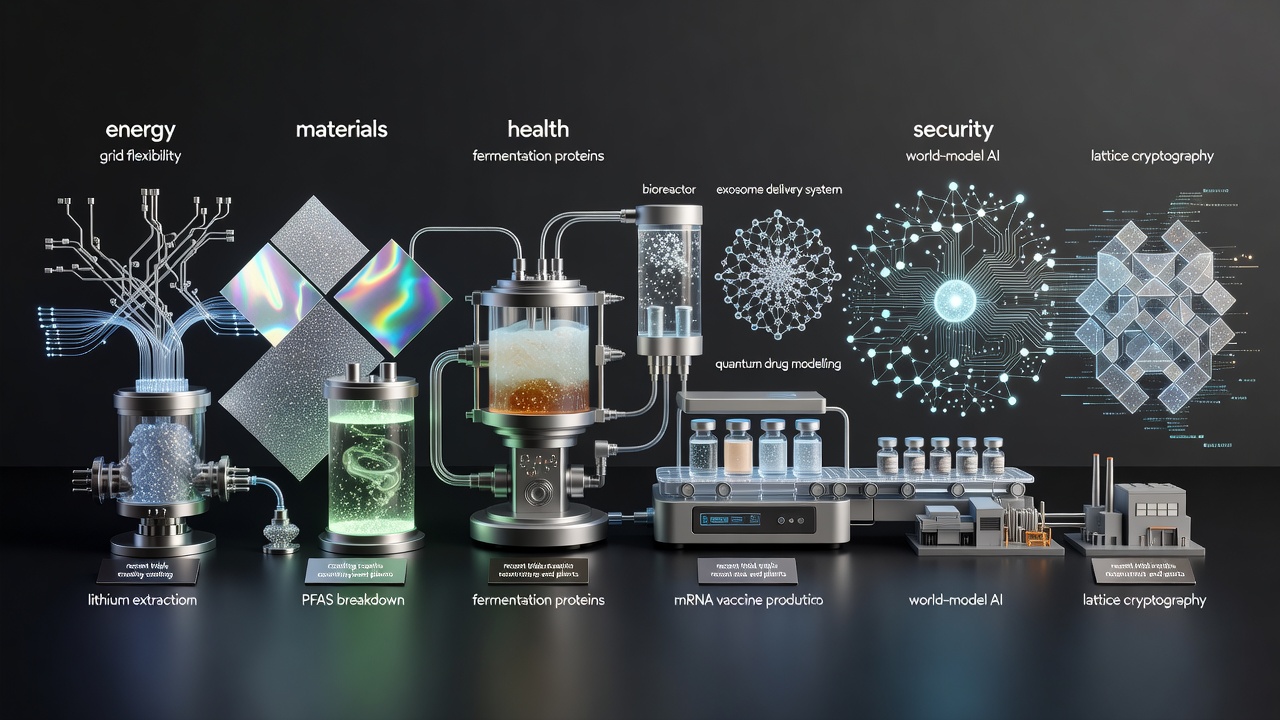
The World Economic Forum released its annual Top 10 Emerging Technologies of 2026 report on June 23 at the Annual Meeting of the New Champions in Dalian, China. The list, produced with Frontiers, spotlights advances expected to deliver major economic and social effects in three to five years. World Economic Forum story. Jeremy Jurgens, Managing Director of the Forum’s Centre for Frontier Technology and Innovation, and Fred Fenter, Chief Executive Editor at Frontiers, noted the selections reflect novelty, development progress, and signals of imminent real-world decisions by governments and industry.
Three patterns stand out across the technologies. Many are personal, built around one patient or specific context. Others are decentralized, generating energy, food, or materials near the point of need. A third group delivers more output with fewer resources, whether through electricity-free cooling or protein production without traditional farming.
Everything-to-grid energy tops the list. Electric vehicles, home batteries, and factory storage sit idle much of the day. New systems pull that power back into the grid during evening peaks when solar fades and demand rises. In California, more than 16,000 solar homes fed 51 megawatts into the network during one 2024 peak, exceeding several fossil peaker plants without emissions, according to the WEF report. Australia added over 180,000 home batteries in the second half of 2025, with state programs paying owners to connect them for collective grid support. World Economic Forum story. New battery chemistries reduce reliance on cobalt and nickel. Better semiconductors and control software turn these assets into coordinated resources rather than passive loads.
Direct lithium extraction follows. Traditional brine evaporation takes up to two years and uses large water volumes, with three-quarters of supply now concentrated in China. DLE methods use sorbents, membranes, and solvents to pull lithium from brine in hours. Spent water returns underground. Plants operate already in Argentina, the US, and Australia. The approach also taps geothermal fluids, oilfield wastewater, and recycled sources, widening supply options. World Economic Forum story. IDTechEx projects DLE will help drive the lithium market toward $52 billion by 2036.
Passive radiative cooling materials come next. These coatings and films reflect 95 percent of sunlight and radiate heat into space, keeping surfaces cooler than ambient air without electricity. Suppliers report up to 20 percent energy savings in retail settings. California and China already mandate cool roofs in building codes. A UK startup developed a cable coating that boosts transmission capacity by 30 percent by keeping lines cooler. World Economic Forum story.
PFAS destruction addresses persistent “forever chemicals.” New processes superheat water, apply electrical currents, or use UV reactions to break carbon-fluorine bonds. A Michigan facility has destroyed PFAS from landfill runoff since 2023. Daikin Industries reported a UV method destroyed 99.99 percent of PFAS in a high-flow wastewater trial. World Economic Forum story. Colorado School of Mines launched a $7 million center in 2026 to evaluate destruction technologies at scale.
Precision fermentation ranks fifth. Microbes receive genetic instructions to produce proteins, enzymes, and other molecules identical to those from crops or animals. The process runs in controlled tanks with lower land, water, and emissions footprints. Companies already supply microbe-derived egg and whey proteins for food manufacturing, with facilities scaling in 2026. The same platform yields cosmetic peptides and pharmaceutical compounds. World Economic Forum story.
Exosome drug delivery uses the body’s natural vesicles to carry therapies. These particles evade immune clearance better than synthetic carriers. A Phase 1 trial stabilized pancreatic cancer patients with no other options by targeting a hard-to-treat mutation. Applications extend to neurological conditions such as Alzheimer’s. World Economic Forum story.
Personalized mRNA cancer vaccines train the immune system against a patient’s unique tumor mutations. Tumor sequencing identifies targets, then a custom vaccine is produced. One melanoma trial showed a 40-50 percent reduction in recurrence or death risk when combined with immunotherapy. World Economic Forum story. Early data point to broader use against lung and pancreatic cancers by the early 2030s.
Quantum simulation for drug discovery models molecular behavior at atomic scale with greater accuracy than classical computers. IBM and Moderna ran one of the largest protein-folding and mRNA interaction simulations in 2025. The method aims to cut the 90 percent clinical-trial failure rate by predicting interactions earlier. World Economic Forum story.
World models represent a new AI category. These systems learn from video, sensors, and text to build internal representations of physical dynamics. NVIDIA’s Cosmos platform trains robots on physical-world data so they adapt to unfamiliar settings. Climate modeling and robotics stand to benefit. World Economic Forum story.
Lattice-based cryptography closes the list. It protects data against future quantum computers by embedding information in complex mathematical structures with added noise. The approach already secures Apple’s iMessage. Google plans integration into Android. World Economic Forum story.
Recent coverage from Fortune India and The Innovator highlights the report’s emphasis on tailored medicine and distributed energy systems. Fortune India. The Innovator. Dubai Future Foundation contributed strategic outlooks for each technology, outlining calls to action for scaling. The full report is available via the WEF site.
Industry observers note the shift from pure AI software toward technologies that touch physical infrastructure, supply chains, and patient care. Battery and grid operators watch everything-to-grid developments closely. Chemical and water treatment firms track PFAS methods. Pharma companies follow exosome and mRNA vaccine progress. Regulators face questions on interoperability standards, data privacy for personalized therapies, and post-quantum security mandates.
These technologies sit at different stages. Some have commercial plants or trials underway. Others require further standards work or policy support. The WEF selections signal where coordinated decisions by companies, governments, and research bodies can accelerate deployment or address bottlenecks. WEF Top 10 Emerging Technologies Report 2026 (PDF).


 WebProNews is an iEntry Publication