
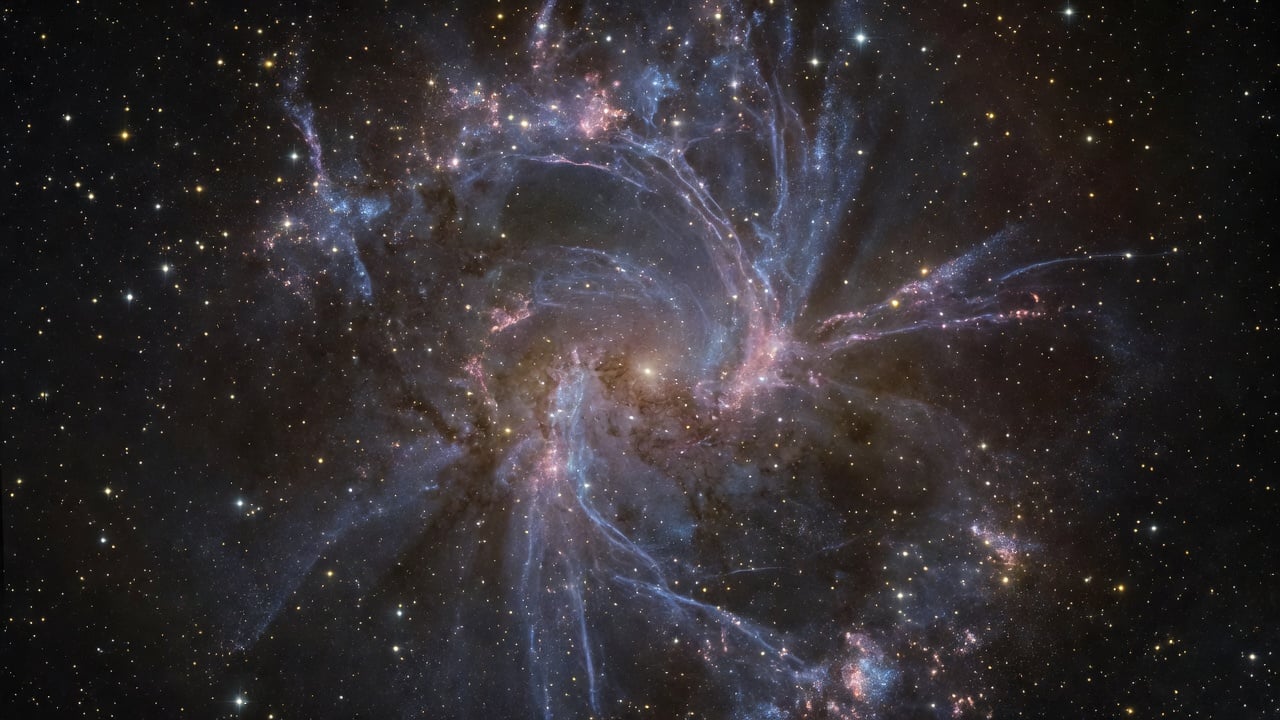
Four years after the James Webb Space Telescope began full science operations, NASA has released images that strip away centuries of mystery from one of the sky’s most studied objects. The views of Centaurus A show a galaxy scarred by cosmic violence. Dust lanes twist in unexpected patterns. Stars appear by the millions where earlier telescopes saw only haze.
Located 11 million light-years from Earth, Centaurus A stands out among nearby galaxies for its restless energy. A supermassive black hole sits at its core, consuming material and blasting out jets of radiation and particles. That activity alone marks the system as unusual. Add in the aftermath of a major galactic collision some 2 billion years ago and the picture grows more complex. The NASA announcement calls these new observations a marker of four years of performance that has exceeded expectations.
Previous instruments struggled here. Hubble’s visible-light cameras could not pierce the thick dust shrouding the center. Spitzer captured broader infrared structures but lacked the resolution to pick out individual stars. Webb changes that equation. Its Mid-Infrared Instrument, known as MIRI, reveals glowing filaments, loops and clouds of warm dust in striking detail. Reddish-purple points scattered across the frame represent stellar nurseries and aging stars shedding material. The image processing team included Alyssa Pagan and Joseph DePasquale from the Space Telescope Science Institute along with Macarena Garcia Marin from the ESA Office at STScI.
But a single view tells only part of the story. Combine MIRI data with images from the Near-Infrared Camera, or NIRCam, and the galaxy transforms again. What appears grainy resolves into a dense field of millions of individual stars. Astronomers can now examine them one by one. “With Webb’s view of Centaurus A, it becomes a case of galactic archaeology,” the European Space Agency noted in related coverage. “Each star revealed helps to reconstruct when different events happened.” Older populations, slowdowns in activity, bursts triggered by the ancient merger. All of it starts to form a timeline.
The black hole drives much of the drama. As it feeds, it not only launches powerful jets but also stirs the surrounding gas and dust. Early spectroscopic analysis from Webb shows fast-moving ionized gas flowing outward, pushed by the central engine. Warmer molecular hydrogen traces a warped, rotating disk closer in. These measurements address a fundamental question in astrophysics. How exactly does a supermassive black hole shape the galaxy that hosts it? The answer seems to involve both stimulation and suppression of star formation. The black hole can compress gas clouds enough to trigger new stars. It can also clear material away and slow the process.
Such interplay has long been theorized. Centaurus A now offers a nearby laboratory to test those ideas with unprecedented clarity. “No single telescope tells the whole story,” said Shawn Domagal-Goldman, division director for astrophysics at NASA Headquarters. “Discoveries build over time and new observatories expand on the foundations laid by earlier missions. Webb represents the most powerful step forward yet.” His words, carried in the official NASA release, underscore how each generation of instruments adds layers to our understanding.
An odd S-shaped feature stands out in the MIRI data. Wisps of material stretch outward like cosmic clouds. A warped parallelogram-like band cuts across the center. Astronomers puzzle over their origins. Did the ancient collision imprint these shapes? Does the black hole continue to sculpt them today? Further study will be needed. Yet the questions themselves show how much remains to be learned even in a galaxy long considered familiar.
Recent coverage highlights the achievement. Engadget reported on the release, noting that the images mark a shift from broad structures to star-by-star analysis. HotHardware emphasized that the telescope sees a rare galaxy long hidden from Hubble by space dust. And Phys.org focused on the dust-shrouded heart revealed after that galaxy clash 2 billion years ago. Each outlet draws from the same NASA data but highlights different aspects. The common thread stays clear. Webb has opened a new chapter in the study of active galaxies.
Look closer at the combined image and the scale becomes apparent. The central region teems with activity that visible light could never expose. Dust-rich regions glow where stars form and die. Jets from the black hole have shaped the distribution of material over eons. The collision itself left a warped disk of gas and dust still visible in the infrared. All these elements connect in a single system. They record a history that astronomers can now read with greater precision than ever before.
Macarena Garcia Marin, who contributed to the image processing, led the proposal behind some of the observations. Earlier peer-reviewed work, including a 2025 paper in Astronomy & Astrophysics on fast ionized gas outflows in Centaurus A’s central region, laid groundwork for these latest results. That research used JWST MIRI data to map relationships between star formation and the active galactic nucleus. The anniversary images build directly on such efforts.
Four years in, the telescope continues to deliver surprises. Its sensitivity across infrared wavelengths has allowed views that simply were not possible before. Centaurus A serves as a vivid example. Once an object partially veiled in mystery, it now stands exposed. Its stars, its dust, its dynamic core. Each element contributes to a richer portrait of how galaxies evolve.
And the work has only begun. Teams will pore over the spectroscopic data for months and years to come. They will model the motions of gas near the black hole. They will trace the chemical signatures in the dust. They will compare stellar populations across different regions to refine the timeline of the merger and its consequences. Other targets will receive similar attention. But this particular galaxy, so close yet so distinctive, offers an ideal testbed.
The images themselves reward careful study. In the MIRI frame, intricate filaments trace loops and clouds across the center. The combined NIRCam and MIRI view reveals the sheer density of stars that fill the frame. What looks like texture is in fact countless suns, each carrying clues about the galaxy’s past. That level of detail turns astronomy into something closer to excavation. Layer by layer, the record emerges.
So the fourth anniversary arrives not with fanfare alone but with concrete advances. Better performance than anticipated. Science operations running smoothly. And data that immediately expands what researchers know about a key object in the southern sky. Centaurus A will never look the same again. Thanks to Webb, its hidden heart now lies open for inspection.


 WebProNews is an iEntry Publication