
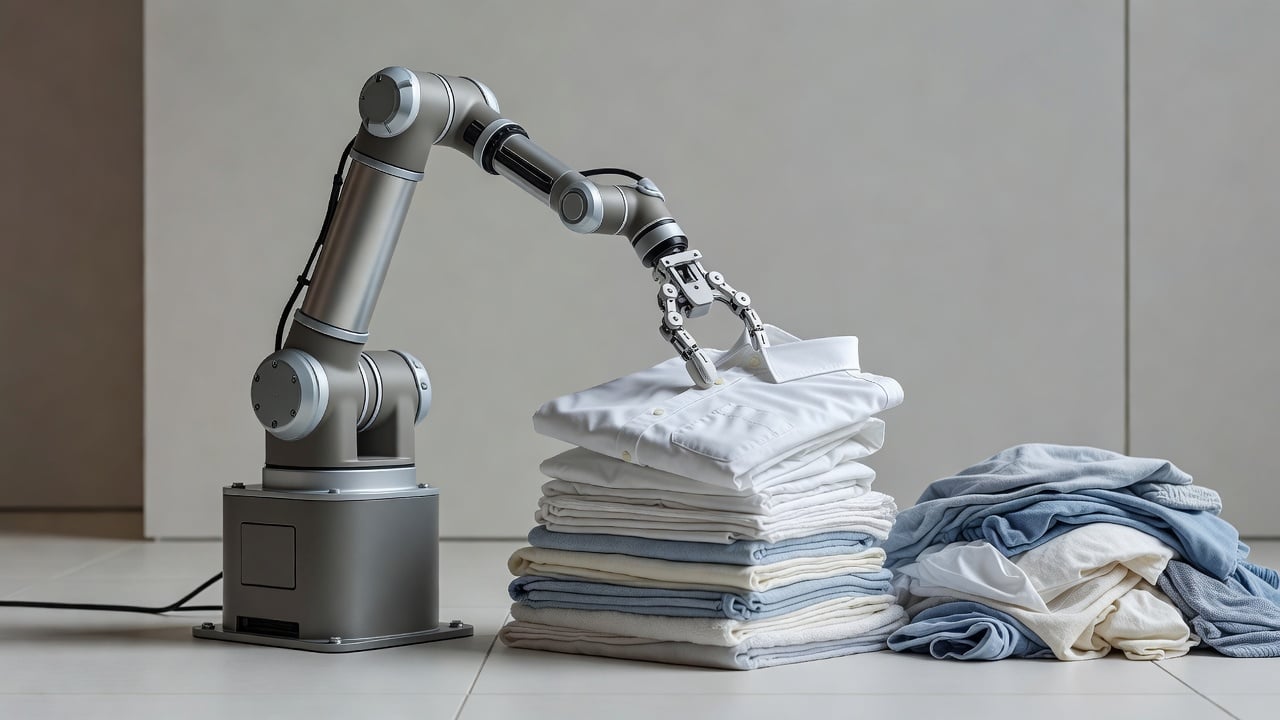
Weaving Robotics has introduced a machine called the Isaac-1 that challenges common assumptions about what household robots should look like. Instead of the bipedal, two-armed humanoids that dominate concept videos and research labs, this device sits on a fixed base with a single articulated arm ending in a specialized gripper. Its design prioritizes function over form, focusing on practical tasks such as folding laundry, sorting clothes, and handling repetitive domestic work that currently consumes hours of human time each week.
The machine appears in demonstration videos as a compact industrial-looking unit mounted on a workbench. A video feed from the TechRadar article shows the Isaac-1 picking up crumpled garments from a pile, shaking them out with precise wrist movements, and then folding them into neat rectangles. The process looks methodical rather than graceful, yet the results match what a careful person might achieve after some practice. This approach stands in contrast to many humanoid projects that attempt to copy human anatomy in hopes of adapting to every possible environment.
Engineers at Weaving Robotics made deliberate choices about the robot’s physical structure. By mounting the arm on a stationary platform, the team eliminated the complex balance systems required for walking robots. Legs add significant cost, power demands, and safety risks in home settings where children or pets might cross paths with a moving machine. The fixed base allows the arm to operate within a defined workspace equipped with cameras and sensors that map the area in three dimensions. This setup resembles automated systems already common in warehouses and manufacturing floors, where predictability matters more than versatility.
The gripper on the Isaac-1 deserves particular attention because it departs from the five-fingered hands many robot developers pursue. Instead of attempting to replicate the full range of human finger movements, the company created a specialized end effector that combines suction, pinching, and fabric-specific manipulation techniques. In testing, this gripper handles various materials from thin t-shirts to thicker towels without tearing or dropping items. The design reflects a growing recognition in robotics that task-specific tools often outperform general-purpose ones for repetitive work.
Training the Isaac-1 required substantial data collection. The company recorded thousands of hours of laundry-folding sessions performed by both humans and earlier robot prototypes. These recordings fed into machine learning models that help the arm predict how different fabrics will behave when lifted, shaken, or placed on a surface. Unlike rule-based programming that struggles with variations in clothing types, the current system adapts to wrinkles, static cling, and slight differences in material stretch. This learning process continues after deployment as the robot encounters new items in actual homes.
Power consumption remains a practical consideration for any device intended for residential use. The Isaac-1 draws electricity comparable to a standard kitchen appliance rather than the high demands of battery-powered walking robots. Its stationary design allows a direct connection to household current, removing the need for frequent recharging stops that would interrupt workflow. Users can schedule operations during off-peak electricity hours or when the home is unoccupied, addressing both cost and noise concerns.
Safety features built into the system reflect lessons learned from industrial automation. The arm moves at controlled speeds within its designated area and stops immediately if unexpected objects enter its path. Multiple layers of sensors detect pressure, proximity, and sudden movements. The company emphasizes that the Isaac-1 is not meant to interact directly with people during operation, recommending that users load clothes into its workspace and retrieve finished items after cycles complete. This separation between human activity and robot motion reduces liability risks that have slowed adoption of more mobile domestic machines.
Cost estimates for the production version remain preliminary, but the simplified mechanical structure suggests a price point significantly below many advanced humanoid prototypes. By avoiding the expense of sophisticated leg mechanisms, dynamic balance algorithms, and full-body coordination software, Weaving Robotics aims to deliver a machine that pays for itself through labor savings within a reasonable period. Early projections indicate that households spending ten or more hours weekly on laundry-related tasks might see return on investment within two years at anticipated pricing levels.
Integration with smart home systems forms another aspect of the design strategy. The Isaac-1 connects to home networks and can receive instructions through mobile applications or voice commands. Users might tell their assistant to start a folding cycle after the washing machine completes its run, creating an automated sequence from dirty clothes to organized drawers. The robot also generates reports about fabric types processed and any items that required manual intervention, helping owners track clothing inventory and maintenance needs.
Critics have pointed out limitations in the current prototype. The machine handles only certain categories of laundry and struggles with very delicate items like silk or garments with complex embellishments. Button-down shirts present particular difficulties because of their structured collars and cuffs. The company acknowledges these constraints and positions the Isaac-1 as a tool for basic items rather than a complete replacement for human effort. Future versions may incorporate additional tools or interchangeable end effectors to expand capabilities.
The broader implications of this approach extend beyond laundry rooms. Many tasks in homes and small businesses involve repetitive manipulation of soft, irregular objects. Hospital linens, restaurant napkins, and retail clothing displays all require similar handling. A machine that succeeds at domestic folding could find applications in commercial settings where consistency and hygiene standards matter. Weaving Robotics has already begun discussions with hospitality chains interested in automating towel and sheet processing.
Development of the Isaac-1 benefited from advances in several supporting technologies. Improved depth cameras provide accurate three-dimensional models of crumpled fabrics. Graphics processing units originally designed for video games now run the complex simulations needed to predict cloth behavior. Open-source libraries for robotic manipulation have reduced the time required to implement basic functions, allowing the team to focus on laundry-specific challenges. These converging capabilities have made specialized robots more practical than they appeared even five years ago.
Comparison with other domestic robot projects highlights different philosophical approaches. Some companies pursue general-purpose humanoids capable of cooking, cleaning, and companionship. These machines require enormous computational resources and face substantial technical hurdles before reaching reliable performance. Weaving Robotics chose instead to solve one common chore exceptionally well. This narrower focus allows faster iteration and more immediate practical value. The strategy mirrors the success of specialized kitchen appliances that perform single functions better than multifunction devices.
Public reaction to demonstration videos has been mixed. Some viewers express disappointment that the robot lacks the futuristic appeal of walking, talking androids. Others appreciate the pragmatic design that seems ready for actual deployment rather than remaining in research laboratories. Comments frequently mention the satisfying visual rhythm of the folding sequence and the potential relief from a tedious weekly chore. The absence of legs and fingers becomes less relevant when the machine consistently produces neatly folded stacks.
Manufacturing plans call for initial production in limited quantities to gather real-world performance data. Early units will go to selected households equipped with monitoring systems that track success rates across different climates, water hardness levels, and family compositions. This information will guide refinements before wider release. The company expects to encounter unexpected failure modes when the robot meets the full variety of real clothing accumulated in typical homes.
Energy efficiency calculations suggest the Isaac-1 could reduce overall household environmental impact despite using electricity. By encouraging people to wash clothes less frequently through better organization and by optimizing folding patterns that minimize wrinkles, the system might decrease ironing and rewashing. These secondary effects require further study but indicate that targeted automation can create benefits beyond simple time savings.
The Isaac-1 represents a shift toward practical robotics that accepts current technological limitations rather than waiting for breakthroughs in artificial general intelligence or advanced materials. Its success or failure will help determine whether specialized machines will fill niches in homes before truly versatile humanoids become affordable and safe. For millions of people who spend substantial time each week sorting, folding, and putting away clothes, even partial automation offers meaningful improvement in daily routines.
Engineers continue tweaking the control algorithms to handle edge cases such as socks that stick together or shirts turned inside out. Each software update brings measurable improvements in completion rates. The iterative process resembles the development of early washing machines that gradually incorporated sensors and automatic cycles after initial mechanical versions. Just as those appliances transformed laundry from an all-day manual process to a background task, the Isaac-1 and similar systems may gradually remove another layer of domestic drudgery.
Future enhancements might include integration with washing and drying equipment to create a continuous flow from dirty to folded. Vision systems could identify stains or damage during sorting and route items appropriately. Voice feedback could alert users when certain garments need special attention. These additions would build upon the core manipulation skills already demonstrated rather than requiring entirely new platforms.
The fixed-base design also simplifies maintenance and repair. Components remain accessible without complex disassembly of leg joints or balance mechanisms. Software updates can be delivered remotely, and mechanical parts follow industrial standards that local technicians might service. This practicality addresses a common criticism of advanced robots that become unusable when specialized support is unavailable.
As Weaving Robotics refines the Isaac-1, the machine serves as a reminder that effective automation often comes from careful observation of specific tasks rather than imitation of human form. The clothes get folded, the time gets saved, and the robot does not need to walk across the room to accomplish its purpose. In focusing on outcomes over appearance, the company may have found a faster route to bringing reliable robotic assistance into ordinary homes. The coming years will reveal whether this pragmatic path leads to wider acceptance of domestic automation or remains a specialized solution for those willing to adapt their routines around a stationary arm.


 WebProNews is an iEntry Publication