
Water scarcity grips vast stretches of the planet. Billions face daily shortages. Yet the air around us holds untapped moisture. Researchers have long chased ways to capture it efficiently. Now a new generation of textiles promises to turn clothing into personal water sources.
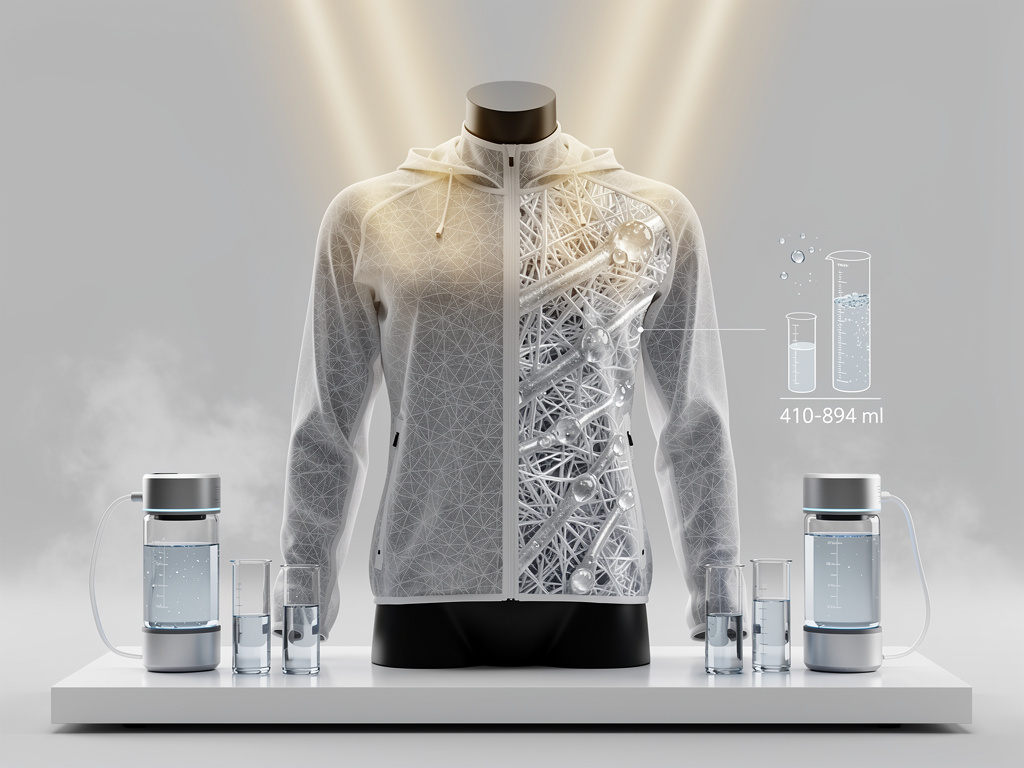
The latest advance comes from engineers at The University of Texas at Austin. They created hierarchical textile fibers integrated into a jacket. This garment harvests drinking water directly from the atmosphere. Even in arid conditions. The prototype collects hundreds of milliliters per day. It points toward clothing that keeps wearers hydrated without external supplies. UT Austin News detailed the breakthrough on June 11, 2026.
From Concept to Wearable Prototype
Traditional atmospheric water harvesting systems rely on bulky sorbents. They suffer from slow kinetics and poor scalability. The UT team tackled those barriers head on. Their design uses specially engineered fibers with hierarchical structures. These combine high surface area for moisture capture with channels that speed water release. The result overcomes previous kinetic bottlenecks that limited real-world use.
In testing the textile achieved 3.76 to 7.45 liters of water per kilogram of sorbent per day. Across relative humidity from 20% to 80% the wearable prototype collected 410 to 894 milliliters. That’s enough to meet basic hydration needs for an individual in many environments. The system pairs the fabric with a portable collector. Sunlight or ambient heat drives the release process. No heavy batteries required.
“We wanted to rethink the form of the technology,” said Guihua Yu, a materials science professor at UT Austin and one of the study’s authors. “If the fabric itself can collect water from air, it opens a new direction for personal and portable water access.” The Engadget article from June 11, 2026, highlighted how the jacket funnels collected moisture to detachable harvesting units rather than storing it in the cloth.
But the UT work doesn’t stand alone. Just days earlier a related paper appeared in Nature Water. It described a field-portable solar-powered system using cellulosic gel fabrics. Assembled into compact cartridges this setup delivers liter-scale output across climates. From humid Austin to the drier Chihuahuan Desert it performed reliably. Even under cloudy conditions with reduced sunlight. The dual-module version produced 1.3 liters per day in Austin tests. Those findings expand the possibilities for both wearable and stationary applications.
Earlier this year Stanford researchers reported hydrogels that last eight months or longer. Previous versions degraded after roughly 30 cycles. The new gels absorb two to four times their weight in water. A black-painted aluminum sheet provides the solar heat to release vapor for condensation. In the Atacama Desert one small panel yielded up to two liters daily. Stanford Doerr School of Sustainability covered the May 2026 results.
MIT engineers unveiled a window-sized passive harvester in June 2025. Its hydrogel material works in Death Valley conditions. A glass chamber and cooling layer help capture and condense vapor efficiently. Such devices show the technology scales beyond clothing. Yet the wearable format addresses a distinct need. Soldiers. Hikers. Residents in remote villages. Anyone who can’t carry extra weight or rely on fixed infrastructure.
The underlying materials draw from multiple fields. Metal-organic frameworks. Hygroscopic salts. Cellulose-based gels. Each offers trade-offs in capacity, regeneration temperature and stability. The UT hierarchical fibers balance those properties for textile integration. They maintain mechanical strength over repeated cycles. They resist the corrosion issues that plague some salt-based sorbents. And they release pure water suitable for drinking.
Challenges remain. Production costs must fall for widespread adoption. Durability under real-world wear and tear needs further validation. Humidity levels still dictate performance. In extremely dry air below 20% relative humidity yields drop. Yet even partial relief matters in water-stressed regions. One liter a day can sustain life when none exists otherwise.
Commercial interest grows. Startups like Atoco develop reticular materials for off-grid harvesting. They target low-humidity performance without heavy energy input. A German firm uses hygroscopic gels powered solely by sunlight. SINTEF researchers in Norway created a diaper-like polymer that absorbs large volumes while staying stable. These parallel efforts suggest the field accelerates.
So what happens when jackets, tents or even military uniforms generate their own water? Logistics simplify. Conflict zones gain resilience. Disaster response improves. Farmers in arid zones monitor crops with less transport burden. The environmental payoff could prove substantial. Less plastic bottle waste. Reduced trucking of water to remote sites.
But don’t expect instant market disruption. Scaling textile production while preserving the delicate sorbent structures demands new manufacturing techniques. Washing the garments without degrading performance poses another hurdle. Integration with existing apparel supply chains will take time. Still the momentum feels unmistakable.
Recent coverage underscores the pace. A June 9, 2026, Nature Water paper on the gel fabric system complements the UT jacket work. It demonstrates how material design at multiple scales unlocks portability without sacrificing output. Together these advances shift atmospheric water harvesting from laboratory curiosity toward practical tool. For billions facing water stress the air itself may soon provide relief. One fiber at a time.


 WebProNews is an iEntry Publication