
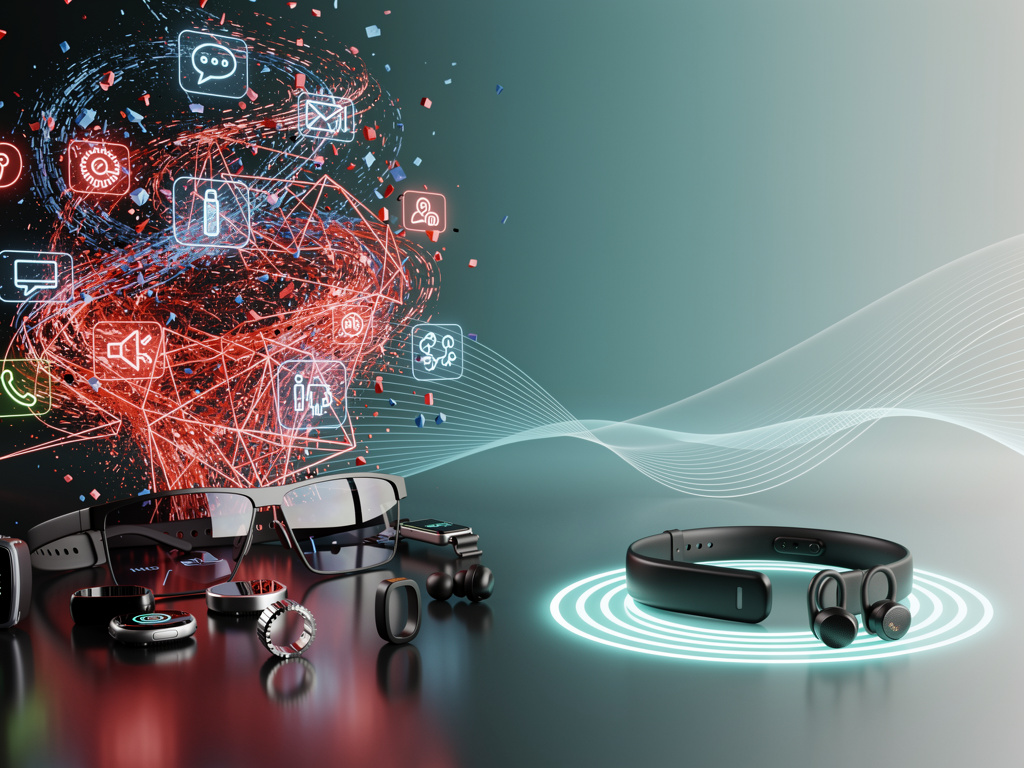
Wearable artificial intelligence devices promise to deliver information directly to users throughout their daily routines, yet many designs currently add to mental strain rather than relieve it. The central challenge lies in creating systems that anticipate needs without demanding constant attention or forcing people to process excessive data streams. As hardware shrinks and algorithms grow more sophisticated, the focus must shift toward reducing cognitive load, the mental effort required to interact with technology while managing real-world responsibilities.
Cognitive overload occurs when the brain receives more inputs than it can effectively sort or act upon. Traditional computing already contributes to this problem through endless notifications, multiple open applications, and the need to switch contexts repeatedly. Wearables intensify the issue because they sit on the body and compete for immediate sensory channels. A smartwatch that vibrates every few minutes with messages, health metrics, navigation cues, and calendar reminders can quickly transform from helpful companion to persistent distraction. Users report feeling tethered to their devices rather than empowered by them, a sentiment echoed across studies examining attention economy and digital wellbeing.
The core principle for effective wearable AI centers on becoming an extension of natural human perception instead of an additional interface to monitor. This requires systems that filter information aggressively and present only what matters at the precise moment it becomes actionable. For example, rather than displaying every incoming text, a well-designed wearable might detect that a user is driving and convert urgent communications into subtle audio tones that convey priority without demanding visual attention. The device learns when silence serves the user better than another data point.
Current market offerings reveal mixed success in this area. Many fitness trackers bombard wearers with graphs, streaks, and achievement badges that require interpretation and emotional investment. While the intention is to motivate healthier habits, the constant scoring system can create anxiety and decision fatigue. Similarly, augmented reality glasses that overlay digital elements onto the physical world risk cluttering vision if not calibrated to user context and preferences. The goal remains to make the technology disappear into the background until truly needed.
Developers are exploring several technical approaches to achieve genuine cognitive relief. Context awareness stands as a foundational element. By combining data from multiple sensors including accelerometers, GPS, microphones, heart rate monitors, and even environmental factors like light levels or temperature, AI models can build a comprehensive picture of what a person is doing and what they likely need. A runner absorbed in their workout might receive no notifications at all, while the same person sitting at a desk might get a gentle reminder about an upcoming meeting only when they finish typing a document.
Personalization through continuous learning further reduces mental effort. Over time, wearable systems can identify individual patterns and preferences. One user might want detailed nutrition breakdowns after meals while another prefers simple traffic updates during their commute. The most effective designs adapt without requiring users to configure settings or create rules manually. This implicit customization prevents the paradox where managing the device consumes more attention than the tasks it aims to simplify.
Voice interaction has emerged as a promising direction, yet even this modality needs refinement to avoid adding cognitive burden. Constantly speaking commands or listening to spoken responses can disrupt social situations or flow states. Future systems may favor haptic feedback through precise vibration patterns that convey information through the skin. Research suggests humans can distinguish dozens of distinct tactile signals with minimal training, offering a private channel that does not interrupt conversations or require looking at screens. A series of increasing pulses might signal rising urgency while different rhythms could represent specific contacts or categories.
Privacy considerations intersect directly with cognitive load management. Users who worry about data collection or unauthorized access expend mental energy on vigilance and decision-making around device usage. Transparent data handling and on-device processing help alleviate these concerns. When AI models run locally rather than sending everything to cloud servers, response times improve and users feel greater control. This sense of security allows people to trust the system more fully and interact with it more naturally.
The medical field demonstrates particularly compelling applications where reduced cognitive load can improve outcomes. Surgeons wearing specialized glasses could receive vital patient data or procedural guidance without shifting focus from the operating table. Nurses might track multiple patients through subtle cues rather than constantly checking monitors or charts. For elderly individuals, wearables that monitor health markers and medication schedules could provide reminders through familiar voices or gentle touches instead of jarring alarms that cause confusion or stress.
Education represents another domain where thoughtful wearable AI could ease mental demands. Students attending lectures might receive definitions or references for unfamiliar terms through private channels without breaking concentration. The technology could highlight connections between concepts being discussed and material studied previously, strengthening learning without forcing active recall or note-taking in the moment. Teachers could similarly monitor class engagement levels through aggregated biometric data and adjust their delivery without needing to interpret individual student expressions constantly.
Despite these possibilities, significant obstacles remain before widespread adoption of truly helpful wearable AI. Battery life continues to limit sophisticated sensing and processing capabilities. Users grow frustrated when devices require frequent charging or suddenly stop functioning during important activities. Hardware designers must balance power consumption with performance while keeping devices lightweight enough to wear comfortably for extended periods.
User interface design for minimal cognitive impact demands new approaches beyond traditional screens or menus. The most successful implementations may avoid visual displays entirely in many scenarios, relying instead on spatial audio, haptic feedback, or even olfactory signals in advanced prototypes. These alternative interfaces require extensive testing to ensure they enhance rather than confuse human perception. What feels intuitive to engineers often overwhelms ordinary users facing information in unexpected formats.
Industry leaders are beginning to recognize that competitive advantage will come from devices that respect human attention rather than compete for it. Companies investing in research around attention-aware computing and calm technology principles position themselves for long-term success. This involves studying how people naturally manage information and designing systems that align with those behaviors instead of forcing new habits.
The economic implications of cognitive overload from wearable technology are substantial. Lost productivity, increased stress-related health costs, and reduced quality of life all carry measurable impacts. Organizations implementing employee wellness programs increasingly include guidance around technology boundaries and notification management. Wearable AI that actively helps enforce these boundaries by filtering work communications during personal time could prove valuable in corporate settings.
Looking ahead, integration between different wearable devices and environmental sensors will further reduce the need for explicit user input. Smart homes and offices equipped with ambient intelligence could communicate with personal wearables to create cohesive experiences. Lights might dim automatically when a user begins reading, or temperature could adjust based on detected stress levels without anyone touching a control. In these scenarios, the wearable becomes one node in a larger supportive network rather than a standalone gadget demanding attention.
Ethical frameworks must guide development to prevent manipulation through personalized information delivery. The same mechanisms that reduce cognitive load by predicting needs could potentially influence behavior in ways that benefit manufacturers over users. Transparent algorithms and user controls over learning processes will help maintain appropriate boundaries. Regulatory attention will likely increase as these technologies mature and demonstrate capacity to shape decisions at scale.
Designers should prioritize human diversity when creating wearable AI systems. Cognitive processing varies significantly across age groups, neurodiverse populations, cultural backgrounds, and individual personalities. What reduces mental effort for one person might increase it for another. Inclusive development processes that include varied test participants from early stages help avoid solutions that work only for specific demographics.
The path forward requires balancing technological capability with psychological understanding. Engineers must work alongside cognitive scientists, psychologists, and user experience researchers to create systems grounded in how human minds actually function. This interdisciplinary collaboration represents a shift from pure feature development toward experience architecture focused on mental wellbeing.
As materials science advances, future wearables may take forms beyond watches, glasses, or earbuds. Flexible electronics could integrate into clothing or even temporary skin patches that disappear from conscious awareness. These form factors offer new opportunities for subtle information delivery through textile-based haptic systems or conductive materials that respond to body chemistry.
Success will ultimately be measured not by how much information these devices can deliver but by how little they need to interrupt daily life while still providing meaningful support. The most sophisticated wearable AI might be the one that users notice least throughout their day because it has learned exactly when and how to make itself useful without becoming another source of mental taxation.
Progress depends on resisting the temptation to add features simply because the hardware can support them. Each additional capability should undergo rigorous evaluation regarding its impact on cognitive resources. The question shifts from “what can this device do” to “what should this device do to make someone’s mental experience better.” This fundamental reorientation will determine whether wearable artificial intelligence fulfills its potential as a genuine aid or joins the growing list of technologies that promise convenience while delivering distraction.
Developers who master this balance will create products that people genuinely depend upon not because they are addictive but because they free mental space for what matters most in work, relationships, and personal growth. The technical challenges are significant, yet the opportunity to improve human experience through thoughtful constraint and intelligent omission makes the pursuit worthwhile.


 WebProNews is an iEntry Publication