
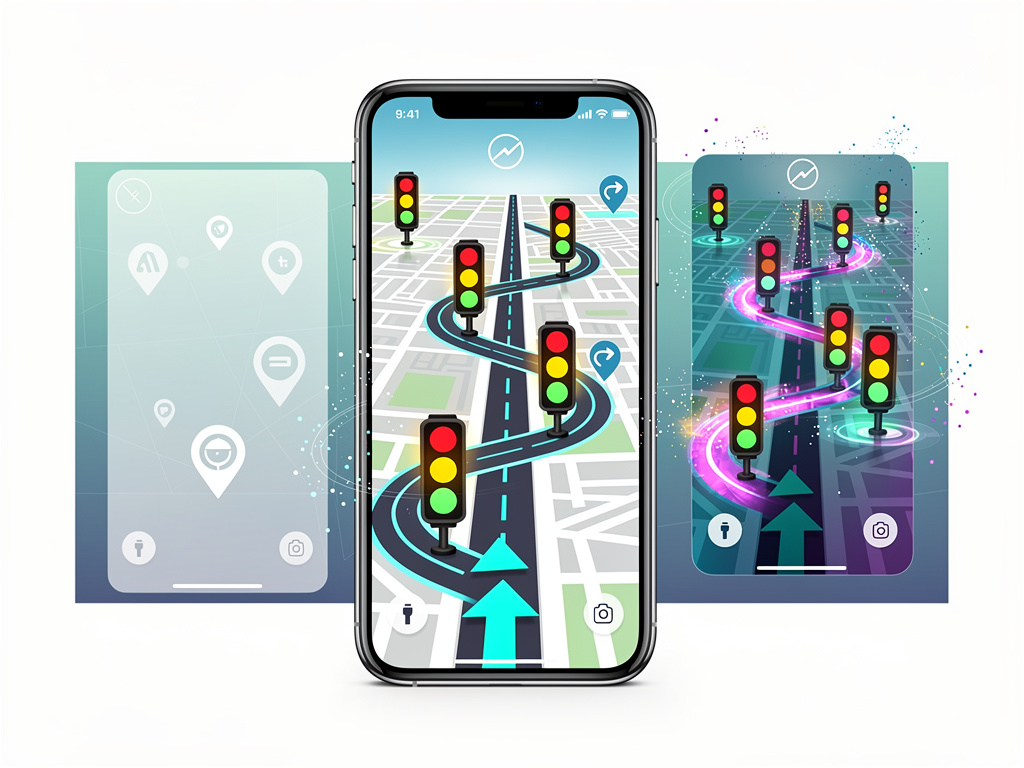
Drivers have waited years for this. Waze now displays traffic light icons along your route. The change brings the crowdsourced navigation app closer to what Google Maps has offered for some time. But it arrives with a twist suited to Waze’s real-time, driver-focused style.
The update rolled out gradually across North America in recent weeks. Users in select areas began seeing small traffic light symbols appear at intersections while navigating. 9to5Google reported the wider deployment just hours ago. Not every driver sees them yet. The feature continues to expand user by user.
And the difference feels immediate. Instead of vague distance calls such as “turn left in 500 feet,” instructions now reference the signal directly. “At the traffic light, turn right.” That clarity matters in dense city grids where one wrong light can send you blocks off course. It reduces hesitation. It builds confidence at complex junctions.
Waze started testing the icons late last year. Early sightings came from Israel. Android Authority covered the initial reports in December 2025. The company limited visibility to the active route only. No icons flood the full map view. That choice prevents clutter. It keeps the display clean for the millions who open the app daily.
Map editors play a central role here. Traffic lights don’t appear automatically everywhere. Editors must add them in the Waze Map Editor, or WME. The process involves placing a permanent hazard icon on approach segments at stop lines. Configuration options allow fine-tuning for unusual intersections.
USA Wazeopedia editors published detailed mapping rules in February. “This feature will enhance driver guidance and driver confidence, especially at complex intersections and in dense urban environments,” the guide states. It allows clearer turn instructions. It helps Wazers orient themselves precisely. The full post lives at Waze Discuss.
Editors with rank three or higher can add lights in the United States. Higher ranks apply for major roads. The system defaults to optimal settings for most cases. Yet editors can adjust visibility or voice prompts for special situations. A light that only controls turning traffic might hide for straight-through drivers. Complex setups require junction boxes or paths to define exact behavior.
Voice guidance improves too. Waze can say “at the lights” or “after the lights” depending on geometry. The latter triggers for turns within about 100 meters past the signal. Such precision helps in places where the turn comes just beyond the intersection. Incorrect mapping risks wrong phrasing. Editors report missing lights as map problems to speed coverage.
The feature builds on years of user requests. Waze’s UserVoice forum carried a popular suggestion since 2024. The company confirmed plans in May 2025. “We’re pleased to confirm that this suggestion is planned,” a Waze team member wrote. That thread sits at Waze UserVoice.
Stop signs may follow. An Autoevolution article from December 2025 quoted Waze feedback indicating both traffic lights and stop signs remain under consideration. The app already shows speed limit changes and other signs. Adding these landmarks fits a broader effort to give drivers better context without distraction.
But why now? Waze competes in a crowded field. Google Maps displays traffic lights. Apple Maps does too. Yet Waze built its reputation on live community reports rather than polished cartography. This update blends the two worlds. It uses editor-added data to support the dynamic routing that made the app famous. Real-time traffic still drives route choices. The lights simply make those routes easier to follow.
Early user reactions vary. Some Reddit threads celebrate the change. Others note incomplete coverage. “As it’s a new feature, there might be missing lights and bugs,” one post reads. Drivers can report gaps. The community fills them. That crowdsourced model has always defined Waze. It continues here.
Rollout remains phased. North American users see progress first. International markets wait. No firm global date exists. Coverage grows as editors map more areas and the app pushes updates to more phones. Beta testers gained early access. Production rollout started in spring and accelerated this month.
The icons stay subtle. They appear only during active navigation or cruise mode. Drivers see at most three lights ahead when not following turn-by-turn directions. The limit avoids visual noise. It focuses attention on immediate decisions.
Longer term, the data could feed other systems. Waze already shares traffic insights with Google. Mapped signals add another layer of urban understanding. City planners might one day tap aggregated patterns. For now, the benefit stays personal. A driver knows exactly which light marks their turn. No more guessing.
Critics once called Waze chaotic. Its interface felt busy. Alerts piled up. This addition counters some of that noise with structure. It gives landmarks without requiring users to zoom or switch views. The app feels smarter. More adult.
Of course challenges remain. Mapping millions of intersections takes time. Editorial standards matter. Poorly placed lights could confuse more than they help. Waze sets defaults to limit errors. Training materials and community forums guide editors. The February mapping guide runs dozens of scenarios from standard four-way signals to firehouse preemption lights.
One detail stands out. Traffic lights enhance safety as much as convenience. Clearer instructions reduce last-second lane changes. They cut down on missed turns that force risky maneuvers. In cities where signals cluster every block, the difference compounds.
Waze continues to evolve. Recent years brought speed bump alerts, curve warnings, and better lane guidance. Traffic lights fit this pattern. They address a basic frustration. Drivers know the roads. They know the rhythm of lights. Now the app knows them too.
Expect further refinement. Stop signs could arrive next. Voice prompts may grow more sophisticated. Integration with CarPlay and Android Auto will determine real-world impact. For millions stuck in daily commutes, even small improvements register.
The rollout isn’t flashy. No grand announcement accompanied the first waves. Yet for industry watchers tracking navigation trends, the signal is clear. Waze moves beyond pure crowdsourcing. It adds fixed reference points to its living map. The result feels more complete. More useful. And for drivers staring at the same red light every morning, a little less frustrating.


 WebProNews is an iEntry Publication