
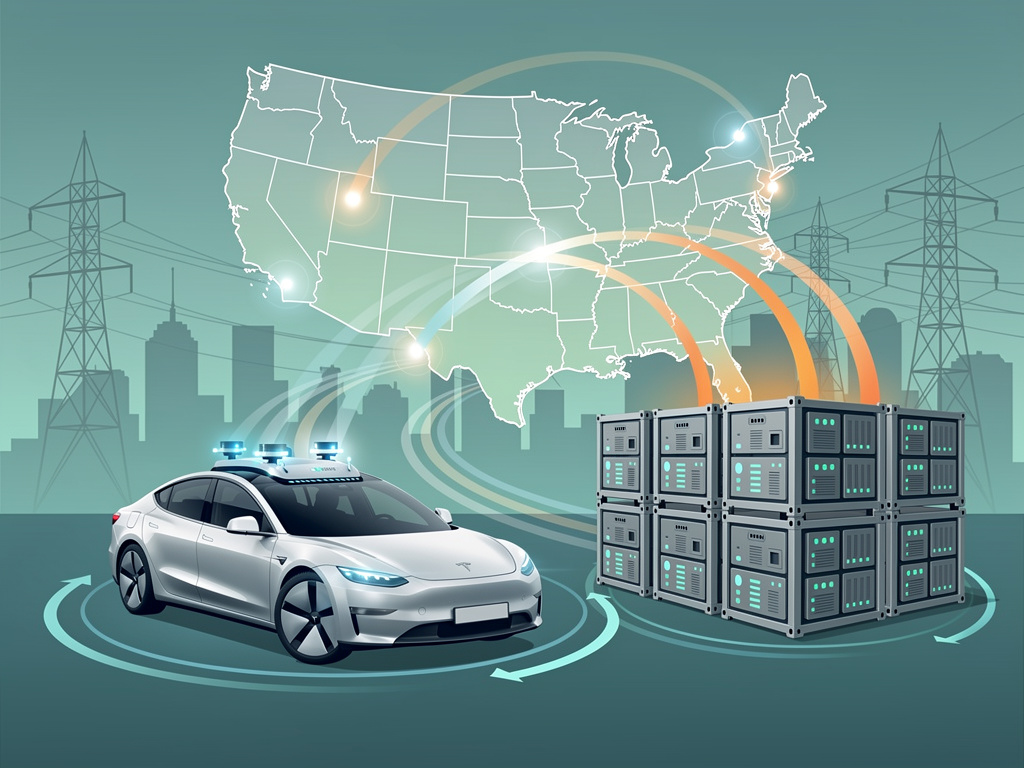
Thousands of electric vehicles in Waymo’s growing autonomous fleet may soon trade their daily routes for a stationary role. Their batteries, after years of intensive use, will help store excess renewable power and release it during peak demand. A deal announced today makes that shift official.
Waymo and B2U Storage Solutions struck a strategic supply agreement. B2U will take retired and swapped-out packs from the robotaxi operator and integrate them into utility-scale storage systems. The partnership targets grids in the very cities where Waymo operates. Batteries that once ferried passengers now prop up the infrastructure that charges the next generation of vehicles. Circular. Practical. And timely.
“Our shared fleet of EVs provide a massive opportunity to support the growth of clean energy on the electricity grid while expanding the circular economy,” said Adam Lenz, head of sustainability and environment at Waymo, in the company’s official blog post. “Through this partnership, we can repurpose our batteries for local grid storage and ensure our batteries continue to provide economic and environmental value to the community long after they’ve retired from the road.” (Waymo Blog)
The scale could prove substantial. Over time the arrangement promises hundreds of megawatt-hours of added storage capacity drawn from Waymo’s thousands of vehicles. B2U has already begun receiving initial smaller shipments. Freeman Hall, CEO of B2U Storage Solutions, expressed clear enthusiasm. “We’re just very pleased and honored to be able to work with them,” he told Ars Technica. “Waymo puts a lot of miles on EVs and their model is expanding rapidly.” (Ars Technica)
Robotaxis accumulate mileage far faster than personal cars. Some Waymo vehicles have already logged years of service with distances well beyond typical consumer driving. That pace accelerates battery wear. Yet the packs retain considerable capacity. A 2025 Geotab study of more than 22,700 electric vehicles across 21 models showed average annual capacity loss of just 2.3 percent. After eight years many still hold over 81 percent of original performance.
Waymo’s current fleet centers on Jaguar I-Pace SUVs equipped with 90-kilowatt-hour batteries. The company has started introducing its own Ojai robotaxi, built with Zeekr and carrying a 93-kilowatt-hour pack. “Put a little haircut on that in terms of degradation and the effective capacity that would be left in those batteries when they’re suitable for repurposing, and we’re still talking about pretty significant capacity per battery,” Hall explained. The result? Large blocks of grid-ready storage deployed quickly.
B2U receives the packs at its Lancaster facility in Los Angeles County. That site already holds more than 1,300 repurposed electric-vehicle batteries. From there modules ship to projects across California and Texas. One installation in Bexar County, Texas, offers 24 megawatt-hours. It sits near San Antonio, an expanding market for Waymo’s driverless service. Another example at SEPV Sierra in Lancaster pairs 32 megawatt-hours of storage with 8 megawatts of solar.
The approach fits a proven model. B2U has managed more than 4,000 EV battery packs. Some early Nissan Leaf modules installed in 2020 continue operating after roughly 2,500 cycles. “Our business is getting the full residual value out of electric vehicle batteries after they’re no longer suitable for automotive use,” Hall said. Demand for storage runs high. Supply must keep pace. This deal helps.
Waymo’s own data underscores the environmental stakes. The all-electric fleet avoids 530 tons of carbon-dioxide emissions for every 500,000 weekly trips. The company normally sources charging electricity from wind and solar projects, sometimes filling gaps with renewable-energy certificates. In Austin, Texas, a temporary arrangement with Uber relied on natural-gas generators from L-Charge. Neighbors complained about noise. Such episodes highlight why local grid reinforcement matters.
“What we think is really cool and unique about this opportunity is that these are the batteries that are helping serve our riders in these communities, and then they’re actually going to B2U to then be deployed in local grids that are near communities that we serve as well,” Lenz told Ars Technica. “So there’s a nice circularity here for our commitment to clean technology and supporting renewable energy on the grids.”
This initiative arrives as battery storage installations surge nationwide. The Solar Energy Industries Association reported 9.7 gigawatt-hours of stationary storage added in the first quarter of 2026 alone. That marked the largest first-quarter total on record and a 32 percent jump from the prior year. California averages 6.1 hours of 100 percent clean power daily. Texas leads in new solar capacity. Both states need flexible storage to balance supply and demand.
B2U’s technology allows whole packs, typically 24 to 54 modules, to slot into cabinets that reach 2.5 megawatt-hours each. The packs operate at lower current in stationary duty than they did propelling vehicles. “You can take the same batteries and run a lot less current through them, but still get a good bit of utility,” Hall told Fast Company. And sometimes the vehicles themselves outlast the original batteries, Lenz noted in the same report. “Sometimes, our vehicles outlast our batteries.” (Fast Company)
The partnership also reflects broader industry movement. Repurposed batteries already serve in various storage projects. Yet the volume from a single high-mileage fleet like Waymo’s could accelerate adoption. Hall anticipates “pretty large numbers in terms of megawatt hours of capacity that can be deployed pretty quickly.” Waymo retains discretion over timing and volume. That flexibility lets the company manage fleet maintenance on its schedule while feeding a growing secondary market.
Proactive battery refreshes help. When efficiency drops, Waymo swaps packs to keep vehicles performing. Those removed units still hold plenty of useful life for grid work. “That’s when we look to these second-life applications, because there’s still a lot of life left in the battery,” Lenz said. The strategy maximizes value at every stage. First on the road. Then on the grid. Only later, perhaps, to recycling.
Hall described the agreement as “a significant milestone in B2U’s mission to provide integrated repurposing services to the automotive industry.” By extending battery use, the partners monetize remaining capacity and deliver stability to grids strained by rising electricity demand. (Electrek)
Analysts have modeled similar flows. A 2024 Nature Communications paper found that reusing 40 percent of electric-vehicle batteries for second-life applications could meet much of Europe’s stationary storage needs by 2040 while trimming primary material demand. The U.S. picture differs but follows parallel logic. Record storage additions signal urgency. High-utilization fleets like Waymo’s offer a concentrated source of suitable packs.
Questions remain. Exact retirement mileage for Waymo vehicles stays undisclosed. Long-term performance of these specific lithium-ion chemistries in stationary duty will require monitoring. Integration costs, warranty terms, and fire-safety protocols all matter. Yet early shipments have begun. Facilities stand ready. The infrastructure exists to scale.
This move also carries strategic weight for Waymo. The company positions itself as more than a transportation provider. It invests in the energy systems that support its operations. Local grids gain resilience. Communities see continued environmental returns from the same battery assets. And the autonomous fleet’s rapid expansion becomes an asset rather than a future disposal challenge.
Hall sees the upside clearly. “The demand for storage is very high.” With thousands of high-mileage batteries entering the pipeline, B2U gains a reliable supply stream. Waymo gains an outlet that aligns with its sustainability goals. The power grids serving San Francisco, Phoenix, Los Angeles, Austin and San Antonio stand to gain backup capacity precisely where it is needed most.
The batteries roll on. Just not down the highway. Instead they sit quietly inside climate-controlled enclosures, absorbing midday solar surpluses and discharging during evening peaks. A quiet revolution in energy management. One pack at a time.


 WebProNews is an iEntry Publication