
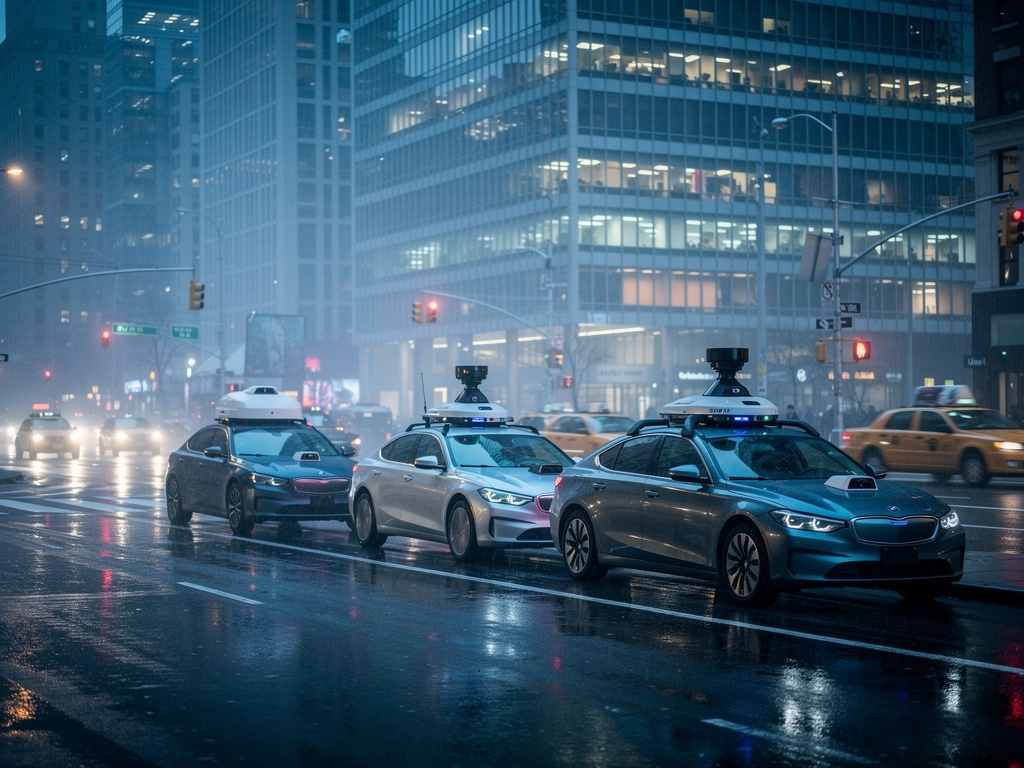
Waymo’s robotaxis have vanished from the streets of Manhattan. No press release. No formal explanation. Just silence — and a city left wondering whether the future of autonomous driving has hit a wall in the five boroughs.
The Alphabet-owned self-driving company quietly ceased its testing operations in New York City, a development first spotlighted by Gizmodo, which reported that the company’s vehicles are no longer collecting mapping data or conducting autonomous test rides in the city. The pullback appears to have happened without any public announcement, leaving regulators, city officials, and industry observers to piece together what went wrong — or what changed.
Waymo had been operating in New York under a testing permit issued by the state’s Department of Motor Vehicles. The company’s Jaguar I-PACE vehicles, outfitted with their distinctive sensor arrays, had become an occasional curiosity on city streets since testing began in 2023. But the operation was always modest compared to Waymo’s sprawling commercial services in Phoenix, San Francisco, and Los Angeles, where the company now completes over 200,000 paid rides per week.
New York was different. It was supposed to be the proving ground that demonstrated autonomous vehicles could handle the most chaotic, dense, and unpredictable urban environment in America. Instead, it became a case study in regulatory friction.
A Regulatory Maze With No Clear Exit
New York’s approach to autonomous vehicles has been, by any measure, the most restrictive in the country. The state requires a licensed safety driver behind the wheel during all AV testing — a mandate that undermines the fundamental economic proposition of driverless technology. The city government layered on additional requirements. And the Taxi and Limousine Commission, which controls for-hire vehicle licensing, never granted Waymo permission to offer commercial rides.
That last point matters enormously. In Phoenix and San Francisco, Waymo moved from testing to revenue-generating service. In New York, there was no visible path to that transition. The company was spending money to drive cars around Manhattan with humans in the front seat, collecting data but generating zero revenue. For a company that has already consumed billions in investment from Alphabet, the calculus eventually becomes unsustainable.
According to Gizmodo, Waymo declined to provide specifics about why testing stopped or when — or whether — it might resume. The company offered only vague language about continuing to evaluate opportunities. That kind of corporate non-answer typically signals one of two things: an internal strategic pivot, or a negotiation playing out behind closed doors.
New York City officials haven’t been much more forthcoming. The Adams administration, which has sent mixed signals about autonomous vehicles, hasn’t publicly addressed Waymo’s departure. Neither has the state DMV offered clarity on the status of Waymo’s testing permit.
The regulatory environment in New York stands in stark contrast to what’s happening elsewhere. California, Arizona, and Texas have all created frameworks — imperfect, contested, but functional — that allow companies to move from testing to commercial deployment. New York has not. The state legislature has repeatedly failed to pass comprehensive AV legislation, leaving the regulatory structure fragmented across multiple agencies with overlapping and sometimes contradictory authority.
This isn’t just a Waymo problem. Cruise, the GM-backed self-driving venture that had also explored New York operations, pulled back from all U.S. testing after a horrific pedestrian dragging incident in San Francisco in late 2023. That event sent shockwaves through the entire AV industry and gave ammunition to skeptics who argued cities weren’t ready for driverless cars — or that driverless cars weren’t ready for cities.
But Waymo’s safety record has been notably different from Cruise’s. The company has published data showing its vehicles are involved in fewer crashes per mile than human-driven cars in the same markets. A study conducted with Swiss Re, the reinsurance giant, found Waymo’s vehicles had 92% fewer property damage claims and zero bodily injury claims compared to human drivers. That data hasn’t been enough to move the needle in Albany or City Hall.
The Economics of Patience — and Its Limits
Waymo’s retreat from New York also reflects a broader strategic recalculation happening inside the company. Under co-CEOs Tekedra Mawakana and Dmitri Dolgov, Waymo has shifted toward a more disciplined expansion model. Rather than racing to plant flags in every major metro, the company is focused on deepening operations where it already has commercial traction.
That means Phoenix, where Waymo One has been operating commercially since 2020. San Francisco, where the service has scaled rapidly despite initial neighborhood resistance. Los Angeles, where it launched in 2024. And Austin, its newest market. Each of these cities offered something New York didn’t: a regulatory pathway to paid rides within a reasonable timeframe.
The financial pressure is real. Alphabet has poured an estimated $5.7 billion into Waymo over the company’s lifetime, with additional funding rounds in recent years. Waymo raised $5.6 billion in a funding round in 2024 alone, with participation from Alphabet and outside investors including Andreessen Horowitz and Silver Lake. That money comes with expectations. Every dollar spent on a market that can’t generate revenue is a dollar not spent on scaling markets that can.
And New York is expensive. Operating costs in Manhattan — from garage space to insurance to the mandatory safety drivers — are among the highest anywhere. The return on that investment, absent a commercial permit, is limited to mapping data and engineering learnings. Valuable, but not indefinitely so.
Some industry analysts have speculated that Waymo may be playing a longer game, waiting for New York’s political environment to shift before re-entering. Governor Kathy Hochul has expressed general support for technology innovation, but autonomous vehicles remain politically toxic in a city where the taxi industry carries significant lobbying weight and where pedestrian safety is a perpetual concern. The city saw over 100 traffic fatalities in 2024, a number that AV proponents argue autonomous technology could help reduce — but that opponents cite as evidence that streets are too dangerous for experimental vehicles.
The taxi and ride-hail industries have their own reasons to resist. New York’s medallion system, which nearly collapsed after the rise of Uber and Lyft, has only recently stabilized. Medallion owners, who saw their assets crater from over $1 million to under $200,000, are understandably wary of another technological disruption. The TWU Local 100, representing transit workers, has also voiced opposition to autonomous vehicles on safety and employment grounds.
So the politics are tangled. The economics are challenging. And the regulatory framework is essentially frozen.
What happens next is genuinely unclear. Waymo could return to New York if legislative action creates a commercial pathway. It could also decide the city isn’t worth the fight — at least not now. Other companies are watching closely. Amazon’s Zoox, which has been testing in several cities, has not announced New York plans. Neither has any other major AV developer.
New York, for all its density and complexity, may end up being one of the last major American cities to see commercial robotaxi service. Not because the technology can’t handle it, but because the city can’t decide whether it wants it.
A Bellwether for the Industry’s Next Chapter
Waymo’s New York experience illuminates a tension that will define the next decade of autonomous vehicle deployment: the gap between technological capability and political readiness. The cars work. They work imperfectly, with edge cases and occasional failures, but the safety data increasingly supports the claim that they outperform human drivers in controlled operating domains.
The harder problem is everything else. Community acceptance. Labor politics. Regulatory frameworks designed for a world of human drivers. Insurance structures. Liability questions. Infrastructure considerations. These are the obstacles that no amount of lidar data can solve.
In markets where Waymo operates commercially, the company has generally won over riders — its app ratings are high, and demand has grown steadily. But each new city brings its own version of resistance. San Francisco saw protests, including activists placing traffic cones on vehicle hoods to disable them. Phoenix dealt with early incidents of road rage directed at the cars. Los Angeles residents in some neighborhoods have complained about vehicles blocking driveways and making unexpected stops.
New York would have amplified every one of those challenges. Narrow streets. Aggressive drivers. Jaywalking pedestrians. Bike lanes. Construction zones that reshape traffic patterns weekly. Double-parked delivery trucks. The operational complexity is an order of magnitude greater than what Waymo faces in the sunbelt cities where it currently thrives.
None of that makes it impossible. But it makes it expensive, slow, and politically risky — a combination that doesn’t align with a company trying to prove its commercial viability to investors.
For now, the robotaxis are gone from New York. The city’s streets remain as congested and chaotic as ever, governed by the same human drivers who cause the vast majority of crashes. Whether that changes anytime soon depends less on technology and more on whether New York’s political establishment decides autonomous vehicles are part of the city’s future — or a threat to its present.
The vehicles are ready. The question is whether New York is.


 WebProNews is an iEntry Publication