
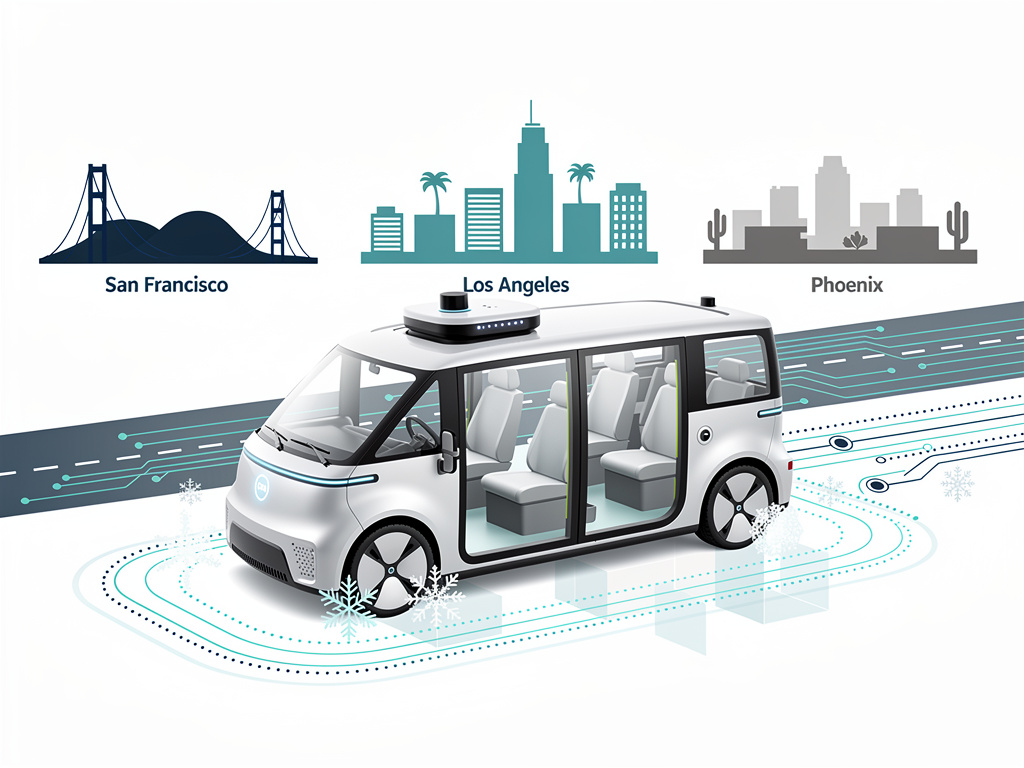
Waymo has begun offering rides in a new vehicle called the Ojai. The pale blue, boxy minivan-style robotaxi marks the company’s first purpose-built autonomous vehicle. No longer does the Alphabet subsidiary rely solely on retrofitted Jaguars. This shift comes at a moment when weekly ride volumes approach half a million and executives eye one million rides per week by year’s end.
The Ojai, manufactured by China’s Zeekr, a Geely subsidiary, rolls out first to select riders in San Francisco, Los Angeles and Phoenix. Trips start free for a limited time. Mashable reported the interior feels like a living room on wheels. Elevator-like sliding doors open to a flat floor with low step-in height. Higher ceilings and extra legroom create space that previous models lacked. A seat-integrated handle offers support. Braille markings and screen-reader compatibility address accessibility from the start.
Three large LED screens let passengers adjust temperature, select music or track the route. The cabin seats four comfortably. Remove the steering wheel and a fifth person fits. Storage accommodates groceries or a stroller. Surfaces appear easier to clean between rides. These details didn’t emerge by chance. Years of rider feedback and community input shaped them.
But the real story sits atop the vehicle. The Ojai carries Waymo’s sixth-generation Driver system. It uses fewer sensors than before. Cameras drop from 29 to 13. Lidars shrink from five to four. The entire suite costs less than $20,000 per vehicle according to reporting by Electrek. That reduction helps explain why the Ojai costs significantly less to build than the Jaguar I-Pace fleet. A small wiper keeps sensors clear in rain or snow. The system sees better in low light and handles harsher weather. Snowy cities once off limits now sit within reach.
Waymo has logged more than 20 million fully autonomous trips across 11 cities. Its vehicles record 92 percent fewer serious crashes than human drivers in comparable conditions. Serious injuries or fatalities occur at a rate 13 times lower. Those numbers come directly from the company’s safety reports. They matter because regulators, competitors and the public watch closely as expansion accelerates.
Production happens at a factory in Mesa, Arizona. There, Zeekr vehicles receive the full autonomous hardware suite. The site now targets output of tens of thousands of vehicles annually. Future models, including versions based on the Hyundai Ioniq 5, will join the line. This domestic final assembly sidesteps some concerns around foreign manufacturing while still drawing on Zeekr’s cost-efficient platform.
Recent coverage highlights the financial logic. CNBC noted the Ojai’s lower manufacturing cost supports faster fleet growth without the capital intensity of earlier custom builds. Removable steering wheel, roomier cabin and improved weather performance all feed into broader scalability. Waymo raised billions in recent funding rounds. It now operates or tests in roughly 20 markets with plans that include Washington, D.C., Denver, Las Vegas, San Diego and even London later this year.
Competitors loom. Tesla pushes its Cybercab vision and Full Self-Driving technology. Zoox deploys purpose-built vehicles that also feature inward-facing seats and no steering wheel. Chinese players move quickly on home turf. Yet Waymo holds a lead in paid autonomous miles and real-world data. Its current fleet exceeds 3,000 vehicles. The Ojai addition, combined with continued use of Jaguar I-Paces during transition, positions the company to multiply ride volume.
Inside the Ojai the experience feels different. Passengers notice the absence of a driver yet the presence of thoughtful details. One early rider described the space as van-like but more refined. Flat floors let legs stretch. Sliding doors eliminate awkward entries. Screens respond cleanly. The ride itself stays smooth. The sixth-generation system builds on proven software that already navigates complex urban environments, freeways and neighborhoods.
And expansion plans keep unfolding. After initial Trusted Tester access in the three launch cities, Waymo will open the Ojai to more users throughout the summer and fall. Denver, Las Vegas and San Diego follow because their climates test the new weather capabilities without extreme cold. Chicago and other snow-heavy markets could come next. Each new city brings fresh data that sharpens the Driver further.
Critics still point to incidents. Waymo paused service in several cities after vehicles encountered flooded streets. Such pauses remind everyone that edge cases persist. But the company’s transparency about safety metrics and rapid iteration has earned measured trust from many local officials. Riders with disabilities have expressed particular enthusiasm. The accessibility features built into the Ojai address real barriers that human-driven services sometimes overlook.
The Ojai doesn’t look revolutionary on the street. Its cornflower-blue color and modest sensor array make it blend in more than earlier roof-heavy prototypes. That ordinariness may help public acceptance. People see a van, not a science project. Yet underneath lies hardware and software refined across millions of miles. The removable steering wheel signals full confidence in the autonomous stack. No fallback human sits ready.
So what does this mean for the industry? Lower vehicle costs accelerate the path to profitability. A more comfortable cabin could lift rider satisfaction and utilization rates. Better all-weather performance opens larger addressable markets. Taken together, these elements suggest Waymo aims to move beyond niche service in sunny cities toward something closer to mass scale. The target of one million weekly rides by the end of 2026 looks ambitious. With the Ojai entering service it appears more attainable.
Waymo’s own blog post announcing the program struck a collaborative tone. “The Ojai was designed as a rider-first platform for fully autonomous ride-hailing, featuring subtle conveniences integrated throughout the vehicle,” it stated. Another passage noted the vehicle integrates accessibility directly into its design after years of input from riders and community partners. Those words reflect a company that has listened to feedback and translated it into metal, glass and code.
Analysts following the autonomous sector see the Ojai as evidence of maturing supply chains. Partnerships with Zeekr and Geely deliver a capable base vehicle at lower cost. U.S. assembly protects intellectual property and jobs. The modular design speeds maintenance and upgrades. All these factors matter when fleets must reach tens or hundreds of thousands of vehicles to achieve meaningful network effects.
Challenges remain. Regulatory approval varies by jurisdiction. Public trust can erode after any high-profile mishap. Competition from Tesla, if its unsupervised driving technology delivers at scale, could compress margins. Yet for now Waymo operates the only widespread driverless ride-hailing service in multiple American cities. The Ojai strengthens that position.
Riders in San Francisco already hail the new vehicles on select trips. Feedback will shape software updates and additional cabin features. Later this year the broader user base gains access. By then the distinctive blue vans may become a more common sight on city streets. Their quiet operation and consistent performance could accelerate the shift away from personally owned cars in dense urban areas.
The arrival of the Ojai doesn’t solve every problem in autonomous transportation. It does, however, demonstrate tangible progress on cost, comfort and capability. For an industry long on promises and short on deployed hardware, that combination carries weight. Waymo has moved from experiment to operation. With this new vehicle it signals intent to grow much larger.


 WebProNews is an iEntry Publication