
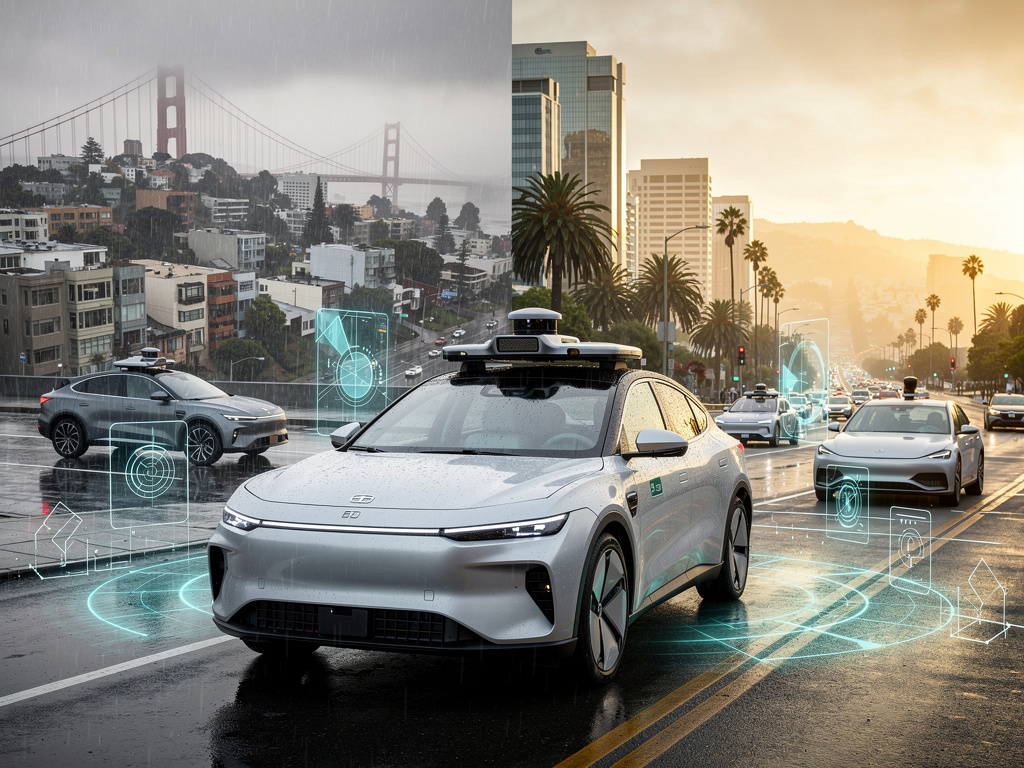
Alphabet’s autonomous vehicle subsidiary Waymo is rolling out its most ambitious hardware upgrade in years, deploying its sixth-generation robotaxi — codenamed Ojai — onto the streets of San Francisco and Los Angeles. The initial deployment, limited to Waymo employees and their guests, marks the beginning of what the company hopes will be a decisive technological leap over a growing field of competitors both domestic and international. The Ojai platform represents not just an incremental improvement but a fundamental rethinking of how self-driving cars perceive and navigate the world, particularly in adverse weather conditions that have long bedeviled the industry.
The announcement, which Waymo made on February 12, 2026, arrives at a moment of intensifying competition in the autonomous ride-hailing sector. While Waymo has maintained a commanding lead in the United States — operating commercially in San Francisco, Los Angeles, Phoenix, Austin, and Atlanta — rivals are circling. Uber has expanded its robotaxi partnerships internationally, and Chinese firms continue to press forward with their own platforms. The Ojai deployment is Waymo’s answer: a vehicle it claims can operate in conditions that would have grounded earlier generations.
A Sensor Suite Rebuilt from the Ground Up
At the heart of the Ojai system is a dramatically redesigned sensor architecture. According to reporting by CNBC, the sixth-generation Waymo Driver features a new suite of proprietary sensors that includes next-generation lidar, radar, and camera systems, all of which have been engineered to function more reliably in rain, fog, snow, and low-light conditions. The company says the new lidar units offer significantly improved range and resolution, while the radar system has been redesigned to better distinguish between stationary objects and moving vehicles in cluttered urban environments.
As detailed by The Register, the Ojai platform consolidates and streamlines many of the external sensor pods that gave earlier Waymo vehicles their distinctive, somewhat ungainly appearance. The new hardware is more tightly integrated into the vehicle’s body, reducing aerodynamic drag and making the cars look closer to conventional vehicles. This is more than cosmetic: the tighter integration also reduces the likelihood of sensor misalignment caused by vibrations or minor impacts, a persistent issue with bolt-on sensor arrays. Waymo has said that the Ojai system uses fewer individual sensor units than its predecessor while achieving broader coverage — a testament to advances in sensor capability and the company’s proprietary data-fusion algorithms.
Weather Has Always Been Autonomous Driving’s Achilles’ Heel
The emphasis on harsh-weather performance is no accident. For years, autonomous vehicle companies have operated primarily in Sun Belt cities where clear skies and dry roads minimize the challenge of sensor perception. Waymo’s own expansion has followed this pattern, with its earliest commercial operations rooted in the perpetually sunny suburbs of Phoenix, Arizona. But as the company has expanded to San Francisco — where fog and rain are routine — and eyes future markets in the Pacific Northwest and the Midwest, weather resilience has become a strategic imperative.
Gizmodo reported that Waymo’s internal testing of the Ojai system included extensive operations in simulated and real-world adverse weather, including heavy rain in the Pacific Northwest and snow in Michigan. The company claims the new system’s perception stack can maintain reliable object detection at distances exceeding 300 meters even in moderate rainfall — a significant improvement over the fifth-generation system, which saw meaningful performance degradation in similar conditions. The upgraded radar system is said to be particularly important in these scenarios, as radar waves penetrate rain and fog far more effectively than the near-infrared light used by lidar.
The Geely Connection: A New Vehicle Platform
The Ojai system is being deployed on a new vehicle platform as well. According to TechEBlog, the sixth-generation Waymo Driver is integrated into a purpose-built electric vehicle developed in partnership with Chinese automaker Geely. The vehicle, which Waymo has not yet given a public model name, features a design optimized for autonomous ride-hailing: a spacious rear cabin, easy ingress and egress, and a flat floor enabled by the EV’s skateboard battery architecture. The partnership with Geely — which also owns Volvo Cars and Polestar — gives Waymo access to a manufacturing partner capable of producing vehicles at scale, a critical consideration as the company looks to expand its fleet from thousands of vehicles to tens of thousands.
The choice of Geely is itself noteworthy. Waymo previously partnered with Jaguar Land Rover for its fifth-generation I-PACE-based fleet and with Stellantis for its Chrysler Pacifica minivans. The shift to Geely reflects both the economic realities of EV manufacturing — Chinese automakers have achieved significant cost advantages in battery electric vehicle production — and the strategic importance of having a partner willing to build vehicles specifically tailored to autonomous operation rather than retrofitting existing consumer models. The new vehicle reportedly includes redundant steering, braking, and electrical systems designed from the factory, rather than added aftermarket.
Employee-First Rollout Signals Cautious Confidence
Waymo’s decision to begin the Ojai deployment with employees and their guests, rather than the general public, follows the company’s established playbook. Each previous generation of the Waymo Driver has gone through an extended internal testing phase before being opened to paying customers. This approach allows Waymo to gather real-world performance data in a controlled setting while managing the reputational risk of any early-stage issues. As CNBC noted, Waymo employees have historically served as some of the most demanding testers, providing detailed feedback on ride quality, routing decisions, and edge-case handling that shapes subsequent software updates.
The dual-city launch in San Francisco and Los Angeles is also strategic. San Francisco’s dense, chaotic streets — with their steep hills, double-parked delivery trucks, aggressive cyclists, and unpredictable pedestrian behavior — represent one of the most challenging urban driving environments in the world. Los Angeles, meanwhile, offers a different set of challenges: high-speed freeway driving, sprawling intersections, and a road network that demands the vehicle handle both dense urban cores and suburban arterials. By testing simultaneously in both cities, Waymo can expose the Ojai system to a maximally diverse set of driving scenarios from day one.
The DoorDash Door Problem: Operational Realities of Running a Robot Fleet
Even as Waymo touts its technological advances, the company continues to grapple with the mundane operational challenges of running a fleet of driverless vehicles in the real world. In a revealing report, TechCrunch detailed how Waymo has been asking DoorDash delivery drivers — who use Waymo vehicles for autonomous food delivery — to ensure they close the car doors properly after retrieving orders. The issue, while seemingly trivial, highlights a fundamental challenge: autonomous vehicles cannot yet handle every physical interaction with the world, and human partners must be trained to work within the system’s constraints.
The DoorDash partnership, which uses Waymo vehicles to transport food orders without a human driver, has been an important revenue diversification strategy for the company. But the door-closing issue illustrates the gap between the elegance of autonomous driving algorithms and the messiness of real-world logistics. A door left ajar can trigger safety protocols that immobilize the vehicle, taking it out of service until a remote operator or field technician intervenes. At scale, such incidents can meaningfully impact fleet utilization rates and, by extension, unit economics. Waymo has reportedly developed new in-vehicle sensors and audio prompts to address the problem, but the episode underscores that the path to fully autonomous commercial operations is paved with unglamorous operational details.
The Global Race Heats Up: Uber and WeRide Push Into Abu Dhabi
Waymo’s Ojai deployment comes as competitors are making aggressive moves of their own. As reported by CleanTechnica, Uber has expanded its robotaxi service to downtown Abu Dhabi in partnership with Chinese autonomous vehicle company WeRide. The expansion marks Uber’s latest effort to build a global autonomous ride-hailing network through partnerships rather than developing its own self-driving technology — an approach that stands in sharp contrast to Waymo’s vertically integrated model.
The Uber-WeRide partnership in Abu Dhabi is significant for several reasons. It demonstrates that the autonomous vehicle industry is increasingly global, with Chinese technology companies finding receptive markets in the Middle East and Southeast Asia even as they face regulatory headwinds in the United States and Europe. It also validates Uber’s platform strategy: by partnering with multiple AV companies across different geographies, Uber aims to become the default ride-hailing interface for autonomous vehicles regardless of which company’s technology is under the hood. For Waymo, which operates its own consumer-facing app and brand, this presents a strategic question about whether its vertically integrated approach can scale as quickly as Uber’s partnership model.
What the Market Is Watching: Scale, Unit Economics, and the Path to Profitability
Industry analysts are watching the Ojai deployment closely for signals about Waymo’s path to profitability. The autonomous vehicle industry has consumed tens of billions of dollars in investment over the past decade, and investors are increasingly impatient for returns. Alphabet does not break out Waymo’s financials in detail, but the unit has been one of the largest cost centers within Alphabet’s “Other Bets” segment, which reported operating losses of several billion dollars annually in recent years.
The Ojai platform’s lower sensor cost — achieved through fewer, more capable units and tighter vehicle integration — is expected to meaningfully reduce the per-vehicle cost of Waymo’s fleet. Combined with the manufacturing efficiencies offered by the Geely partnership, industry observers believe Waymo could bring the cost of each robotaxi below $100,000 for the first time, down from estimates of $150,000 to $200,000 for its Jaguar I-PACE-based vehicles. If accurate, this would represent a critical step toward unit economics that can support a profitable, scaled operation. As tech commentator Sawyer Merritt noted on X, the generational improvement in both capability and cost structure positions Waymo to widen its lead in the U.S. market even as new entrants emerge.
The Road Ahead: Expansion, Regulation, and Public Trust
Waymo has not announced a specific timeline for when the Ojai-equipped vehicles will be available to the general public, but the company’s historical pattern suggests a phased rollout over several months. The employee testing phase will likely be followed by an expanded “trusted tester” program before full commercial availability. Meanwhile, Waymo continues to navigate a complex and evolving regulatory environment. California, Arizona, and Texas have been relatively welcoming to autonomous vehicle testing and deployment, but other states remain cautious, and federal legislation governing self-driving cars has stalled repeatedly in Congress.
Public trust remains another critical variable. High-profile incidents involving autonomous vehicles — including Waymo’s own occasional run-ins with confused traffic situations — continue to generate headlines and fuel skepticism. The Ojai platform’s improved perception capabilities and weather resilience may help reduce the frequency of such incidents, but Waymo knows that a single serious accident can set public acceptance back by years. The company’s cautious, employee-first deployment strategy reflects this reality. In the autonomous vehicle business, the race is not always to the swift but to the steady — and Waymo, with its sixth-generation system, is betting that methodical technological superiority will ultimately prevail over faster-moving but less capable rivals.
For now, the Ojai robotaxis are quietly picking up Waymo employees on the streets of San Francisco and Los Angeles, navigating fog-shrouded intersections and rain-slicked boulevards with what the company promises is unprecedented confidence. Whether that confidence translates into commercial dominance will be one of the defining questions in autonomous transportation for the years ahead.


 WebProNews is an iEntry Publication