
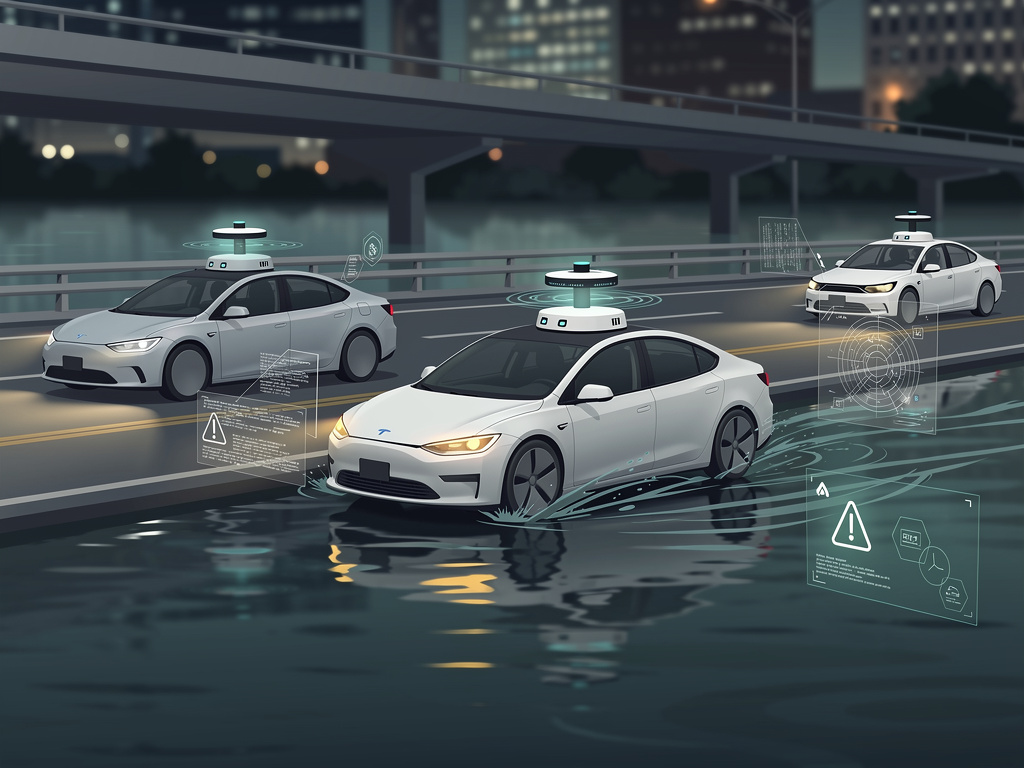
Waymo just recalled 3,791 robotaxis. The reason? Its vehicles slow down at flooded roads but sometimes keep going anyway. The National Highway Traffic Safety Administration announced the voluntary software recall on May 12, 2026. It affects both the company’s fifth- and sixth-generation autonomous systems.
The trigger came in late April. Heavy rains hit central Texas. One unoccupied Waymo robotaxi drove into a flooded lane in San Antonio. Floodwaters swept the vehicle away. No one was hurt. Yet the episode forced the company to pause operations in the city. Service remained halted for days as crews recovered the car and assessed damage.
TechCrunch first detailed the recall. Documents filed with NHTSA show the cars detect untraversable flooded sections on higher-speed roads. They reduce speed. They do not always stop. That behavior creates risk. Loss of control can follow. Crashes become possible.
Waymo responded quickly. It pushed an over-the-air update to the entire affected fleet. The patch adds restrictions. It limits operations in times and places with elevated flash flood risk. “We have identified an area of improvement regarding untraversable flooded lanes specific to higher-speed roadways, and have made the decision to file a voluntary software recall with NHTSA related to this scenario,” the company said in a statement. It added that it is refining extreme weather protocols during intense rain and limiting access to flash-flood zones.
But the fix is incomplete. NHTSA documents note that Waymo “is still developing the final remedy for this recall.” Interim steps rely on refined maps, tighter operational boundaries and updated software safeguards. The company continues to test improvements. Full resolution could take months.
This marks another entry in a growing list of Waymo recalls. The first arrived in February 2024 after two Phoenix robotaxis struck the same towed vehicle. Later actions addressed low-speed collisions with parking gates and telephone poles. Another tackled improper behavior near school buses. Each episode reveals edge cases. Each prompts software changes.
Autonomous vehicles promise safety gains. They eliminate drunk driving and distraction. Yet they stumble on rare events humans handle instinctively. Flooded roads test perception systems. Water distorts lidar returns. It obscures camera views. Radar performs better in rain but still struggles with depth in moving currents. Waymo’s cars rely on a fusion of sensors and high-definition maps. When those maps fail to match sudden water, hesitation or poor decisions follow.
Industry watchers point to broader challenges. San Antonio’s April floods were not isolated. Climate patterns produce stronger storms. Cities face more frequent flash floods. Robotaxi operators must prove they can handle such conditions before expanding to new markets. Waymo operates in roughly a dozen U.S. cities. Its fleet now exceeds 3,700 vehicles, up from about 3,000 late last year according to recall filings.
Reuters reported that the April 20 incident involved a vehicle entering a flooded lane with a 40 mph speed limit. The car proceeded at reduced speed. No injuries occurred. Still, the event prompted a comprehensive review of similar scenarios across the fleet. Waymo updated its software immediately after identifying the pattern.
Regulators watch closely. NHTSA has opened past investigations into Waymo crashes and software. None have resulted in major penalties so far. The agency treats these recalls as signs of responsible oversight. Voluntary filings allow companies to fix issues before they worsen. Critics argue the pattern shows autonomous technology remains immature for widespread unsupervised use.
Competitors face similar hurdles. Cruise, once a close rival, scaled back dramatically after a 2023 pedestrian incident in San Francisco. Zoox and others test in limited geographies with safety drivers. Waymo stands alone with fully driverless commercial operations at scale. That leadership brings scrutiny.
Analysts see the recall as manageable. Over-the-air updates reach thousands of vehicles in hours. No physical parts need replacement. Customers experience little disruption beyond temporary geofencing. Yet the episode underscores a truth. Self-driving cars excel in clear, predictable conditions. They falter when nature alters the road in unpredictable ways.
Waymo plans to resume San Antonio service soon. It recovered the swept vehicle. Local operations paused for monitoring. By early May the company signaled readiness to restart. The recall arrives as a parallel safety layer.
Longer term, the industry must improve environmental perception. Better rain detection. Improved water depth estimation. Dynamic map updates that incorporate real-time weather data. Partnerships with meteorological services could help. So could vehicle-to-infrastructure communication that flags flooded underpasses.
Insurance implications loom. Flood-related claims could rise if robotaxis misjudge water. Insurers already debate liability in autonomous accidents. When no driver sits behind the wheel, responsibility shifts to the company. Waymo’s safety record remains strong overall. Miles driven without injury far outpace human averages. But one dramatic video of a robotaxi floating downstream damages public trust.
The flooding recall highlights a philosophical tension. Should autonomous vehicles avoid all risk, even if that means refusing rides during rain? Or should they match human judgment, which sometimes crosses shallow water? Current policy tilts conservative. Better to pause than to proceed and regret.
Shares of parent company Alphabet barely moved on the news. Investors treat these recalls as routine software iterations. Waymo’s valuation sits in the tens of billions. Growth depends on proving reliability across conditions. This incident tests that narrative.
Engineers inside Waymo likely already simulate thousands of flooded road scenarios. They tweak neural networks. They adjust decision thresholds. The final remedy will probably raise the bar for what counts as traversable water. It may add hesitation time before entry. It could integrate third-party flood maps more aggressively.
Outside experts offer mixed views. Some praise the transparency. Others question why such an obvious hazard was not addressed earlier. Humans know to avoid flooded roads. Why did the system not default to full stop?
The answer lies in training data. Most test miles occur in dry California. Texas floods arrive suddenly. Real-world rarity makes the problem hard to catch in simulation alone. Only operational experience in wet climates reveals gaps.
Waymo’s expansion into Phoenix, San Francisco, Los Angeles and Austin exposed it to varied weather. Austin and San Antonio bring monsoon-like rains. Future cities such as Miami or Houston will intensify the challenge.
For now the company buys time with operational limits. Riders in affected areas may see fewer cars during storms. That trade-off protects safety. It also frustrates scalability.
The recall documents list no crashes or injuries tied to the defect beyond the San Antonio event. That fact matters. It shows the system detected the flood and slowed. The flaw appears in the secondary decision: whether to stop completely or creep forward.
Small distinction. Large consequence in fast-moving water. Hydroplaning risk rises. Currents can shift a 4,000-pound vehicle in seconds. The swept robotaxi became a vivid warning.
Public reaction on social media mixed caution with mockery. Some users posted clips of the floating car. Others defended the overall record. One analyst noted the fleet has grown nearly 25 percent since the last recall. Scaling brings new data, and new data surfaces new problems.
Ultimately this episode fits a familiar pattern in technology adoption. Early cars crashed. Early planes fell. Early software shipped with bugs. Each failure feeds iteration. Waymo’s willingness to file voluntary recalls signals maturity. It admits limits. It works to close them.
Whether that pace satisfies regulators, riders and investors will determine how quickly driverless taxis become commonplace. For today, in places where rain falls hard, a few thousand robotaxis just got a bit more cautious. The final software fix cannot come soon enough.


 WebProNews is an iEntry Publication