
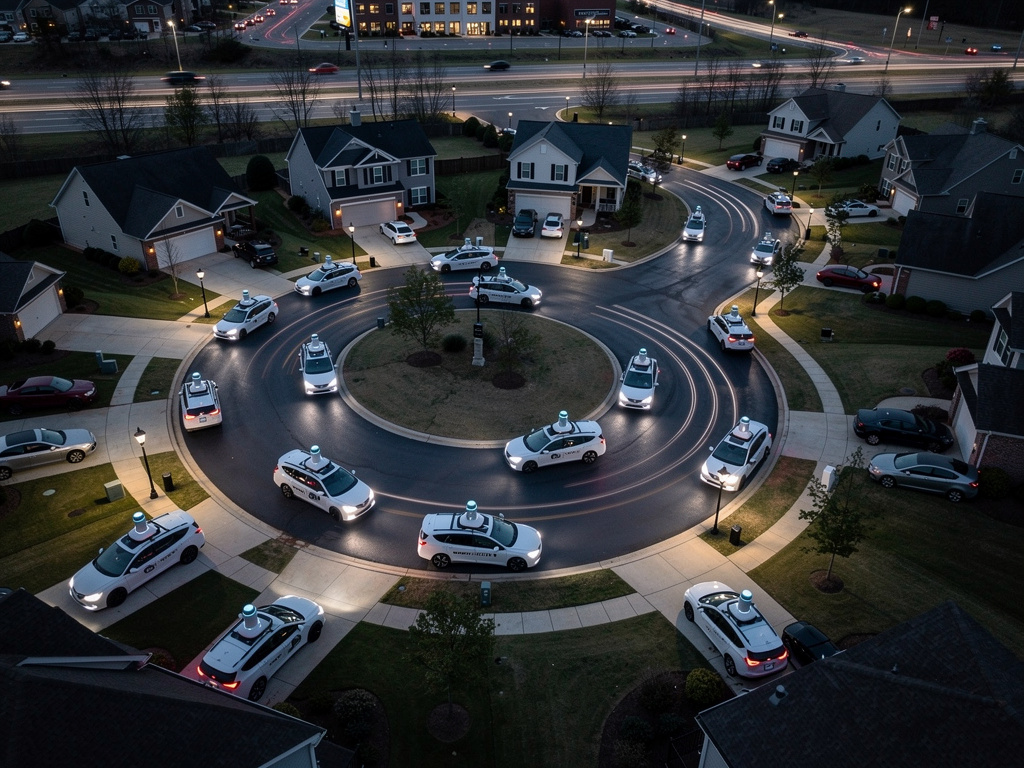
Battleview Drive in northwest Atlanta’s Buckhead area used to offer quiet mornings. Not anymore. In recent weeks, dozens of empty Waymo robotaxis have turned the suburban cul-de-sacs into their own private loops. They arrive. They circle. They leave. Often with no one inside.
Residents first spotted the autonomous Jaguars about two months ago. The gatherings intensified lately. One neighbor told local station WSB-TV that roughly 50 vehicles rolled through between 6 and 7 a.m. one morning. Videos captured by homeowners show the cars proceeding down the street in formation, executing U-turns at the dead end, and heading back out. Empty.
The Routing Glitch That Exposed Bigger Operational Challenges
The behavior traces to a routing issue. Waymo confirmed it acted after community complaints. In a statement shared with ABC News, the company said it had “already worked with our fleet partner to address this routing behavior.” That partner, according to recent social media discussion and reports, appears tied to Uber. Waymo operates its Atlanta rides through the Uber app.
Yet the fix came only after visible disruption. One resident placed a “Children at Play” sign in the road. Eight Waymos promptly stacked up, each struggling to maneuver around the obstacle and each other. “We had, at one point, eight Waymos that were stuck trying to figure out how to turn around,” the neighbor recalled. The scene played out like a mechanical ballet gone wrong. Short loops. Repeated passes. No passengers.
This isn’t abstract. Families live here. Kids wait for school buses. Pets roam. “We’re families, we have small animals and pets, got kids getting on the bus in the morning and it just doesn’t feel safe to have that traffic,” one homeowner explained to WSB-TV. Another added, “We would like to just see them stay on main traffic roads. I don’t think there’s any reason for them to be on small residential cul-de-sacs if they’re not picking up somebody.” And this: “It’s almost every little cul-de-sac in our area, so I think it’s a problem.”
The incidents coincide with other recent stumbles for Waymo. Days earlier, the company issued a software update after some vehicles attempted to drive through flooded roads, as reported by The Verge. That update followed a voluntary recall. Safety remains the core promise. Waymo repeatedly notes its more than 500,000 weekly trips nationwide have reduced traffic injuries. But these empty swarms test local patience in a city where the service launched less than a year ago.
Waymo now runs in multiple markets. A TechCrunch report from February detailed operations across 10 U.S. cities, with a fleet nearing 3,000 vehicles at the time. Expansion brought service to Miami, deeper freeway access in select spots, and partnerships that spread the vehicles wider. Atlanta formed part of that growth. Yet suburban streets were never meant for this volume of repositioning traffic.
Critics see deeper signals. Empty miles reveal inefficiencies in how fleets balance supply and demand. When vehicles lack immediate rides, the system directs them somewhere. In this case, that somewhere became quiet residential loops ideal for course correction or waiting. The algorithm didn’t account for the human experience of watching ghost cars circle your home at dawn.
But the company moved quickly once videos spread. “At Waymo, we are committed to being good neighbors. We take community feedback seriously,” the statement continued. It stressed safety gains and a desire to maintain strong ties with Atlanta residents. No public data has emerged yet on exactly how many empty trips occur citywide or what percentage of fleet activity involves such repositioning.
Local officials face pressure too. Residents contacted city council members, state transportation leaders, and even sought direct replies from Waymo before the statement arrived. Responses from government bodies remain limited in public view. The episode highlights a gap. Commercial robotaxi deployment brings data on mapping, sensors, and machine learning. It also surfaces friction with the communities that host the vehicles overnight and between rides.
So what happens next? Waymo’s software tweak should prevent repeats in Buckhead. The larger question lingers. How will operators refine fleet positioning as they scale to thousands more vehicles across dozens of neighborhoods? Early markets like Phoenix and San Francisco saw their share of odd behaviors before smoothing out. Atlanta now joins that list.
Residents aren’t opposed to the technology outright. Many express curiosity about the rides. Their frustration centers on the side effects. Increased traffic on streets designed for low volume. Potential hazards during school hours. The surreal sight of synchronized empty cars performing endless turns. One local captured footage that spread rapidly online. The images showed not innovation in motion but automation stuck in a literal loop.
Industry watchers note the timing. Waymo continues to expand even as competitors like May Mobility enter Atlanta, per earlier Wall Street Journal coverage. Public trust depends on more than safety statistics. It requires vehicles that respect the rhythm of daily suburban life rather than interrupt it.
The Buckhead swarm lasted hours in some cases. It ended when the routing change took effect. Yet the memory remains fresh. Homeowners still scan their streets each morning. They wonder if another wave will appear. For now, the cul-de-sacs sit quieter. The robotaxis have new instructions. The test, however, continues.


 WebProNews is an iEntry Publication