
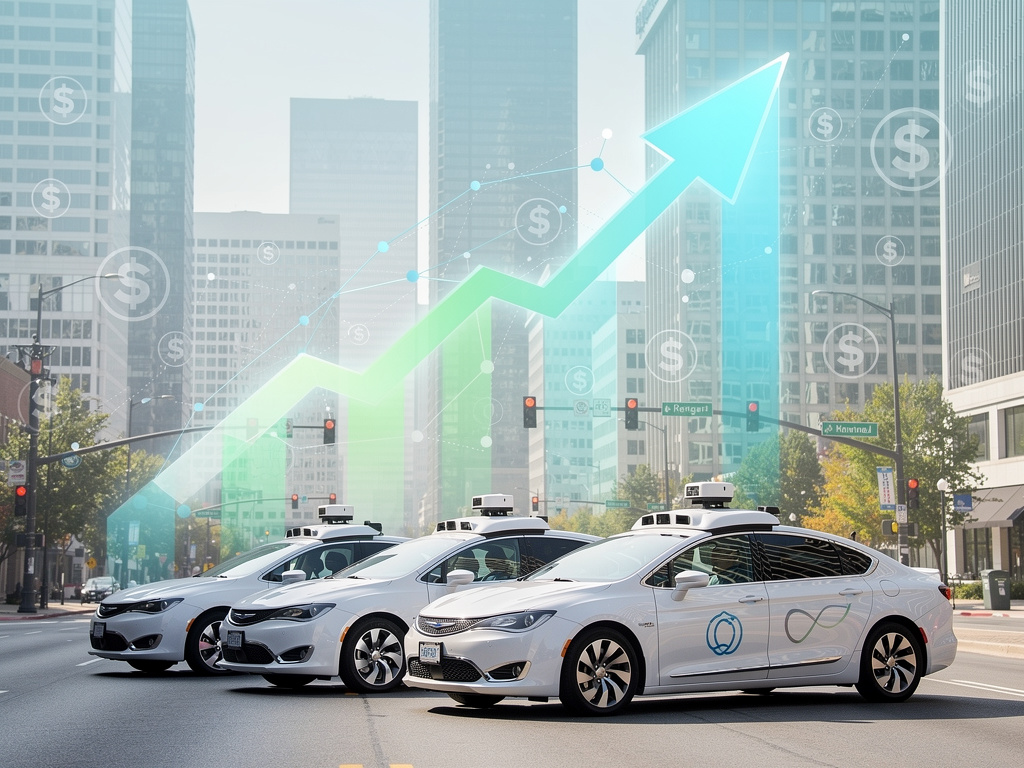
The autonomous vehicle sector has entered a decisive phase, with Alphabet’s Waymo securing $5.6 billion in fresh capital that underscores both the technology’s immense promise and the staggering investment required to achieve scale. This massive funding round, one of the largest in autonomous vehicle history, positions Waymo to expand its robotaxi operations across multiple U.S. cities while competitors struggle to match its technological lead and operational footprint.
According to The New York Times, the funding round attracted participation from new and existing investors, reflecting continued confidence in Waymo’s ability to commercialize self-driving technology despite years of development costs and regulatory hurdles. The capital injection arrives at a critical juncture when the company operates paid robotaxi services in San Francisco, Phoenix, Los Angeles, and Austin, completing over 150,000 paid trips weekly across these markets.
The funding announcement represents a stark contrast to the broader autonomous vehicle industry, where several high-profile competitors have scaled back operations or ceased development entirely. Waymo’s parent company, Alphabet, has demonstrated unusual patience with the unit’s path to profitability, a luxury that standalone startups cannot afford. The new capital will primarily fund geographic expansion, fleet growth, and continued refinement of the company’s proprietary sensor suite and artificial intelligence systems that power its fifth-generation autonomous vehicles.
The Economics of Autonomous Ambition
Industry analysts estimate that Waymo has consumed more than $10 billion in cumulative investment since its inception as the Google Self-Driving Car Project in 2009. The company’s willingness to secure additional billions signals that the path to profitability remains measured in years rather than quarters, even as operational metrics show encouraging progress. Each Waymo vehicle reportedly costs between $150,000 and $200,000 to manufacture, a figure that must decline substantially before the unit economics can compete favorably with human-driven ride-hailing services.
The business model hinges on achieving sufficient scale to offset these capital-intensive beginnings. Waymo’s average fare reportedly ranges from $15 to $30 per trip, comparable to Uber and Lyft pricing in its operating markets. However, without driver compensation—typically 60-70% of ride-hailing costs—the company projects eventual margin advantages that could reshape urban transportation economics. The challenge lies in reaching the operational density and reliability that would allow dramatic fleet expansion while maintaining safety standards that have become Waymo’s calling card.
Financial markets have responded cautiously to autonomous vehicle investments following the collapse or retreat of numerous competitors. Cruise, General Motors’ autonomous unit, suspended operations in late 2023 after a pedestrian dragging incident in San Francisco, only resuming limited testing in 2024. Ford and Volkswagen shuttered their joint venture, Argo AI, in 2022 after investing approximately $3.6 billion. These failures have concentrated investor attention on the few remaining players with demonstrated technical capability and operational experience in real-world conditions.
Geographic Expansion as Competitive Moat
Waymo’s expansion strategy focuses on Sun Belt cities with favorable weather conditions, regulatory environments, and grid-pattern streets that simplify autonomous navigation. The company’s selection of Austin as its fourth market reflects this calculated approach, targeting cities where technology adoption rates run high and municipal governments have signaled openness to autonomous vehicle deployment. Each new city requires months of mapping, testing, and regulatory approval before commercial launch, creating natural barriers to entry that protect early movers.
The company’s operational data reveals the complexity of urban autonomous driving. Waymo vehicles in San Francisco navigate some of the nation’s most challenging driving conditions, including steep hills, dense fog, aggressive human drivers, cyclists, and pedestrians. The system has logged millions of autonomous miles in the city, encountering edge cases that would take decades to experience in less demanding environments. This accumulated experience represents a significant competitive advantage that cannot be easily replicated, even by well-funded competitors.
Phoenix remains Waymo’s most mature market, where the company has operated since 2017 and removed human safety drivers from its vehicles in 2020. The desert city serves as a proving ground for operational efficiency, with the company refining its fleet management, maintenance protocols, and customer service systems. Lessons learned in Phoenix have accelerated launches in subsequent markets, demonstrating the value of operational experience alongside technological capability.
The Technology Arms Race Continues
Waymo’s fifth-generation autonomous vehicle platform represents years of iterative improvement over earlier systems. The sensor suite includes multiple lidar units, radar arrays, and high-resolution cameras that create a 360-degree view extending several hundred meters. The company manufactures many sensors in-house, reducing costs while maintaining quality control over components critical to system performance. This vertical integration strategy contrasts with competitors who rely more heavily on third-party sensor suppliers.
The artificial intelligence systems processing sensor data have evolved through exposure to countless driving scenarios. Machine learning models trained on this vast dataset can predict pedestrian behavior, anticipate traffic flow changes, and navigate construction zones with increasing sophistication. Waymo engineers emphasize that autonomous driving represents not a single technological breakthrough but rather the integration of dozens of subsystems, each requiring continuous refinement. The company’s investment in simulation technology allows testing of dangerous or rare scenarios millions of times virtually before encountering them on public roads.
Regulatory frameworks continue evolving alongside the technology, with California, Arizona, and Texas adopting different approaches to autonomous vehicle oversight. Waymo has invested heavily in regulatory relationships, providing data to transportation authorities and working collaboratively on safety standards. The company’s safety record—no serious injuries attributed to its autonomous system in millions of miles of operation—has proven crucial in maintaining regulatory goodwill and public acceptance.
Market Dynamics and Competitive Pressures
The robotaxi market remains nascent, with total industry revenues measured in hundreds of millions rather than billions of dollars annually. However, projections suggest the autonomous ride-hailing market could reach $50 billion to $100 billion by the early 2030s as technology improves, costs decline, and consumer acceptance grows. Waymo’s first-mover advantage in key markets positions the company to capture disproportionate share during this growth phase, assuming execution remains strong and no catastrophic safety incidents undermine public confidence.
Tesla represents Waymo’s most formidable potential competitor, though the companies pursue fundamentally different technological approaches. Tesla’s camera-based system relies on neural networks trained across millions of customer vehicles, while Waymo’s lidar-centric approach prioritizes redundancy and deterministic safety. Tesla CEO Elon Musk has repeatedly promised imminent robotaxi deployment, most recently targeting 2025, though these timelines have consistently slipped. The company’s Full Self-Driving system remains a Level 2 driver assistance feature requiring constant human supervision, far from the Level 4 autonomy Waymo has achieved.
Chinese autonomous vehicle companies, including Baidu’s Apollo Go and Pony.ai, have deployed robotaxis in multiple Chinese cities, operating under regulatory frameworks that differ substantially from U.S. requirements. These companies benefit from supportive government policies and lower labor costs but face barriers entering Western markets due to geopolitical tensions and data security concerns. The autonomous vehicle industry increasingly reflects broader technological competition between the United States and China, with each country nurturing domestic champions while restricting foreign competitors.
The Path Forward Remains Uncertain
Waymo’s massive funding round provides runway to pursue aggressive expansion, but significant obstacles remain. Weather conditions continue challenging autonomous systems, with heavy rain, snow, and fog degrading sensor performance. The company currently restricts operations during severe weather, a limitation that must be overcome for true ubiquity. Additionally, the economic model requires far greater density than currently achieved, with vehicles spending substantial time repositioning between rides rather than generating revenue.
Public acceptance represents another critical variable. Surveys show consumers remain skeptical about autonomous vehicles, with safety concerns paramount despite Waymo’s strong record. High-profile incidents involving other autonomous vehicle operators have generated negative publicity that affects the entire industry. Waymo has responded by emphasizing transparency, publishing safety data, and conducting extensive public education efforts. The company’s strategy of gradual expansion, proving safety and reliability in each market before moving to the next, reflects awareness that public trust must be earned incrementally.
The labor implications of autonomous vehicles have generated political opposition in some jurisdictions, with driver unions and worker advocates warning of job displacement. Waymo has attempted to address these concerns by emphasizing new jobs created in fleet management, maintenance, and customer support, though these positions number far fewer than the drivers potentially displaced. The political economy of autonomous vehicles will likely influence regulatory decisions and expansion timelines as the technology matures.
Industry Implications and Strategic Positioning
Waymo’s ability to secure $5.6 billion during a period of general skepticism toward unprofitable technology companies demonstrates investor conviction that autonomous vehicles will eventually transform transportation. The funding provides Waymo with resources to outlast competitors and achieve the scale necessary for profitability. However, the capital requirements also illustrate why autonomous vehicles remain the province of deep-pocketed corporations and well-funded startups rather than a broadly accessible technology.
The autonomous vehicle industry has entered a consolidation phase, with viable competitors numbering in the single digits globally. Waymo’s combination of technological leadership, operational experience, and financial resources positions the company as the likely Western market leader, barring unexpected developments. The company’s challenge now shifts from proving technological feasibility to demonstrating business model viability—a transition that will require years of execution and continued patience from Alphabet’s leadership.
For urban planners, transportation authorities, and automotive industry executives, Waymo’s progress represents both opportunity and disruption. Cities must prepare for the possibility of widespread autonomous vehicle deployment, considering implications for parking, traffic flow, and public transit. Automotive manufacturers face strategic decisions about whether to develop autonomous technology internally, partner with specialists like Waymo, or focus on traditional vehicle manufacturing. The coming years will determine whether autonomous vehicles fulfill their transformative promise or remain a niche technology serving limited markets and use cases.


 WebProNews is an iEntry Publication