
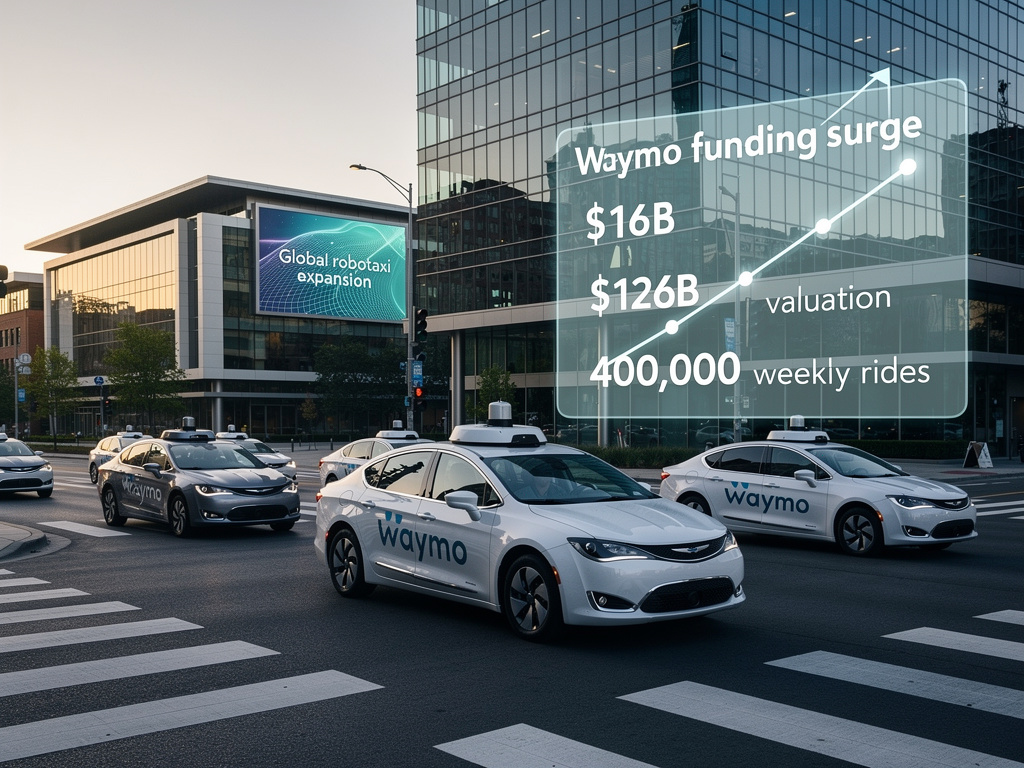
Waymo has secured what stands as one of the largest funding rounds in autonomous vehicle history, raising $16 billion at a staggering $126 billion valuation in a deal that signals Silicon Valley’s renewed conviction in self-driving technology. The round, led by Sequoia Capital, DST Global, and Dragoneer Investment Group, represents a watershed moment for Alphabet’s autonomous driving unit as it prepares to expand beyond its current American footprint into international markets including the United Kingdom by 2026.
The funding announcement comes as Waymo operates more than 400,000 weekly rides across its existing markets, demonstrating operational scale that has eluded competitors who have either shuttered operations or significantly scaled back ambitions. According to Bloomberg, the capital infusion will fuel an aggressive expansion strategy that includes deploying thousands of additional vehicles across major metropolitan areas while simultaneously entering new geographic territories that have remained largely untapped by autonomous vehicle operators.
The valuation places Waymo firmly in rarefied air, commanding a price tag that exceeds many established automotive manufacturers despite generating revenue from a service that remains confined to select cities. Industry observers note that the premium reflects investor confidence in Waymo’s technological lead, regulatory relationships, and operational expertise gained from years of real-world testing. As Waymo’s official blog detailed, the company has accumulated more autonomous miles than any competitor, creating a data moat that becomes increasingly valuable as machine learning models require ever-larger training sets.
The Investor Coalition Behind Autonomous Ambitions
Sequoia Capital’s decision to lead the round marks a significant endorsement from one of venture capital’s most prestigious firms, which has historically been selective about late-stage investments of this magnitude. In a detailed post explaining the investment thesis, Sequoia partners outlined their conviction that autonomous vehicles represent a multi-trillion dollar market opportunity, with Waymo positioned as the clear category leader based on technological sophistication and operational metrics.
The investor syndicate extends beyond traditional venture capital, incorporating growth equity firms and strategic investors who bring complementary capabilities to Waymo’s expansion plans. DST Global, known for backing technology companies during critical scaling phases, joins Dragoneer Investment Group in providing capital that will support both geographic expansion and fleet densification in existing markets. According to Bloomberg Law, the round also included participation from existing investors, though Alphabet’s specific contribution was not disclosed in initial announcements.
Operational Metrics Demonstrate Market Readiness
The 400,000 weekly rides figure represents more than a vanity metric—it demonstrates that Waymo has achieved the operational density required to make autonomous ride-hailing economically viable in its core markets. This volume translates to approximately 57,000 rides daily, distributed across service areas in San Francisco, Los Angeles, Phoenix, and Austin. The company has methodically expanded service zones within these cities, moving beyond initial pilot areas to cover substantial portions of urban cores and surrounding neighborhoods.
Waymo’s approach contrasts sharply with competitors who announced ambitious timelines only to retreat when faced with technical or regulatory challenges. As Silicon Republic reported, the company’s conservative expansion strategy, while slower than some observers desired, has allowed it to build robust relationships with municipal authorities and accumulate the operational experience necessary to manage a fleet at scale. Each market entry follows an extensive mapping and testing phase, with safety drivers initially present before transitioning to fully autonomous operations.
International Expansion Breaks New Ground
The planned 2026 entry into the United Kingdom represents Waymo’s first international market and presents unique challenges distinct from American operations. British roads feature different traffic patterns, regulatory frameworks, and infrastructure characteristics that will test the adaptability of Waymo’s autonomous systems. According to TechCrunch, the company is also exploring opportunities in Tokyo, though specific timelines for Japanese operations remain undisclosed.
Regulatory approval processes in international markets typically involve extensive documentation of safety records, technical specifications, and operational protocols. Waymo’s extensive American track record provides a foundation for these applications, though European and Asian regulators maintain distinct requirements that may necessitate system modifications. The UK’s relatively progressive stance on autonomous vehicle testing, combined with London’s status as a global financial center with substantial transportation demand, makes it an logical initial international target.
Capital Deployment Strategy Focuses on Fleet and Technology
The $16 billion will fund multiple strategic priorities, with vehicle procurement representing a substantial portion of planned expenditures. Waymo operates a fleet of Jaguar I-PACE electric vehicles equipped with custom sensor suites, and scaling to serve additional markets requires thousands of additional units. As Electrive noted, the company has also announced partnerships with Geely to develop purpose-built autonomous vehicles, suggesting that future capital deployment may shift toward custom platforms optimized for robotaxi operations rather than modified consumer vehicles.
Beyond hardware, significant capital will support continued software development, sensor refinement, and the expansion of mapping operations required for new markets. Each city demands detailed three-dimensional maps that serve as reference points for real-time navigation, a labor-intensive process that must be completed before service launch. The company also maintains substantial teams focused on simulation, using virtual environments to test edge cases and rare scenarios that would take years to encounter in real-world driving.
Competitive Dynamics Reshape Around Waymo’s Lead
The funding round arrives as the autonomous vehicle sector has consolidated dramatically from the crowded field that existed just five years ago. Former competitors including Cruise have substantially reduced operations following safety incidents, while others have pivoted toward highway autonomy or driver assistance features rather than full self-driving capabilities. Waymo’s ability to raise capital at this valuation underscores the winner-take-most dynamics that appear to be emerging in the robotaxi sector, where operational scale and safety records create compounding advantages.
Tesla’s Full Self-Driving system, while deployed across millions of vehicles, operates under a different model that requires driver supervision and positions the technology as an advanced driver assistance system rather than true autonomy. Chinese competitors including Baidu’s Apollo and Pony.ai have demonstrated impressive capabilities in domestic markets but face regulatory and geopolitical barriers to Western expansion. As Electrek analyzed, Waymo’s combination of technological maturity, operational experience, and capital resources creates a formidable competitive moat.
Economic Model Approaches Profitability Inflection
While Waymo has not disclosed detailed financial metrics, industry analysts estimate that the unit economics in mature markets are approaching break-even as fleet utilization improves and operational costs decline through scale efficiencies. The removal of safety drivers eliminates the largest variable cost in ride-hailing operations, though vehicle maintenance, remote assistance, and fleet management still require substantial personnel. The company’s ability to operate vehicles nearly 24 hours daily, limited only by charging requirements, provides utilization advantages over human-driven alternatives.
The path to profitability depends heavily on achieving sufficient density within service areas, as fixed costs including mapping, regulatory compliance, and technology development must be amortized across ride volume. Waymo’s strategy of deepening service in existing markets before entering new geographies reflects this economic reality, prioritizing utilization improvements over geographic breadth. According to a post from Sundar Pichai on X, Alphabet remains committed to supporting Waymo through the capital-intensive scaling phase as the unit moves toward sustainable economics.
Safety Record Becomes Central Competitive Advantage
Waymo has leveraged its safety performance as a key differentiator, regularly publishing data showing lower collision rates compared to human drivers in comparable conditions. The company employs a multi-layered safety approach combining redundant sensors, conservative driving behaviors, and remote assistance capabilities that allow human operators to provide guidance in ambiguous situations. This safety-first approach has occasionally drawn criticism for overly cautious vehicle behavior, but has proven essential for maintaining regulatory relationships and public trust.
Recent incidents involving competitor vehicles have heightened regulatory scrutiny across the autonomous vehicle sector, making Waymo’s clean operational record increasingly valuable. Municipal authorities considering autonomous vehicle permits now demand extensive safety documentation and operational histories, requirements that favor established operators with proven track records. The company’s willingness to operate transparently, including publishing detailed safety reports and engaging with community stakeholders, has established a regulatory playbook that newer entrants struggle to replicate.
Technology Evolution Continues Beyond Current Capabilities
Despite achieving commercial operations, Waymo continues investing heavily in advancing its autonomous systems to handle increasingly complex scenarios and environmental conditions. Current operations remain geofenced to mapped areas under favorable weather conditions, with expansion to new environments requiring extensive validation. The company’s research teams focus on challenges including improved performance in heavy rain, snow, and other adverse conditions that currently limit service availability.
Sensor technology represents another area of ongoing investment, with each vehicle generation incorporating improved lidar, radar, and camera systems that provide enhanced perception capabilities. As noted in commentary from Andreessen Horowitz on X, the autonomous vehicle sector continues to benefit from broader advances in artificial intelligence and machine learning, with foundation models and improved training techniques enabling more sophisticated decision-making systems. Waymo’s scale advantages extend to data collection, as each mile driven generates training data that improves system performance across the entire fleet.
Market Structure Implications for Transportation Ecosystem
The emergence of viable robotaxi services carries profound implications for urban transportation, potentially disrupting both personal vehicle ownership and traditional ride-hailing services. Economic models suggest that autonomous vehicles could reduce transportation costs by 50-70% compared to human-driven alternatives at scale, fundamentally altering consumer behavior and urban planning assumptions. Cities may need to reconsider parking requirements, road design, and public transit investments as autonomous vehicles reshape mobility patterns.
The labor implications remain contentious, with autonomous vehicles potentially displacing millions of professional drivers while creating new roles in fleet management, remote assistance, and vehicle maintenance. Waymo has emphasized that its expansion will generate substantial employment in these emerging categories, though the net employment impact across the broader transportation sector remains uncertain. Policymakers are beginning to grapple with these transitions, with some jurisdictions implementing autonomous vehicle taxes or requiring companies to support workforce development programs.
Global Race for Autonomous Vehicle Leadership Intensifies
Waymo’s international expansion occurs against a backdrop of intensifying national competition for autonomous vehicle leadership, with China, the United States, and European nations all viewing the technology as strategically significant. Chinese companies have deployed autonomous vehicles across multiple cities domestically and are seeking international expansion opportunities, though geopolitical tensions complicate market access. European regulators are developing frameworks to enable autonomous vehicle deployment while maintaining strict safety standards and data protection requirements.
The United Kingdom’s receptiveness to Waymo’s entry reflects a broader strategy to position itself as a hub for autonomous vehicle development and deployment post-Brexit. British officials have signaled willingness to adapt regulatory frameworks to accommodate innovative transportation technologies, viewing autonomous vehicles as an economic development opportunity. As discussed in analysis from industry observers on X, the regulatory environment will likely prove as important as technological capabilities in determining which companies succeed in international markets.
Investment Thesis Extends Beyond Immediate Returns
The investors backing Waymo’s $16 billion round are making a long-term bet that autonomous vehicles will fundamentally transform transportation, creating market opportunities measured in trillions rather than billions of dollars. This patient capital approach acknowledges that achieving full geographic coverage and regulatory approval across major markets will require years of additional investment before the business reaches its full potential. The valuation reflects not current revenue but projected market share in a future where autonomous vehicles have displaced significant portions of personal vehicle ownership and traditional ride-hailing.
The risk-reward calculus for investors centers on Waymo’s ability to maintain its technological lead while navigating complex regulatory environments and managing the operational challenges of scaling a physical service across diverse geographies. The company’s Alphabet backing provides financial stability that allows it to outlast competitors who may struggle to secure ongoing funding through the capital-intensive scaling phase. For Sequoia and other lead investors, the bet represents conviction that winner-take-most dynamics will reward the category leader with outsized returns despite the substantial capital requirements and extended timeline to profitability.


 WebProNews is an iEntry Publication