
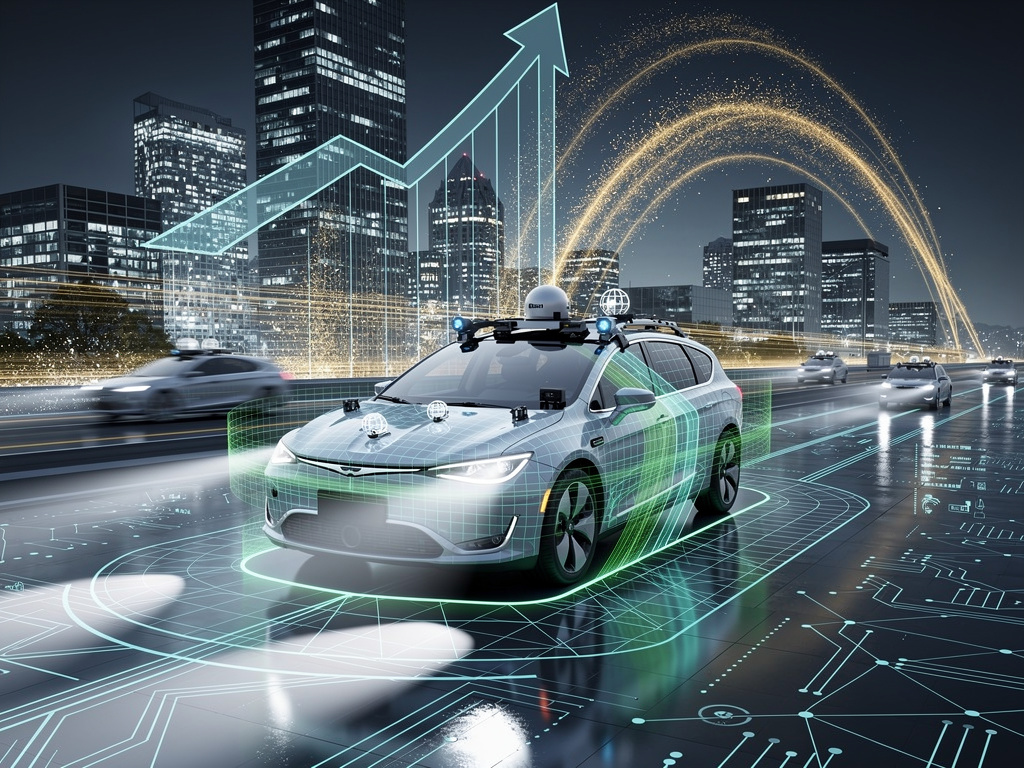
In what could mark one of the largest single funding rounds in autonomous vehicle history, Waymo is reportedly in advanced discussions to raise $16 billion, according to TechCrunch. The massive capital infusion would represent a watershed moment for Alphabet’s self-driving subsidiary, which has spent nearly two decades developing technology that promises to revolutionize transportation but has yet to achieve widespread commercial viability.
The funding round, if completed, would dwarf previous investments in the autonomous vehicle sector and signal renewed confidence in a technology that has faced repeated setbacks and skepticism. For Waymo, which currently operates robotaxi services in limited markets including Phoenix, San Francisco, and Los Angeles, the capital would provide resources to accelerate expansion plans and compete against well-funded rivals like Cruise, Zoox, and Tesla. The timing of this fundraising effort comes as the autonomous vehicle industry stands at a critical juncture, with companies racing to prove their business models can generate sustainable returns after years of development costs.
Sources familiar with the matter indicate that the funding would come from a combination of external investors and additional capital from parent company Alphabet, though the exact composition remains unclear. The $16 billion figure represents approximately double Waymo’s previous valuation estimates and suggests that investors see significant potential in the company’s technology platform and market position. This capital raise also reflects the enormous financial requirements of scaling autonomous vehicle operations, which demand substantial investments in vehicle fleets, sensor technology, computational infrastructure, and regulatory compliance.
The Strategic Imperative Behind Massive Capital Requirements
Waymo’s pursuit of such substantial funding underscores the capital-intensive nature of autonomous vehicle deployment at scale. Unlike traditional software companies that can expand with relatively modest incremental costs, autonomous vehicle operators must invest heavily in physical assets, including modified vehicles equipped with expensive sensor arrays, maintenance facilities, and charging or fueling infrastructure. Industry analysts estimate that achieving profitability in robotaxi operations requires deploying thousands of vehicles across multiple markets, each representing hundreds of thousands of dollars in upfront costs.
The company has made notable progress in recent years, expanding its operational footprint and increasing ride volumes. Waymo now provides over 100,000 paid rides weekly across its service areas, demonstrating growing consumer acceptance of driverless technology. However, this scale remains far below what would be necessary to generate positive cash flow when accounting for the company’s substantial research and development expenses, operational costs, and ongoing technology refinement. The new funding would theoretically provide runway to reach critical mass in key markets while continuing to advance the underlying technology.
Competitive Pressures and Market Dynamics Intensifying
The autonomous vehicle sector has experienced significant consolidation and strategic shifts in recent years, with several high-profile companies scaling back ambitions or exiting the market entirely. Ford and Volkswagen shuttered their joint venture Argo AI in 2022, while Cruise faced operational suspensions following safety incidents in San Francisco. These setbacks have created an opening for Waymo to establish itself as the dominant player in commercial autonomous ride-hailing, but only if it can execute on expansion plans before competitors regroup or new entrants emerge.
Tesla’s approach to autonomous driving represents a fundamentally different competitive threat, relying on camera-based systems and a vast fleet of customer vehicles to gather training data rather than purpose-built robotaxis with expensive lidar sensors. While Tesla’s Full Self-Driving system remains classified as a driver assistance feature requiring human supervision, CEO Elon Musk has repeatedly promised imminent robotaxi capabilities. Chinese companies including Baidu’s Apollo Go and Pony.ai have also made substantial progress, operating autonomous services in multiple Chinese cities and potentially positioning themselves to expand internationally.
Technology Maturation and Operational Challenges
Despite Waymo’s technical leadership in many aspects of autonomous driving, significant challenges remain before the technology can achieve true ubiquity. The company’s vehicles excel in well-mapped urban environments with favorable weather conditions but still struggle with edge cases, construction zones, and adverse weather that human drivers navigate routinely. Each operational design domain requires extensive mapping, testing, and validation before launch, limiting the speed at which Waymo can expand geographically.
The safety record of autonomous vehicles has come under increased scrutiny from regulators and the public following several high-profile incidents involving competitors. Waymo has generally maintained a strong safety profile, with the company reporting that its vehicles are involved in significantly fewer injury-causing crashes than human drivers. However, any serious incident could trigger regulatory restrictions or erode public trust, potentially derailing expansion plans regardless of available capital. The company must balance aggressive growth with maintaining the conservative operational approach that has preserved its safety record.
Economic Model and Path to Profitability
The fundamental economics of autonomous ride-hailing remain unproven at scale, with questions persisting about whether the elimination of driver costs can offset the substantial technology and operational expenses. Waymo charges fares comparable to traditional ride-hailing services, but without the need to share revenue with human drivers. In theory, this should create attractive unit economics once fixed costs are amortized across sufficient ride volume. However, the reality involves significant expenses for vehicle maintenance, remote assistance operators, cleaning, insurance, and ongoing technology development.
Industry observers note that the $16 billion funding round suggests investors believe Waymo can achieve profitability within a reasonable timeframe, likely five to seven years. This timeline would require the company to expand from its current three markets to perhaps a dozen or more major metropolitan areas, growing its fleet from hundreds to thousands of vehicles. The capital would need to fund not only this expansion but also continued research and development to improve the technology’s capabilities and reduce per-vehicle costs through economies of scale and technological advancement.
Regulatory Environment and Policy Considerations
The regulatory framework governing autonomous vehicles remains fragmented and evolving, with different states and municipalities adopting varying approaches to permitting and oversight. California, where Waymo conducts significant operations, has implemented relatively comprehensive regulations but has also shown willingness to suspend operations following safety concerns, as demonstrated by the Cruise suspension. Federal regulations remain limited, with the National Highway Traffic Safety Administration providing guidance but leaving primary regulatory authority to states.
Waymo’s substantial funding could provide resources to navigate this complex regulatory environment, including investments in government relations, safety validation, and compliance infrastructure. The company has generally maintained positive relationships with regulators through transparent reporting and conservative operational practices. However, rapid expansion into new jurisdictions will require obtaining permits, conducting pilot programs, and building relationships with local officials who may face constituent concerns about driverless vehicles operating on public roads.
Implications for the Broader Autonomous Vehicle Industry
The magnitude of Waymo’s reported funding round sends a powerful signal about investor confidence in autonomous vehicle technology despite years of delayed timelines and unmet promises. If completed, the investment would likely trigger renewed interest in the sector, potentially benefiting other companies through improved access to capital and increased public attention. However, it could also raise the stakes for competitors who may struggle to match Waymo’s resources and technological lead.
The funding may also accelerate consolidation in the autonomous vehicle sector, as companies with less capital or inferior technology face increasing pressure to merge, sell, or exit the market. Waymo’s scale advantages in data collection, technology development, and operational expertise become more formidable with each additional billion dollars of investment. Smaller players may find it increasingly difficult to compete unless they can identify distinct market niches or technological approaches that differentiate them from Waymo’s comprehensive platform.
For Alphabet, the decision to support such a substantial funding round represents both an endorsement of Waymo’s progress and an acknowledgment of the extended timeline required to achieve returns on its autonomous vehicle investment. The parent company has invested billions in Waymo since acquiring the project from Google’s research division in 2016, with limited financial returns to date. The new funding suggests that Alphabet’s leadership believes the technology is approaching commercial viability and that additional capital can accelerate the path to profitability rather than simply extending an indefinite research project.
As the autonomous vehicle industry enters what may prove to be a decisive phase, Waymo’s reported $16 billion funding round represents a substantial bet that the technology is ready to transition from limited pilot programs to genuine commercial scale. The coming years will reveal whether this confidence is justified or whether autonomous vehicles require even more time, capital, and technological breakthroughs before achieving the transformative impact that has been promised for more than a decade. For now, the funding round positions Waymo as the clear leader in a race that remains far from finished.


 WebProNews is an iEntry Publication