
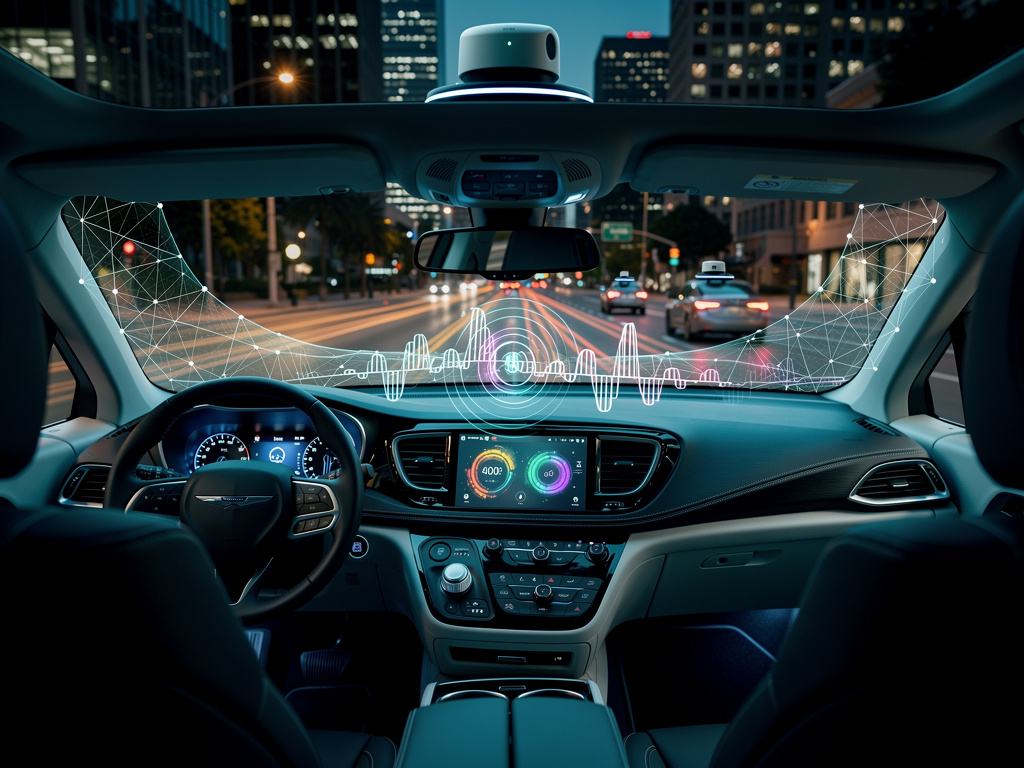
Gemini’s Quiet Ride: Waymo’s Bold Bet on AI to Humanize Driverless Cars
In the rapidly evolving world of autonomous transportation, Waymo has quietly begun testing a new in-car AI assistant powered by Google’s Gemini model, marking a significant step toward making robotaxi experiences more interactive and user-friendly. This development, uncovered through a detailed examination of a 1,200-line system prompt, allows passengers to engage in conversations, query general knowledge, and even control certain vehicle features like climate settings or music playback. According to reports from TechCrunch, the assistant is designed to enhance the ride without distracting from the core autonomous driving technology, positioning Waymo at the forefront of integrating advanced AI into everyday mobility.
The integration comes at a pivotal time for Waymo, a subsidiary of Alphabet Inc., as it expands its fleet and services across multiple cities. Riders in select robotaxis can now summon the AI via voice commands, asking for trivia, local recommendations, or simple adjustments to the cabin environment. This isn’t just about convenience; it’s a strategic move to address one of the biggest hurdles in autonomous vehicle adoption: the eerie silence of a driverless car. By infusing Gemini’s natural language processing capabilities, Waymo aims to create a companion-like experience that could boost user satisfaction and retention in a competitive market.
Industry observers note that this testing phase is part of a broader push to leverage AI beyond navigation. Gemini, known for its multimodal abilities handling text, images, and more, could eventually interpret passenger gestures or integrate with external data sources for real-time updates. However, the rollout is cautious, with the AI restricted from accessing sensitive vehicle controls or making decisions that could impact safety, ensuring it complements rather than competes with Waymo’s core autonomous driving system.
From Blackouts to Breakthroughs: Lessons in Resilience
Recent events in San Francisco have underscored the challenges Waymo faces in real-world deployment. On December 20, 2025, a major power outage caused by a PG&E substation fire plunged parts of the city into darkness, stalling traffic lights and disrupting autonomous vehicles. Waymo’s robotaxis, among others, encountered difficulties navigating the chaos, leading to a temporary pause in services to prioritize safety and emergency access. As detailed in a postmortem from Gizmodo, the incident highlighted the limitations of relying solely on onboard sensors without human remote intervention, which Waymo has deliberately avoided to maintain full autonomy.
Despite the setbacks, Waymo reported that its vehicles successfully navigated over 7,000 dark stoplights during the outage, showcasing the robustness of its AI-driven perception systems. The company quickly implemented fleet-wide updates to improve handling of similar scenarios, including better coordination with local authorities like San Francisco’s mayor’s office. This resilience is crucial as Waymo scales up, with posts on X from the company’s official account emphasizing ongoing improvements in AI strategies to manage unexpected urban disruptions.
The blackout also sparked discussions about the integration of assistants like Gemini in crisis situations. Could an in-car AI provide real-time guidance to passengers during outages, such as suggesting alternative routes or explaining delays? While current testing focuses on benign interactions, experts speculate that future iterations might evolve to include emergency protocols, drawing on Gemini’s ability to process vast datasets for predictive insights.
Expansion Horizons: Waymo’s Growing Footprint
Waymo’s ambitions extend far beyond San Francisco’s gridlocked streets. In 2025, the company has aggressively expanded its robotaxi operations, now offering over 250,000 fully autonomous paid rides weekly across cities like Phoenix, Los Angeles, Austin, and Atlanta. A report from CNBC highlights how Waymo leads the pack in this growth, outpacing competitors like Zoox and Tesla, which are still ramping up supervised autonomous services.
This expansion includes innovative features like airport shuttles, with Waymo boasting over 500,000 rides to and from Phoenix Sky Harbor and San Jose International airports. Social media buzz on X reflects rider enthusiasm, with users praising the seamless integration of autonomous tech in high-traffic areas. Yet, the addition of Gemini raises questions about personalization—could the AI learn from rider preferences across trips, suggesting playlists or routes based on past behavior?
Competitive pressures are mounting. Uber and Lyft are set to test robotaxis in London following Waymo’s lead, as noted in PCMag. Waymo’s AI assistant could serve as a differentiator, offering a more engaging experience than rivals’ offerings. Internally, Waymo’s AI team, as shared in their recent blog posts, is focusing on generalizable models that adapt to diverse environments, from bustling freeways to quiet suburbs.
AI at the Wheel: Technical Underpinnings
Diving deeper into the technology, Gemini’s role in Waymo’s ecosystem builds on years of AI advancements. The model’s system prompt, as analyzed in the TechCrunch piece, outlines capabilities for handling queries ranging from historical facts to light-hearted banter, all while adhering to strict safety guidelines. This is no small feat; integrating a large language model into a moving vehicle requires low-latency responses and robust error-handling to prevent any interference with driving decisions.
Waymo’s data from over 33 million autonomous miles, including superior safety records—up to 3.5 times better at avoiding injury-causing crashes than human drivers—provides a rich foundation for training such AI. Posts on X from Waymo underscore this, with videos demonstrating smooth merges onto freeways and adherence to traffic signals, all powered by advanced intelligence.
However, challenges remain. Privacy concerns loom large: How much data does Gemini collect during interactions? Waymo assures that conversations are anonymized and not used for training without consent, but industry insiders worry about potential vulnerabilities in cloud-connected systems. Moreover, the AI’s limitations in understanding nuanced contexts, like regional dialects or ambiguous requests, are areas for refinement.
Regulatory and Ethical Crossroads
As Waymo pushes boundaries, regulatory scrutiny intensifies. Global deployments of robotaxis, as outlined in a Reuters factbox, show a patchwork of approvals, with cities like San Francisco demanding transparency on AI integrations. The recent blackout prompted calls for better infrastructure coordination, potentially influencing how assistants like Gemini are certified for public use.
Ethically, the humanization of robotaxis through AI raises philosophical questions. Does a chatty assistant alleviate or exacerbate the uncanny valley effect of driverless travel? Rider feedback on X suggests mixed sentiments—some appreciate the companionship, while others prefer silence. Waymo’s strategy seems to balance this by making the AI optional, activated only on request.
Looking ahead, partnerships could amplify Gemini’s impact. Collaborations with ride-hailing giants like Uber, already facilitating Waymo rides in Atlanta, might extend to AI-enhanced features, blending autonomous driving with personalized services.
Pioneering the Passenger Experience
The true test of Gemini’s integration will be in user adoption. Early testers report positive experiences, with the AI handling queries efficiently and adding a layer of entertainment to commutes. For instance, asking for restaurant recommendations en route has become a highlight, drawing on real-time data without compromising the vehicle’s focus on the road.
Comparisons to other AI assistants in vehicles, like those in Tesla’s Full Self-Driving suite, reveal Waymo’s edge in full autonomy. While Tesla relies on supervision, Waymo’s driverless model allows Gemini to shine as a pure companion, free from human oversight distractions.
Yet, scalability is key. As Waymo eyes more cities in 2026, ensuring Gemini’s consistency across diverse locales— from Atlanta’s sprawl to London’s congestion—will require ongoing iterations. Industry reports suggest this could set a standard for AI in mobility, influencing everything from public transit to delivery services.
Future Trajectories: Beyond the Horizon
Waymo’s postmortem on the San Francisco blackout, as covered by Gizmodo, emphasizes learning from anomalies to build more resilient systems. This mindset extends to AI development, where Gemini could evolve to predict and mitigate issues like traffic disruptions or passenger discomfort.
Global trends indicate a robotaxi boom, with Reuters noting deployments worldwide betting on reshaping urban transport. Waymo’s lead, bolstered by Gemini, positions it to capture market share, potentially unlocking new revenue through premium AI features.
In conversations with insiders, the consensus is optimistic: This isn’t just about tech; it’s about redefining mobility. As one executive put it, “Gemini turns a ride into a dialogue,” potentially normalizing autonomous travel for skeptics.
Sustaining Momentum in Autonomy
Safety data continues to bolster Waymo’s case. With millions of miles logged, the company’s AI prowess in avoiding crashes outstrips human benchmarks, providing a safety net for innovations like in-car assistants.
Social media sentiment on X reflects growing trust, with users sharing stories of reliable rides, even in challenging conditions. This organic endorsement could accelerate adoption as Waymo integrates feedback into Gemini’s updates.
Ultimately, Waymo’s testing of Gemini signals a maturation in autonomous tech, blending cutting-edge AI with practical mobility solutions. As the company navigates expansions and hurdles, this initiative could redefine what it means to hail a ride in the age of intelligent machines.
Charting Uncharted Roads
The broader implications for the industry are profound. Competitors like Zoox and Tesla, as per CNBC, are watching closely, potentially accelerating their own AI integrations to keep pace.
Regulatory bodies may soon mandate AI transparency, especially post-incidents like the blackout detailed in AI CERTs News from aicerts.ai. Waymo’s proactive updates demonstrate a commitment to compliance and improvement.
For passengers, the promise is a seamless, engaging journey. As Gemini evolves, it might handle complex tasks like coordinating group rides or integrating with smart home devices, further embedding AI into daily life.
Innovators at the Intersection
Waymo’s AI team blog, referenced in X posts, reveals a strategy focused on momentum, safely scaling services faster than ever. This includes refining models like Gemini for edge cases, ensuring reliability in varied scenarios.
The assistant’s potential in education or entertainment—quizzing riders on trivia or narrating city history—adds value, turning commutes into productive time.
As 2026 approaches, with more airports and cities on the horizon, Waymo’s fusion of Gemini and autonomy could herald a new era, where cars not only drive themselves but converse intelligently too.


 WebProNews is an iEntry Publication