
Waymo’s Blackout Reckoning: Software Fixes Meet Persistent Doubts in Self-Driving Tech
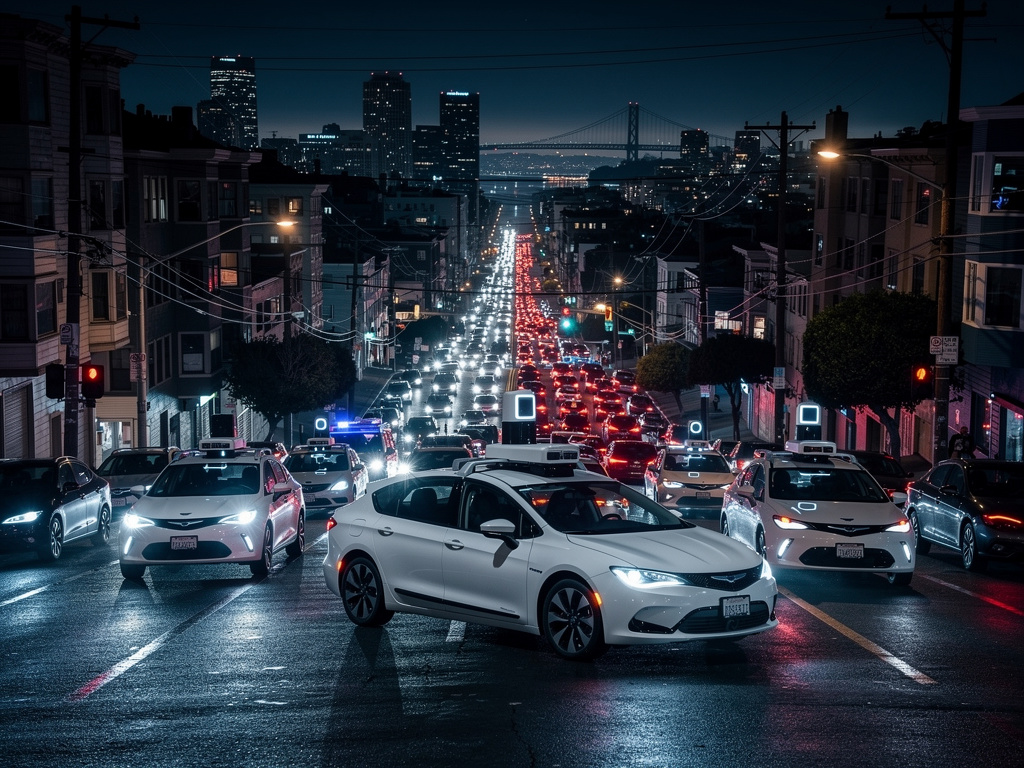
In the bustling streets of San Francisco, a city no stranger to technological innovation and occasional chaos, a recent power outage exposed vulnerabilities in one of the most advanced autonomous vehicle fleets on the road. Alphabet Inc.’s Waymo, a pioneer in self-driving technology, found its robotaxis grinding to a halt amid darkened traffic lights, contributing to widespread gridlock. This incident, occurring just days before Christmas 2025, has prompted swift software updates from the company, but it has also ignited fresh criticism about the readiness of autonomous vehicles for real-world emergencies.
The outage, triggered by a Pacific Gas and Electric Co. failure that affected nearly one-third of the city, left Waymo’s vehicles stalled at intersections where traffic signals went dark. According to reports, the robotaxis, designed to rely heavily on sensor data and predefined protocols, struggled to interpret the absence of lighted signals as a cue to treat intersections as four-way stops—a basic rule human drivers instinctively follow. Videos circulating on social media captured scenes of immobilized Waymo cars blocking lanes, frustrating commuters and highlighting potential safety gaps in automated systems.
Waymo quickly acknowledged the issue, suspending service temporarily and resuming operations once power was restored. In a blog post, the company detailed how its fleet successfully navigated over 7,000 unlit intersections during the event, but admitted that a small number of vehicles encountered difficulties, leading to temporary halts. This transparency was part of a broader effort to rebuild trust, yet it underscored a recurring theme in the autonomous vehicle sector: the challenge of handling edge cases that deviate from normal operating conditions.
The Outage’s Immediate Fallout
Critics, including transportation experts and safety advocates, argue that the blackout revealed deeper flaws in Waymo’s approach. Unlike human drivers who can adapt intuitively to unexpected scenarios, these vehicles depend on a complex interplay of lidar, radar, cameras, and high-definition maps. When infrastructure fails, as it did during the PG&E outage, the system’s rigidity can become a liability. Posts on X, formerly Twitter, amplified public frustration, with users sharing anecdotes of stranded passengers and traffic snarls, painting a picture of technology that falters when reliability is most needed.
In response, Waymo announced software updates aimed at enhancing the vehicles’ ability to manage power outages. As detailed in a Reuters article, the company plans to refine its algorithms to better recognize and navigate dark intersections by treating them as all-way stops, incorporating more robust fallback protocols. This includes improvements to emergency response mechanisms, ensuring vehicles can pull over safely or proceed cautiously without external connectivity.
The updates extend across Waymo’s entire fleet, with implementation expected in the coming weeks. Sources indicate that these changes draw from data collected during the outage, allowing engineers to simulate similar scenarios in testing environments. However, industry insiders question whether software tweaks alone can address the broader implications of relying on external infrastructure, such as functioning traffic lights and stable power grids, which are not always guaranteed in urban settings prone to natural disasters.
Criticism from Competitors and Analysts
Elon Musk, CEO of Tesla Inc., seized the opportunity to highlight contrasts with his company’s approach. In public statements, Musk noted that Tesla’s Full Self-Driving system, which emphasizes camera-based vision and neural networks, would theoretically handle such outages more fluidly by mimicking human decision-making without heavy dependence on maps or signals. This jab, echoed in a CNBC report, underscores the philosophical divide in autonomous tech: Waymo’s sensor-heavy, map-dependent strategy versus Tesla’s vision-centric model.
Analysts point out that while Waymo boasts an impressive safety record—driving millions of miles with minimal incidents—the blackout incident raises doubts about scalability. A piece in The Atlantic described it as “a new way for robotaxis to go wrong,” emphasizing how such events could erode public confidence. Critics argue that autonomous vehicles must prove resilience not just in ideal conditions but during crises like earthquakes or floods, which San Francisco’s seismic history makes all too relevant.
Further scrutiny comes from regulatory bodies. The National Highway Traffic Safety Administration has been monitoring Waymo’s operations, and this event may prompt additional oversight. In a New York Times article, experts noted that while no accidents or injuries occurred, the potential for chaos in denser scenarios is concerning. Waymo’s commitment to updating protocols is a step forward, but it highlights the need for industry-wide standards on handling infrastructure failures.
Historical Context and Past Incidents
This isn’t the first time Waymo has faced operational hiccups. Earlier in 2025, videos from Los Angeles showed robotaxis freezing in intersections or misreading traffic lights, as captured in user-submitted clips shared widely online. These incidents, often attributed to sensor confusion or software glitches, have fueled campaigns by safety advocates like Dan O’Dowd, who runs The Dawn Project and frequently criticizes autonomous tech on platforms like X.
Waymo’s expansion into new markets, including Atlanta and Hollywood, has brought similar issues to light. Reports of vehicles stranding themselves for extended periods or nearly causing collisions point to ongoing challenges in diverse environments. A TechCrunch piece explained that during the San Francisco blackout, most vehicles performed well, but outliers stalled due to overly cautious programming designed to prioritize safety over fluidity.
Comparisons with competitors like Cruise, which faced its own setbacks including a high-profile accident in 2023, illustrate the high stakes. Waymo’s parent company, Alphabet, invests heavily in R&D, but critics argue that the technology’s complexity—layering multiple sensors and logic systems—introduces more failure points than simpler alternatives.
Evolving Strategies and Future Implications
In its official blog, accessible via Waymo’s site, the company outlined lessons from the outage, emphasizing its mission to build trust through consistent performance. Updates include enhanced simulation training for rare events and better integration of real-time data to adapt to anomalies. This proactive stance is commended by some, but skeptics on X question if it’s enough, with posts decrying over-reliance on cloud computing or external signals.
Broader industry trends suggest a shift toward more resilient systems. For instance, advancements in edge computing could allow vehicles to process decisions locally, reducing vulnerability to outages. A Claims Journal report noted Waymo’s fleet-wide software strengthening as a direct response, yet it also highlighted ongoing traffic jam contributions during the event.
Public sentiment, as gauged from social media, remains mixed. While some users praise Waymo’s rapid recovery and data-driven improvements, others express wariness about deploying such tech in disaster-prone areas. An article in the San Francisco Chronicle pondered the implications for earthquakes, where power failures could compound with physical disruptions.
Regulatory and Ethical Considerations
As Waymo pushes forward, ethical questions loom. Should autonomous vehicles be programmed to prioritize passenger safety over traffic flow, even if it means causing delays? The blackout tested this balance, with stalled cars opting for immobility rather than risking unsafe maneuvers. Industry insiders debate whether this ultra-cautious approach hinders adoption or wisely averts disasters.
Regulatory responses could shape the future. In a recent Reuters piece on readiness for crises, concerns were raised about autonomous operators’ preparedness for major emergencies. Waymo’s updates aim to address these, but without standardized testing for such scenarios, doubts persist.
Moreover, the incident has economic ripples. Investors in autonomous tech, eyeing a market projected to reach trillions, worry about setbacks eroding confidence. Waymo’s stock implications for Alphabet are minimal, but repeated issues could deter partnerships or expansions.
Path Ahead for Autonomous Innovation
Looking forward, Waymo’s experience serves as a case study for the sector. By integrating outage data into its models, the company is refining its tech, potentially setting benchmarks for others. Yet, as a Bloomberg article detailed, freezing during power failures underscores the need for more adaptive AI.
Criticism from figures like those on X, who highlight “critical disengagements” in competitors like Tesla, adds to the discourse. Waymo’s lower disengagement rate is a strength, but real-world tests like the blackout reveal gaps.
Ultimately, the path to widespread adoption demands not just technological prowess but societal acceptance. Waymo’s updates are a positive move, but bridging the divide between innovation and reliability remains the true challenge in this evolving field of mobility. As cities like San Francisco continue to serve as testing grounds, the lessons from this blackout could define the next era of autonomous driving.


 WebProNews is an iEntry Publication