
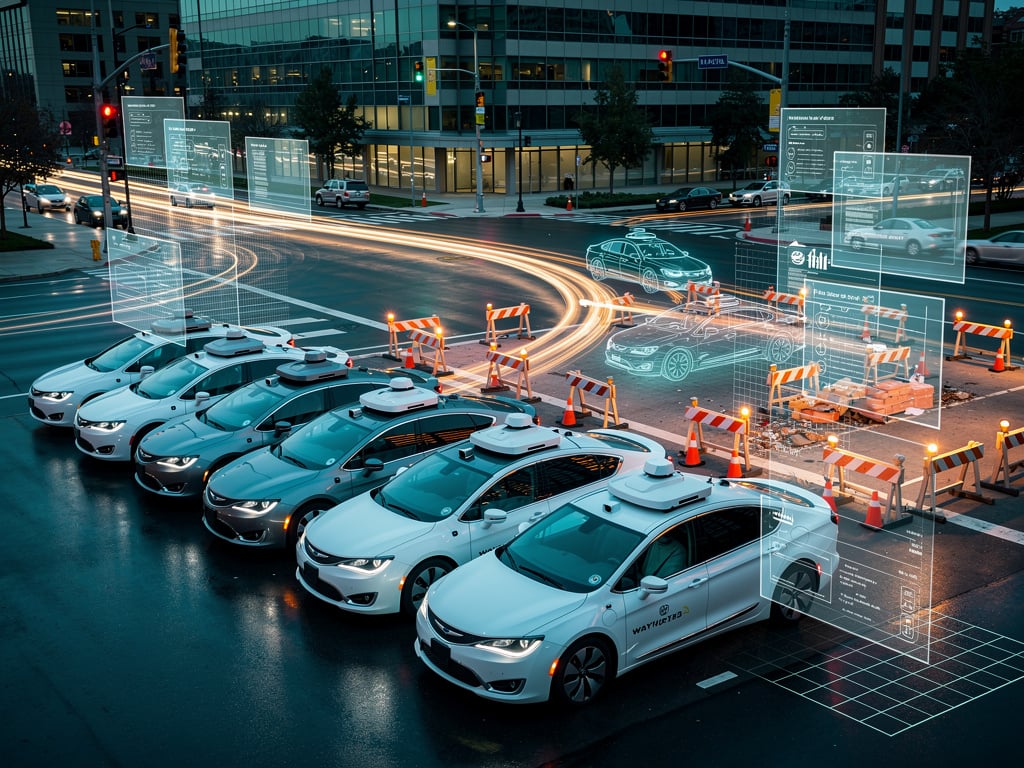
Waymo has issued its sixth recall this year, affecting roughly 3,800 of its self-driving vehicles after discovering a software issue that could cause the cars to behave unpredictably near construction zones. The company notified the National Highway Traffic Safety Administration of the voluntary recall on October 10, marking another chapter in the ongoing process of refining autonomous technology for real-world deployment.
According to a report from The Next Web, the problem stems from how the autonomous driving software interprets certain temporary traffic patterns found in work zones. In specific situations, the system might direct a vehicle to make an unexpected movement, such as drifting slightly outside its lane or hesitating longer than necessary when merging. While Waymo emphasized that no crashes or injuries have been linked to this defect, the company acted quickly to prevent any potential safety risks.
The recall involves a software update that Waymo began deploying over-the-air to its entire fleet in Phoenix, San Francisco, Los Angeles, and Austin. Because these vehicles operate without human drivers in many markets, the ability to push fixes remotely represents one of the distinct advantages of robotaxi operations compared with traditional car manufacturers. Owners of personally owned vehicles with similar hardware would typically need to visit a dealership, but Waymo’s cloud-connected fleet allows instantaneous distribution of corrected code.
This latest action follows five previous recalls earlier in the year, each addressing different aspects of the perception and decision-making systems. Previous updates corrected issues ranging from incorrect braking responses around emergency vehicles to occasional failures in recognizing certain road markings after heavy rain. The frequency of these recalls has drawn mixed reactions from industry observers. Some see the pattern as evidence of a transparent and safety-first approach, while others question whether the underlying technology has been sufficiently proven before expanding to thousands of vehicles across multiple cities.
Waymo, which operates under the corporate umbrella of Alphabet, maintains one of the largest autonomous vehicle fleets in commercial service. The company’s Jaguar I-PACE vehicles, equipped with multiple lidar sensors, radar, and high-resolution cameras, have collectively driven tens of millions of miles on public roads. In Phoenix, the service runs driverless 24 hours a day in most neighborhoods. San Francisco has seen similar expansion after state regulators granted permission for fully unsupervised operations. Los Angeles and Austin represent newer frontiers where the company continues to balance rapid scaling with careful risk management.
Construction zones present unique challenges for autonomous systems. Unlike standard roadways with consistent lane markings and predictable traffic flow, work areas often feature temporary signs, cones, barrels, irregular pavement edges, and flaggers directing traffic with hand signals. Human drivers adapt to these conditions through experience and intuition, but translating that flexibility into reliable software requires extensive training data and sophisticated scenario modeling. The latest bug apparently surfaced during routine analysis of logged driving data rather than through an actual incident, demonstrating how Waymo uses fleet-wide telemetry to identify edge cases before they become problems.
The software patch focuses on improving how the planning module weighs conflicting inputs from the perception system when it encounters non-standard road configurations. Engineers adjusted parameters that govern lane boundary estimation and added additional logic for recognizing common construction patterns such as shifted lanes or narrowed passages. The company also expanded its simulation testing to include thousands of additional synthetic work-zone scenarios to verify the changes.
Critics of the autonomous vehicle industry sometimes point to recalls as signs of fundamental immaturity in the technology. However, automotive safety experts note that traditional automakers issue recalls far more frequently than the public realizes. According to NHTSA data, millions of conventional vehicles are recalled annually in the United States for issues ranging from faulty airbags to problematic software in advanced driver assistance systems. The difference with companies like Waymo lies in the visibility and the fact that every update touches a fleet that operates without a human fallback in many cases.
Waymo’s approach to safety includes multiple layers of protection. In addition to the primary autonomous driving system, vehicles maintain a secondary monitoring framework that can intervene if the main stack produces commands outside predefined safety envelopes. Remote assistance centers also stand ready to provide guidance when vehicles encounter situations they cannot resolve independently, though the goal remains full independence. The company reports that its vehicles now require human intervention far less frequently than in previous years, with some metrics showing intervention rates dropping below once per several thousand miles in mature markets.
Public acceptance of robotaxis continues to grow even as technical hurdles remain. Rider surveys conducted by Waymo indicate high satisfaction rates once passengers complete their first few trips. The absence of a driver eliminates variables such as erratic braking or unwanted conversation, while the consistent and predictable nature of the autonomous system appeals to many users. Still, isolated incidents where vehicles have stopped unexpectedly or taken conservative routes through construction areas have fueled social media criticism and occasional regulatory scrutiny.
California’s Department of Motor Vehicles and Public Utilities Commission maintain strict oversight of autonomous vehicle testing and deployment. Companies must report every disengagement and collision, creating a public dataset that allows comparison between operators. Waymo has consistently ranked among the leaders in miles driven between interventions, yet the absolute number of reported events naturally increases as the fleet size and operational area expand. This latest recall will add to those statistics, even though it was initiated proactively.
The construction zone issue highlights a broader technical reality facing all autonomous vehicle developers. Static maps and fixed infrastructure work well for highway driving but prove insufficient for urban environments where road conditions change daily. Successful systems must combine high-definition maps with real-time sensor interpretation and machine learning models capable of generalizing from limited examples. Waymo has invested heavily in creating what it calls a “world model” that attempts to predict how other road users will behave in ambiguous situations, though perfect prediction remains impossible.
Competitors such as Cruise, Motional, and Zoox face similar challenges, though each has chosen different operational strategies. Cruise, once considered Waymo’s closest rival, significantly scaled back operations after a high-profile incident in San Francisco involving a pedestrian. The company continues testing but has shifted focus toward slower, more deliberate expansion. Motional has partnered with Hyundai and focuses on supplying technology to ride-hailing networks rather than operating its own fleet. Zoox, owned by Amazon, develops purpose-built vehicles without steering wheels and has concentrated testing primarily in Las Vegas and San Francisco.
As these companies push forward, regulatory frameworks struggle to keep pace. Federal guidelines remain advisory rather than mandatory, leaving much of the responsibility to state authorities with varying levels of expertise and resources. NHTSA has increased its attention to autonomous systems following several notable incidents across the industry, including high-speed crashes involving vehicles operating in automated modes. The agency’s investigators now regularly request detailed telemetry data when crashes occur, accelerating the feedback loop between real-world performance and safety improvements.
Waymo maintains that its safety record exceeds that of human drivers when measured by crashes per million miles. Independent analyses by insurance industry researchers have begun corroborating some of these claims, though long-term data across all conditions and locations remains limited. The company publishes quarterly safety reports that break down performance by city and time of day, offering more transparency than many traditional automakers provide about their advanced driver assistance features.
The latest recall, while representing a setback in public perception, actually demonstrates the advantage of software-defined vehicles. Rather than requiring physical modifications or lengthy shop visits, the entire fleet can receive improved instructions within hours of validation. This rapid iteration cycle allows continuous enhancement without disrupting service for long periods. Passengers might notice slightly different behavior after an update, but the core experience of summoning a car through an app and riding without a driver stays consistent.
Looking ahead, Waymo plans to continue expanding its service areas while simultaneously increasing vehicle production. The company recently announced plans to build thousands of additional I-PACE vehicles and is reportedly exploring partnerships with other manufacturers to diversify its hardware options. Each new market brings fresh construction patterns, weather conditions, and traffic cultures that must be incorporated into the training data.
The software fix for construction zones will likely be followed by additional refinements as the fleet accumulates more experience in these challenging environments. Engineers will analyze how the updated system performs across hundreds of thousands of additional miles, looking for any residual edge cases that might require further attention. This iterative process of identifying problems, developing solutions, testing extensively in both simulation and reality, and deploying updates has become the standard operating procedure for companies pursuing level 4 autonomy.
For riders in Phoenix, San Francisco, Los Angeles, and Austin, the recall should translate to slightly smoother encounters with road work. The vehicles may handle lane shifts and temporary signals with greater confidence and fewer hesitations. While the change might seem minor to individual passengers, it contributes to the gradual accumulation of reliability that will eventually make autonomous transportation as commonplace as elevators or air travel.
The incident also serves as a reminder that achieving safe autonomous operation requires constant vigilance. Even after accumulating millions of miles, new situations continue to emerge that reveal gaps in the system’s understanding. Companies that treat every logged mile as valuable training data and respond transparently to discovered weaknesses stand the best chance of building public trust over time.
Waymo’s willingness to issue a recall affecting its entire active fleet demonstrates commitment to safety that extends beyond marketing language. By addressing the construction zone behavior before any harm occurred, the company reinforces the idea that commercial robotaxi service must maintain standards at least as high as, and preferably higher than, those expected from human drivers. As the technology matures and fleets grow larger, this disciplined approach to incremental improvement will determine which operators ultimately succeed in transforming urban mobility. The path forward involves continued data collection, rapid software updates, and honest communication with regulators and the public about both capabilities and limitations.


 WebProNews is an iEntry Publication