
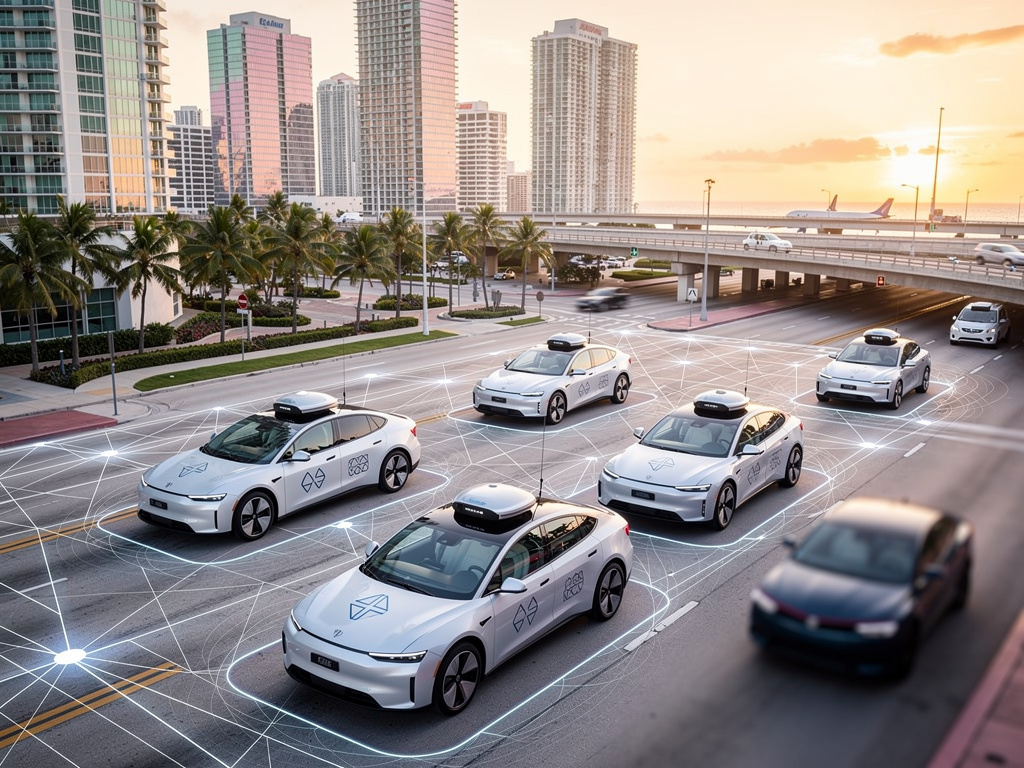
Waymo’s Miami Debut Signals Accelerated Push in Autonomous Mobility
Waymo, the autonomous vehicle unit of Alphabet Inc., has officially rolled out its robotaxi service in Miami, marking a significant milestone in the company’s expansion strategy across the United States. The launch, which began welcoming public riders on January 22, 2026, positions Miami as the sixth major market for Waymo’s fully driverless ride-hailing operations. This move comes amid intensifying competition in the self-driving technology sector, where Waymo aims to solidify its dominance by scaling operations rapidly. According to reports, the service initially covers a 60-square-mile area in Miami, with plans to extend to key locations like the airport in the near future.
The announcement has generated buzz in the tech and transportation industries, highlighting Waymo’s aggressive timeline for growth. In a post on X, Waymo confirmed the rollout, stating that riders can now experience fully autonomous trips with no human driver behind the wheel. This expansion follows successful deployments in cities such as Phoenix, San Francisco, Los Angeles, Austin, and Atlanta, demonstrating the company’s confidence in its proprietary “Waymo Driver” technology. Industry observers note that this launch is part of a broader plan to introduce services in around a dozen new cities throughout 2026, including Dallas, Houston, San Antonio, and Orlando.
Drawing from recent coverage, the Miami service leverages Waymo’s fleet of electric vehicles, emphasizing safety and accessibility. The company has partnered with fleet management firms like Moove to facilitate the rollout, ensuring a steady supply of vehicles equipped with advanced sensors, lidar, and AI-driven decision-making systems. Early user feedback on social platforms suggests high interest, with posts on X praising the seamless integration of the service into Miami’s vibrant urban environment.
Strategic Expansion Amid Competitive Pressures
Waymo’s entry into Miami is not just about adding another pin on the map; it’s a calculated step to extend its lead over rivals like Tesla, Cruise, and Zoox. As detailed in a CNBC article, Miami represents a strategic choice due to its dense population, tourism-driven economy, and challenging driving conditions, including heavy traffic and unpredictable weather. These factors provide a real-world testing ground for Waymo’s algorithms, which have been refined over millions of miles of operation in other markets.
Financially, the expansion aligns with Alphabet’s broader investment in autonomous tech. Waymo has reportedly achieved over 1 million rider-only miles weekly in its existing markets, a metric that underscores the scalability of its model. Insiders point out that the company’s focus on regulatory approvals has been key; in Miami, Waymo secured necessary permits from local and state authorities, building on precedents set in California and Arizona. This regulatory savvy has allowed Waymo to outpace competitors who have faced setbacks, such as Cruise’s operational pauses following safety incidents.
Moreover, the launch incorporates lessons from prior rollouts. For instance, Waymo’s freeway testing in San Francisco and Los Angeles has informed highway capabilities in Miami, where intercity travel is common. Posts from Waymo on X highlight ongoing employee testing at airports in Texas, signaling that airport integrations—crucial for business travelers—will soon follow in Florida. This phased approach minimizes risks while maximizing user adoption.
Technological Underpinnings and Safety Focus
At the core of Waymo’s Miami service is the fifth-generation Waymo Driver, a suite of hardware and software that enables vehicles to navigate complex scenarios without human intervention. This system includes redundant sensors for 360-degree perception, machine learning models trained on vast datasets, and predictive analytics for anticipating road behaviors. As reported in an Engadget piece, the technology has evolved to handle Miami-specific challenges like pedestrian-heavy zones in South Beach and construction-prone areas downtown.
Safety remains paramount, with Waymo boasting a track record that includes fewer incidents per mile than human-driven vehicles. The company conducts rigorous simulations and real-world validations before public launches, a process that has drawn praise from regulators. In Miami, initial rides are monitored remotely, allowing for quick interventions if needed, though the service is marketed as fully autonomous. This blend of innovation and caution appeals to industry insiders wary of the pitfalls seen in other autonomous ventures.
Beyond hardware, Waymo’s app ecosystem plays a vital role. Users can hail rides via a user-friendly interface, with features like real-time ETA predictions and accessibility options for those with disabilities. Integration with electric vehicle charging infrastructure ensures sustainability, aligning with Miami’s push toward greener transportation. Recent X posts from Waymo emphasize this eco-friendly angle, positioning the service as a complement to public transit rather than a replacement.
Market Implications and Economic Ripple Effects
The economic impact of Waymo’s Miami launch could be substantial, potentially reshaping local mobility patterns. Analysts estimate that robotaxi services could capture a significant share of the ride-hailing market, currently dominated by Uber and Lyft. By offering competitive pricing—often lower due to the absence of driver costs—Waymo aims to attract daily commuters and tourists alike. A Transport Topics report notes that the service’s airport testing phase could boost efficiency for air travel, reducing wait times and congestion at terminals.
For Alphabet, this expansion bolsters its portfolio diversification beyond search and advertising. Investors have responded positively, with stock movements reflecting confidence in Waymo’s path to profitability. The unit’s goal of 1 million weekly rides by the end of 2026, as mentioned in a TipRanks analysis, underscores ambitious scaling plans. This target involves not just geographic growth but also fleet expansion, with thousands of vehicles projected to hit the roads.
Locally, Miami’s economy stands to benefit from job creation in maintenance, operations, and tech support roles. Partnerships with entities like Moove could foster innovation hubs, drawing talent to South Florida. However, challenges loom, including public skepticism about autonomous vehicles and potential regulatory hurdles as services scale.
Rivalry Dynamics and Future Horizons
Competition in the autonomous space is heating up, with Tesla’s Full Self-Driving ambitions and Amazon-backed Zoox eyeing similar expansions. Waymo’s Miami move widens its gap, as highlighted in another TipRanks story, by demonstrating operational maturity. Unlike Tesla’s consumer-focused approach, Waymo’s commercial ride-hailing model prioritizes fleet efficiency and data accumulation for continuous improvement.
Looking ahead, Waymo’s roadmap includes deeper integrations with urban infrastructure, such as smart city initiatives in Miami. Collaborations with local governments could enable features like traffic signal communication, enhancing flow and reducing emissions. X updates from Waymo tease upcoming launches in Texas and Florida, suggesting a Sun Belt focus where weather conditions favor year-round testing.
Industry experts anticipate that successes in Miami will accelerate adoptions elsewhere, potentially influencing global standards for autonomous mobility. Yet, ethical considerations, including data privacy and equitable access, remain critical discussion points.
Innovation Ecosystem and Broader Trends
Waymo’s progress is intertwined with advancements in AI and sensor tech, fields where Alphabet holds significant advantages. The Miami launch incorporates updates from ongoing R&D, such as enhanced night vision and weather adaptability, crucial for Florida’s rainy seasons. Coverage in MarketScreener emphasizes how this bolsters Alphabet’s market position, with Waymo contributing to the parent company’s innovation narrative.
Partnerships extend beyond fleets; integrations with apps like Google Maps could streamline user experiences, creating a seamless ecosystem. This interconnectedness appeals to insiders tracking how tech giants are weaving autonomous services into daily life.
Social sentiment, gleaned from X, shows enthusiasm mixed with curiosity. Users are sharing ride experiences, praising the novelty while questioning long-term reliability. Waymo’s responsive social strategy helps build trust, addressing concerns in real-time.
Operational Challenges and Mitigation Strategies
Despite the hype, scaling in Miami presents hurdles like navigating diverse traffic mixes, from scooters to luxury cars. Waymo’s response involves hyper-local mapping and AI refinements, as detailed in a Yahoo Autos article. The company also invests in community outreach to educate residents on the technology.
From a business standpoint, monetization strategies include dynamic pricing and subscriptions, aimed at loyal users. This could evolve into B2B offerings, such as delivery services, expanding revenue streams.
As Waymo pushes boundaries, its Miami foray exemplifies the maturation of autonomous tech, setting benchmarks for safety, efficiency, and user satisfaction.
Global Context and Long-Term Vision
Placing Miami in a wider context, Waymo’s U.S.-centric growth contrasts with international efforts by companies like Baidu in China. Yet, lessons from Miami could inform future overseas expansions, where regulatory environments vary.
The launch also spotlights workforce shifts, with automation potentially displacing traditional drivers while creating tech jobs. Policymakers in Florida are monitoring these dynamics, balancing innovation with employment concerns.
Ultimately, Waymo’s Miami success could catalyze broader adoption, proving that driverless mobility is not just feasible but transformative for urban living.
Reflections on Industry Evolution
Reflecting on Waymo’s journey, from Google’s self-driving car project to a leading robotaxi provider, the Miami expansion encapsulates years of iteration. Insiders recall early tests in Phoenix, now scaled nationwide.
Current X buzz around the launch amplifies its visibility, with viral videos showcasing smooth rides through Miami’s streets.
This momentum positions Waymo as a frontrunner, driving the sector toward a future where autonomous vehicles redefine transportation norms. As more cities come online, the ripple effects will likely influence policy, investment, and daily commutes across the nation.


 WebProNews is an iEntry Publication