
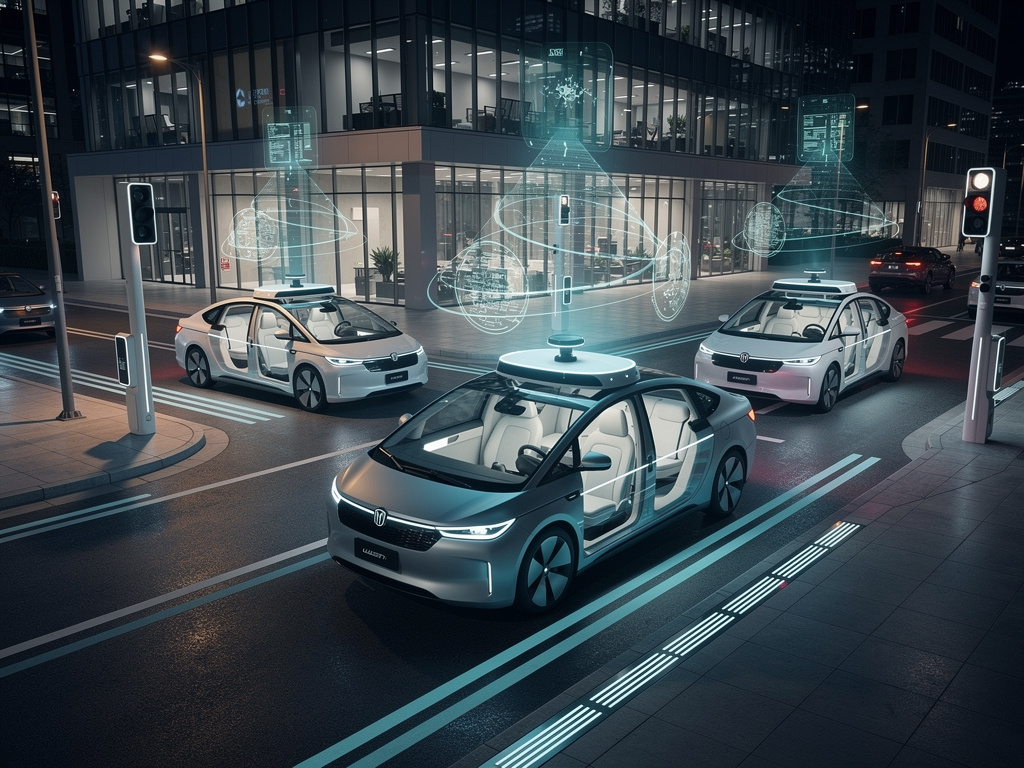
For years, the autonomous vehicle industry has operated with a safety net — human operators stationed behind the wheel or monitoring remotely, ready to intervene when algorithms falter. Now, Alphabet’s Waymo is making the boldest declaration yet that the training wheels are coming off. The company announced it will deploy its sixth-generation autonomous driving technology without any option for a human driver, eliminating the steering wheel and pedals entirely from its next fleet of robotaxis. It is a move that signals not just technological confidence but a fundamental restructuring of the economics of self-driving transportation.
The announcement, first reported by CNET, marks a pivotal moment in Waymo’s two-decade journey from a secretive Google research project to the operator of the largest commercial robotaxi service in the United States. The company currently provides over 200,000 paid rides per week across San Francisco, Phoenix, Los Angeles, and Austin, but every one of those trips takes place in a vehicle that still has a steering wheel and pedals — a vestige of the human-driven era that Waymo now intends to leave behind.
A New Vehicle Built From the Ground Up for Full Autonomy
Waymo’s sixth-generation system, known internally as the next evolution of the Waymo Driver, will be integrated into a purpose-built vehicle developed in partnership with Chinese automotive giant Geely. Unlike the current fleet of modified Jaguar I-PACE SUVs, the new vehicle will be designed from the outset without traditional driver controls. There will be no steering wheel, no brake pedal, no accelerator — just a cabin optimized for passengers. According to CNET, this represents Waymo’s commitment to what the company calls “fully autonomous operation,” a term that distinguishes it from the semi-autonomous systems offered by competitors like Tesla, which still require human oversight.
The partnership with Geely is itself noteworthy. Geely, which owns Volvo Cars and Polestar, has become one of the world’s most prolific automotive conglomerates. The collaboration suggests Waymo is seeking a manufacturing partner with the scale and engineering chops to produce purpose-built autonomous vehicles at volumes that could meaningfully reduce per-unit costs — a critical factor in making robotaxi services economically viable without perpetual subsidies from Alphabet’s deep pockets.
The Sensor Suite Gets Smarter and Cheaper
Central to the sixth-generation announcement is a dramatically reworked sensor array. Waymo has long relied on a combination of lidar, cameras, and radar to give its vehicles a 360-degree understanding of their surroundings. The new generation reportedly features a more tightly integrated sensor suite that reduces the number of individual components while improving overall perception capability. Waymo has indicated that the cost of its sensor package has dropped significantly with each generation, and the sixth generation continues that trajectory.
This cost reduction matters enormously. One of the persistent criticisms of Waymo’s approach — particularly from Tesla CEO Elon Musk, who has dismissed lidar as a “crutch” — has been that the expense of lidar-equipped sensor arrays makes the economics of robotaxi operations untenable at scale. Waymo’s counter-argument, reinforced by this latest generation, is that lidar costs are falling rapidly and that the safety advantages of a multi-sensor approach justify the investment. The company points to its safety record: Waymo vehicles have driven tens of millions of fully autonomous miles with a crash rate significantly below the human average, according to data the company has published in partnership with independent researchers.
Regulatory Hurdles and the Path to Deployment
Removing the steering wheel and pedals from a commercial vehicle is not merely an engineering decision — it is a regulatory one. Under current federal motor vehicle safety standards, cars sold in the United States are required to have certain driver controls. However, the National Highway Traffic Safety Administration has been working on updated rules that would accommodate vehicles designed for fully autonomous operation. Waymo’s announcement suggests the company is confident that regulatory frameworks will evolve in time for its sixth-generation deployment, which is expected to begin in the coming years.
Several states have already created permitting pathways for driverless vehicles without traditional controls. California, Arizona, and Texas — all states where Waymo currently operates — have been among the most progressive in establishing regulatory frameworks for autonomous vehicles. But federal standards remain the key bottleneck for large-scale deployment. The autonomous vehicle industry has lobbied Congress for years to pass legislation that would create a clear national framework, but those efforts have repeatedly stalled amid safety concerns and political gridlock.
The Competitive Pressure Driving Waymo’s Ambitions
Waymo’s aggressive timeline is not happening in a vacuum. The competitive environment for autonomous vehicles has intensified dramatically in 2025. Tesla has announced plans to launch its own robotaxi service, and while its approach relies on cameras alone rather than the multi-sensor fusion Waymo employs, the sheer scale of Tesla’s fleet and its ability to collect real-world driving data from millions of vehicles gives it a formidable advantage in certain respects. Meanwhile, Amazon-backed Zoox has been testing its own purpose-built, bidirectional robotaxi on public roads, and Chinese companies like Baidu’s Apollo Go and Pony.ai are scaling rapidly in their home market.
Cruise, the General Motors-backed robotaxi venture that was once Waymo’s closest domestic competitor, has effectively exited the space after a series of safety incidents in 2023 and 2024 led to the suspension of its permits and ultimately GM’s decision to wind down the operation. Cruise’s implosion served as a cautionary tale for the industry but also removed a major competitor from Waymo’s path, giving the Alphabet subsidiary a wider berth to establish market dominance in the United States.
Economics of the Driverless Future
The financial implications of removing human drivers — and now even the hardware that accommodates them — are substantial. Labor costs represent the single largest expense in traditional ride-hailing and taxi operations. By eliminating not just the driver but the very possibility of a driver, Waymo is signaling that it sees a future where the cost per mile of a robotaxi ride drops below that of personal car ownership. This has long been the holy grail of the autonomous vehicle industry: making it cheaper and more convenient to summon a self-driving car than to own, insure, fuel, and maintain a personal vehicle.
Alphabet has invested billions of dollars in Waymo over the years, and the unit has yet to turn a profit. But the trajectory of the business is encouraging to investors. Waymo’s ride volume has grown rapidly — the company reported that weekly paid trips roughly doubled over the course of 2024 — and the expansion into new cities continues. The sixth-generation technology, with its lower sensor costs and purpose-built vehicle platform, could be the inflection point where unit economics begin to work in Waymo’s favor.
Safety Questions That Won’t Go Away
For all the technological optimism, the decision to remove human controls entirely raises profound safety questions. What happens when the autonomous system encounters a scenario it cannot handle? Current Waymo vehicles can be manually driven by a technician in certain situations — during maintenance, for example, or to navigate unusual circumstances. A vehicle without a steering wheel eliminates that option entirely, placing total reliance on the autonomous system and remote support capabilities.
Waymo has built out a sophisticated remote assistance infrastructure that allows human operators to provide guidance to vehicles that encounter confusing situations — a blocked road, an ambiguous traffic signal, or an unusual construction zone. The company maintains that remote assistance, combined with the vehicle’s ability to pull over and stop safely in any situation it cannot resolve, provides an adequate safety margin. Critics, including some safety advocates and transportation researchers, argue that removing all manual controls is premature and that edge cases in autonomous driving remain too unpredictable for full reliance on software.
What the Sixth Generation Means for the Broader Industry
Waymo’s move toward a fully autonomous, purpose-built vehicle is likely to have ripple effects across the transportation sector. If the sixth-generation deployment succeeds, it will validate the thesis that autonomous vehicles can operate safely and economically without any human fallback at the vehicle level. That would accelerate investment in autonomous technology across trucking, delivery, and public transit — sectors where labor costs are similarly significant and where autonomous solutions are already being tested.
It would also reshape the auto industry itself. If robotaxi services become ubiquitous and affordable, personal vehicle ownership could decline in urban areas, a trend that would have enormous implications for automakers, dealerships, insurance companies, and the vast ecosystem of businesses that depend on the current model of individual car ownership. Waymo’s sixth generation is, in this sense, not just a new product — it is a bet on an entirely different model of mobility, one where the car you ride in is not yours, has no driver, and was never designed for one.
As CNET noted, Waymo’s announcement represents the company’s clearest statement yet that the future of transportation will not include a steering wheel. Whether the rest of the industry — and the regulators, insurers, and consumers who must embrace it — are ready for that future remains the defining question of the autonomous vehicle era.


 WebProNews is an iEntry Publication