
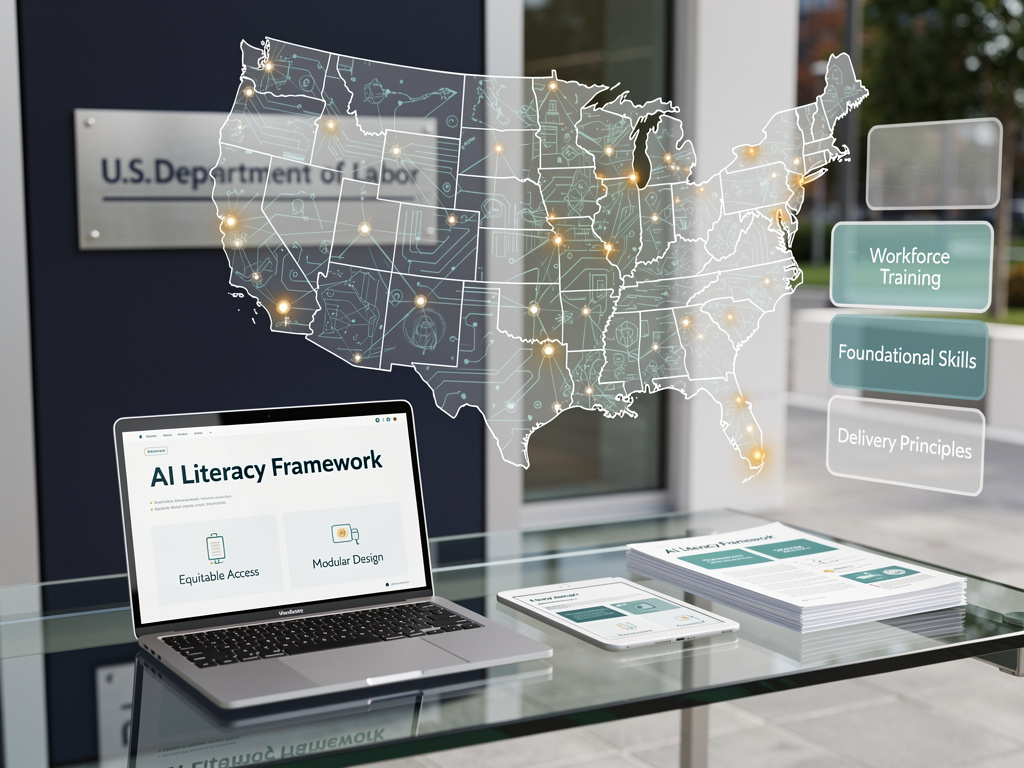
The U.S. Department of Labor has fired a starting gun in what may become the most consequential workforce development initiative since the GI Bill — a comprehensive Artificial Intelligence Literacy Framework designed to serve as a national blueprint for preparing American workers, employers, and educators for an economy increasingly shaped by machine intelligence.
Released on February 13, 2025, by the Department’s Employment and Training Administration (ETA), the framework does not mandate specific curricula or impose regulatory requirements. Instead, it offers a structured set of foundational content areas and delivery principles intended to guide states, local workforce boards, educational institutions, and private-sector training providers as they build AI literacy programs from the ground up. The timing is deliberate: as generative AI tools proliferate across virtually every sector — from healthcare and finance to manufacturing and retail — federal officials are signaling that AI competency is no longer a niche skill but a baseline requirement for economic participation.
A Federal Framework Without Federal Mandates
According to the U.S. Department of Labor’s official announcement, the AI Literacy Framework is built around several foundational content areas that collectively define what it means to be “AI literate” in the modern economy. These include understanding what AI is and how it works at a conceptual level, recognizing AI applications in workplace settings, grasping the ethical and societal implications of AI deployment, and developing practical skills for interacting with AI-powered tools and systems.
Critically, the framework is designed to be modular and adaptable. Rather than prescribing a one-size-fits-all curriculum, the Department has outlined delivery principles that emphasize accessibility, equity, and scalability. The intent is to ensure that AI literacy training reaches not only white-collar knowledge workers in coastal tech hubs, but also frontline workers in rural communities, older Americans re-entering the job market, and individuals with limited prior exposure to digital technologies. Acting Secretary of Labor Julie Su has framed the initiative as essential to ensuring that the benefits of AI are broadly shared rather than concentrated among a narrow technical elite.
Why the Framework Matters Now
The release comes at a moment of extraordinary urgency. A January 2025 report from the McKinsey Global Institute estimated that generative AI could automate tasks accounting for up to 30 percent of hours currently worked in the U.S. economy by 2030. Meanwhile, a World Economic Forum survey found that six in ten workers will require retraining before 2027, yet only half currently have access to adequate training opportunities. The gap between the pace of AI adoption and the pace of workforce preparation has become one of the defining economic policy challenges of the decade.
The Department of Labor’s framework attempts to address this gap by providing a common vocabulary and conceptual architecture that disparate training efforts can rally around. Before this release, AI literacy initiatives across the country operated in a largely fragmented fashion — community colleges developed their own curricula, private bootcamps marketed proprietary programs, and state workforce agencies experimented with pilot projects that rarely scaled beyond initial cohorts. The federal framework is intended to bring coherence to these efforts without stifling local innovation.
Inside the Framework’s Core Architecture
The framework identifies several tiers of AI literacy, recognizing that different workers need different levels of understanding depending on their roles. At the foundational level, all workers should understand basic AI concepts — what machine learning is, how algorithms process data, and what distinguishes AI-assisted decision-making from human judgment. This baseline literacy is intended to demystify AI and reduce the fear and misinformation that often accompany technological disruption.
At intermediate and advanced levels, the framework envisions more specialized competencies. Workers in data-intensive fields, for example, would benefit from understanding model training, bias detection, and the principles of responsible AI governance. Managers and organizational leaders, meanwhile, need frameworks for evaluating when and how to deploy AI tools, assessing vendor claims, and managing the human-AI collaboration dynamics that are reshaping team structures across industries. The Department has emphasized that these tiers are not rigid hierarchies but flexible pathways that can be customized to industry-specific needs.
Delivery Principles: Equity at the Center
Perhaps the most notable aspect of the framework is its explicit focus on equitable access. The delivery principles outlined by the ETA stress that AI literacy programs must be designed with underserved populations in mind from the outset — not as an afterthought. This includes workers with disabilities, individuals with limited English proficiency, formerly incarcerated persons seeking reentry into the workforce, and communities of color that have historically been excluded from technology-sector opportunities.
The framework also calls for multi-modal delivery approaches, recognizing that not all learners can or will engage with traditional classroom instruction. Online modules, workplace-embedded training, community-based workshops, and peer-learning models are all cited as viable delivery mechanisms. The Department has encouraged public-private partnerships to fund and scale these efforts, pointing to existing models such as the American Job Centers network as potential infrastructure for distributing AI literacy programming at the local level.
Industry and Workforce Development Reactions
Early reactions from the workforce development community have been cautiously optimistic. National organizations such as the National Skills Coalition have long advocated for federal leadership on digital literacy, and the AI framework represents a significant step in that direction. However, some observers have noted that a framework without dedicated funding streams risks becoming aspirational rather than operational. Congress has yet to appropriate significant new resources specifically earmarked for AI workforce training, and existing Workforce Innovation and Opportunity Act (WIOA) funds are already stretched thin across competing priorities.
The private sector, too, has a significant stake in the framework’s success. Companies including Microsoft, Google, and Amazon have launched their own AI skills initiatives in recent years, often in partnership with community colleges and nonprofit organizations. The federal framework could serve as a coordination mechanism, helping align corporate training investments with public workforce development goals. At the same time, some industry leaders have expressed concern that government frameworks could lag behind the rapid evolution of AI capabilities, potentially anchoring training programs to yesterday’s technology rather than tomorrow’s.
The Broader Policy Context
The AI Literacy Framework does not exist in isolation. It builds on a series of executive actions and policy documents that have sought to position the federal government as a proactive steward of AI governance. President Biden’s October 2023 Executive Order on the Safe, Secure, and Trustworthy Development and Use of Artificial Intelligence included provisions directing federal agencies to address AI’s workforce implications. The Department of Labor subsequently convened stakeholder listening sessions, consulted with academic researchers, and reviewed international models — including the European Union’s AI Act and Canada’s Pan-Canadian AI Strategy — before finalizing the framework.
Internationally, the United States has been playing catch-up on AI workforce policy. The OECD’s AI Policy Observatory has tracked national AI strategies across more than 60 countries, and many — including Singapore, South Korea, and Finland — have implemented AI literacy programs that are further along in execution than anything currently operating at scale in the U.S. The Department of Labor’s framework is an attempt to close that gap, though its ultimate impact will depend heavily on implementation at the state and local levels.
What Comes Next for America’s AI-Ready Workforce
The road from framework to practice will be long and uneven. State workforce agencies will need to translate the federal guidance into actionable programming, secure funding, recruit qualified instructors, and build assessment mechanisms to measure outcomes. Community colleges — which serve as the primary postsecondary training ground for millions of American workers — will need to integrate AI literacy into existing programs of study while simultaneously developing new credentials that employers recognize and value.
For individual workers, the message from Washington is clear: AI literacy is no longer optional. Whether one is a nurse navigating AI-assisted diagnostic tools, a logistics coordinator optimizing supply chains with predictive algorithms, or a small business owner evaluating AI-powered marketing platforms, a baseline understanding of artificial intelligence is becoming as fundamental as computer literacy was a generation ago. The Department of Labor’s framework provides the scaffolding; the question now is whether the nation’s workforce development infrastructure can build on it fast enough to keep pace with the technology itself.
The framework is available in full on the Department of Labor’s website, and the ETA has invited public comment and stakeholder engagement as implementation planning moves forward in the coming months.


 WebProNews is an iEntry Publication