
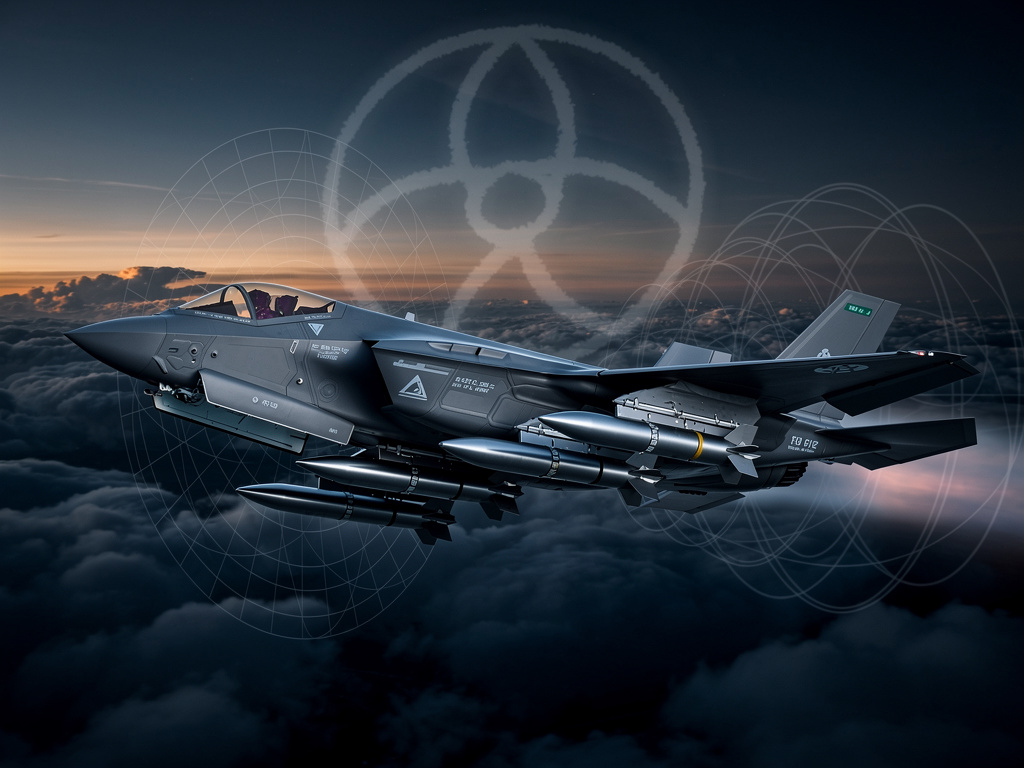
The United States military has quietly crossed a significant threshold in aerial warfare capabilities, marking a shift in how nuclear deterrence is projected globally. In a development that alters the strategic calculus for NATO and its adversaries, the F-35A Lightning II has officially demonstrated its ability to deploy the B61-12 thermonuclear gravity bomb. Footage recently released and analyzed by Newsweek via MSN confirms the successful release of a Joint Test Assembly (JTA)—a non-nuclear, high-fidelity mock-up—from the stealth fighter’s internal weapons bay. This event signifies the operational readiness of the F-35A as a Dual-Capable Aircraft (DCA), a designation allowing it to carry both conventional and nuclear ordnance.
This certification is not merely a technical checkbox; it represents the culmination of a decade-long integration effort involving the F-35 Joint Program Office (JPO), Sandia National Laboratories, and the U.S. Air Force. While legacy platforms such as the F-15E Strike Eagle and the F-16 Fighting Falcon have long held this role, the F-35A introduces a variable that previous generations could not: low-observable stealth technology combined with nuclear delivery. By carrying the weapon internally, the jet maintains its stealth profile, allowing it to penetrate contested airspace protected by advanced air defense systems—a capability previously reserved for strategic bombers like the B-2 Spirit.
Engineering the B61-12 for Internal Carriage and Precision Guidance
The weapon at the center of this integration, the B61-12, is the latest iteration of a nuclear family that has been in service since the Cold War. However, treating the B61-12 as a simple update belies the extent of the engineering overhaul. According to technical specifications detailed by Sandia National Laboratories, the bomb undergoes a Life Extension Program (LEP) that consolidates and replaces four legacy variants (the B61-3, -4, -7, and -10). The critical modification is the addition of a Boeing-designed tail kit assembly, which converts the weapon from a standard gravity bomb into a guided munition with significantly improved accuracy.
This increased precision allows strategic planners to lower the explosive yield necessary to destroy a target. The B61-12 features a “dial-a-yield” capability, reportedly ranging from 0.3 kilotons to 50 kilotons. This adjustability, combined with the F-35’s sensors, creates a system where the delivery vehicle can identify targets and release ordnance with coordinates updated in real-time. The recent tests involved releasing the JTA at supersonic speeds, a rigorous stress test for the tail kit’s mechanical systems. As noted in coverage by Air & Space Forces Magazine, the certification allows the F-35A to carry two B61-12s internally, ensuring that the drag penalty associated with external pylons does not compromise the aircraft’s range or radar cross-section.
NATO’s Deterrence Strategy and the European Theater
The timing of this operational capability aligns with a period of heightened friction between NATO and the Russian Federation. The concept of “nuclear sharing” remains a cornerstone of Alliance defense policy, wherein U.S. nuclear weapons are stored at bases in Belgium, Germany, Italy, the Netherlands, and Turkey. Historically, these host nations maintained their own fleets of dual-capable aircraft—primarily F-16s and Panavia Tornados—to deliver these weapons if authorized. As these European air forces transition to the F-35A, the certification ensures continuity in the Alliance’s nuclear posture.
The geopolitical ramifications are immediate. With the F-35A now certified, NATO commanders possess a delivery system capable of bypassing the Anti-Access/Area Denial (A2/AD) bubbles established by Russian S-400 and S-500 missile batteries. A recent report from Breaking Defense highlights that the F-35A is the first 5th-generation fighter to achieve this status, officially putting the platform ahead of schedule for its nuclear role, originally anticipated for January 2024. This development serves as a direct counter-signal to Moscow, particularly following recent aggressive rhetoric regarding tactical nuclear drills near the Ukrainian border.
The Role of Joint Test Assemblies in Safety Verification
The footage circulating of the drop test emphasizes the safety protocols inherent in nuclear weapons testing. The unit dropped was a Joint Test Assembly (JTA). These units are engineered to replicate the mass, center of gravity, and aerodynamic characteristics of a live warhead but contain no fissile material. Instead, they are packed with sensors and data recorders that track the weapon’s performance from release to impact. This distinction is vital for industry observers to understand; the U.S. has not conducted an explosive nuclear test since 1992, relying instead on sub-critical experiments and computer simulations to verify the stockpile’s reliability.
The use of JTAs allows the Department of Energy and the Department of Defense to validate the “stockpile-to-target sequence.” This sequence encompasses every physical environment the weapon encounters, from storage bunkers to the vibration of the aircraft pylon, and finally, the high-G forces of release and spin-stabilization. According to analysis by the Bulletin of the Atomic Scientists, ensuring the electrical interface between the 21st-century digital architecture of the F-35 and the analog origins of the B61 design required extensive software bridging, proving that the modernization of the triad relies as much on code as it does on physics.
Tactical Implications for Pacific and European Commands
While the European theater is the primary focus for B61-12 deployment due to NATO sharing agreements, the certification has weight in the Indo-Pacific. The United States does not forward-deploy nuclear weapons to allied soil in the Pacific (such as Japan or South Korea) as it does in Europe. However, the ability of U.S. Air Force F-35s to deploy rapidly to the region with nuclear capability creates a new layer of ambiguity for Chinese defense planners. The People’s Liberation Army (PLA) has invested heavily in pushing U.S. carrier groups and bombers away from its coastline. The F-35A, operating from dispersed airfields, complicates this defensive strategy.
Furthermore, the integration supports the Air Force’s Agile Combat Employment (ACE) doctrine. Unlike the massive infrastructure required for B-2 or B-21 bombers, F-35s can operate with a smaller logistical footprint. This dispersal capability makes pre-emptive strikes against U.S. nuclear assets significantly harder. As reported by Reuters, the certification applies only to the F-35A (the conventional takeoff and landing variant), not the F-35B (STOVL) or F-35C (carrier-based), limiting this specific nuclear role to land-based runways for the time being.
Cost and Controversy Surrounding the Modernization
The program has not proceeded without financial scrutiny. The B61-12 LEP is the most expensive nuclear bomb program in U.S. history, with costs estimated at over $10 billion for roughly 400 to 500 units. Critics argue that adding a guidance tail kit to a nuclear weapon blurs the line between strategic deterrence and tactical usability, potentially lowering the threshold for nuclear use. The argument posits that a more accurate, lower-yield weapon might tempt commanders to view it as a battlefield solution rather than a weapon of last resort.
Conversely, proponents argue that credibility is the currency of deterrence. If an adversary believes the U.S. would never use a megaton-class weapon due to collateral damage concerns, that weapon ceases to deter limited aggression. The B61-12/F-35 combination provides a “usable” option in the eyes of military theorists, which paradoxically is intended to ensure it never needs to be used. The Federation of American Scientists notes that while the capability is new, the mission is old; the F-35 is simply picking up the mantle from the F-16, ensuring that the tactical leg of the nuclear triad does not become obsolete due to advances in enemy air defenses.
Future Trajectory of the Dual-Capable Fleet
Looking ahead, the Air Force is moving toward a mixed fleet of nuclear-capable platforms. The forthcoming B-21 Raider will eventually shoulder the heavy bomber responsibility, but the F-35A will serve as the flexible, forward-deployed arm of this posture. The full operational capability (FOC) for the F-35A in this role involves not just the aircraft and the bomb, but the certification of the maintenance crews, storage facilities, and security protocols across multiple NATO bases.
As nations like Germany finalize their acquisition of the F-35 specifically to maintain their participation in nuclear sharing—replacing their aging Tornado fleet—the political solidarity of the alliance is physically reinforced by this hardware. The successful drop tests of the safe JTA units serve as the final technical validation before these aircraft sit on quick-reaction alert pads, loaded with the real B61-12s, ready to launch within minutes of a presidential order.


 WebProNews is an iEntry Publication