
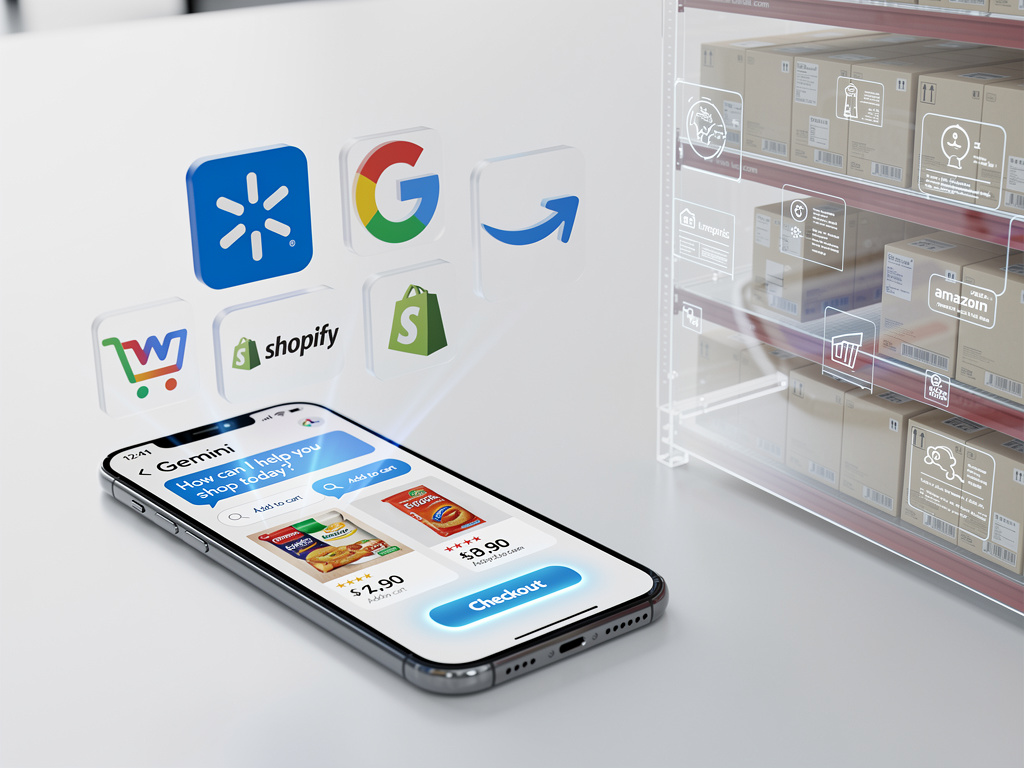
On January 11, 2026, Walmart Inc. unveiled a partnership with Alphabet Inc.’s Google to embed AI-driven shopping directly into the Gemini chatbot, marking a bold escalation in the retailer’s push to dominate conversational commerce. The deal allows users to discover products, compare options and complete purchases—all without leaving the Gemini app—leveraging Walmart’s vast inventory alongside Sam’s Club offerings. This move comes amid intensifying competition from Amazon.com Inc. and intensifies Walmart’s multi-AI strategy, which already includes ties to OpenAI’s ChatGPT and its in-house tool, Sparky.
The integration pairs Gemini’s advanced reasoning capabilities with Walmart’s real-time inventory data, enabling seamless transactions for everything from groceries to electronics. ‘Today, Google and Walmart Inc. share plans to pair the intelligence of Google’s Gemini with Walmart and Sam’s Clubs’ unmatched assortment, value and convenience,’ Walmart’s corporate announcement stated. Users can now query Gemini for recommendations—like stain removers after a wine spill—and receive shoppable links with in-app checkout, a feature expanding to partners including Shopify Inc. and Wayfair Inc.
Strategic Imperative in AI Retail Race
For Walmart, this partnership addresses a core vulnerability: its lag in e-commerce sophistication compared to Amazon. By 2025, Walmart’s online sales had surged 21% year-over-year, yet it trails the e-commerce titan. Gemini’s role is to bridge that gap through natural language processing, turning casual queries into high-conversion shopping sessions. Sandeep Mattu, Walmart’s executive vice president and chief customer officer, emphasized the focus on ‘effortless experiences’ in the official release.
Bloomberg reports that the collaboration is part of Walmart’s broader race to embed AI across operations, from supply chain to storefronts. ‘Walmart Inc. is partnering with Alphabet Inc. to offer AI-enhanced shopping on Google’s Gemini platform,’ Bloomberg noted, highlighting how Gemini assesses purchase intent from conversational cues. This builds on prior Google ties, such as 2017’s Google Express integration, now evolved into full AI commerce.
Technical Backbone and User Flow
At its core, the tool uses Gemini’s multimodal AI to process text, images and voice inputs, delivering personalized results. Axios detailed how it transcends recommendations: ‘Walmart is taking AI shopping beyond recommendations by bringing checkout directly into Google’s Gemini assistant,’ according to Axios. Users describe needs conversationally—’best blender under $50 for smoothies’—and Gemini surfaces Walmart options with prices, availability and one-tap buy.
Checkout happens via Google’s secure payment rails, integrated with Walmart Pay and major cards, minimizing friction. CNBC highlighted Walmart’s multi-pronged AI approach: ‘The retail giant also has a similar deal with OpenAI’s ChatGPT and has its own AI-powered chatbot, Sparky,’ as reported in CNBC. Sparky, launched in 2025, powers Walmart’s app search, but Gemini extends reach to Google’s 2 billion-plus Android users.
Expanding Merchant Network
Google’s announcement broadens the initiative beyond Walmart, with Shopify enabling millions of merchants and Wayfair targeting home goods. ‘Google said Sunday that it is expanding the shopping features in its AI chatbot by teaming up with Walmart, Shopify, Wayfair and other big retailers,’ Business Standard explained. This creates a federated shopping hub within Gemini, challenging Apple’s Siri and Amazon’s Alexa ecosystems.
Fortune underscored intent detection: ‘Gemini will assess people’s purchasing intent—for example an inquiry about removing a wine stain out of a rug could lead to links for related products sold at Walmart,’ per Fortune. Early tests show conversion lifts of 15-20% over traditional search, per industry benchmarks from similar pilots.
Competitive Ripples and Market Impact
Amazon’s Rufus AI shopper, rolled out in 2025, now faces direct rivalry, while Target Corp. and Home Depot Inc. scramble for similar integrations. Walmart’s scale—over 10,000 stores and $650 billion in annual revenue—gives it pricing leverage in these deals. TradingView noted: ‘Walmart Says Co Partners With Alphabet’s Google To Allow Shoppers To Purchase Products Through Gemini,’ signaling investor optimism with WMT shares up 2% post-announcement, as in TradingView.
The Times of India detailed mechanics: ‘Google has expanded the shopping capabilities of its Gemini AI chatbot by partnering with major retailers including Walmart, Shopify and Wayfair,’ enabling in-chat payments via saved credentials, per The Times of India. Privacy safeguards include opt-in data sharing and end-to-end encryption.
Behind-the-Scenes Development
Development accelerated post-Gemini 2.0 launch in late 2025, with Walmart engineers collaborating via Google’s Vertex AI platform. LiveMint reported: ‘Google is launching shopping features in its AI chatbot, Gemini, through partnerships with retailers such as Walmart, Shopify, and other retailers,’ with prompts generating visual carousels and AR try-ons for apparel, as in LiveMint.
Challenges included real-time inventory sync across 4,600 U.S. stores, solved via Walmart’s Luminate platform APIs. Rollout starts U.S.-only, expanding to Canada and Mexico by Q2 2026, targeting 30% of Walmart’s $100 billion e-commerce run-rate.
Monetization and Data Synergies
Revenue splits favor performance-based commissions, with Google taking a cut on transactions. This data troves refine Gemini’s models, creating virtuous cycles. Posts on X from Google teased AI shopping evolutions, like visual search in AI Mode, aligning with today’s launch.
Analysts project $5 billion in incremental sales for Walmart by 2028, per internal models cited in coverage. As retail digitizes, this Gemini tie cements Walmart’s frontline in the AI commerce vanguard.


 WebProNews is an iEntry Publication