
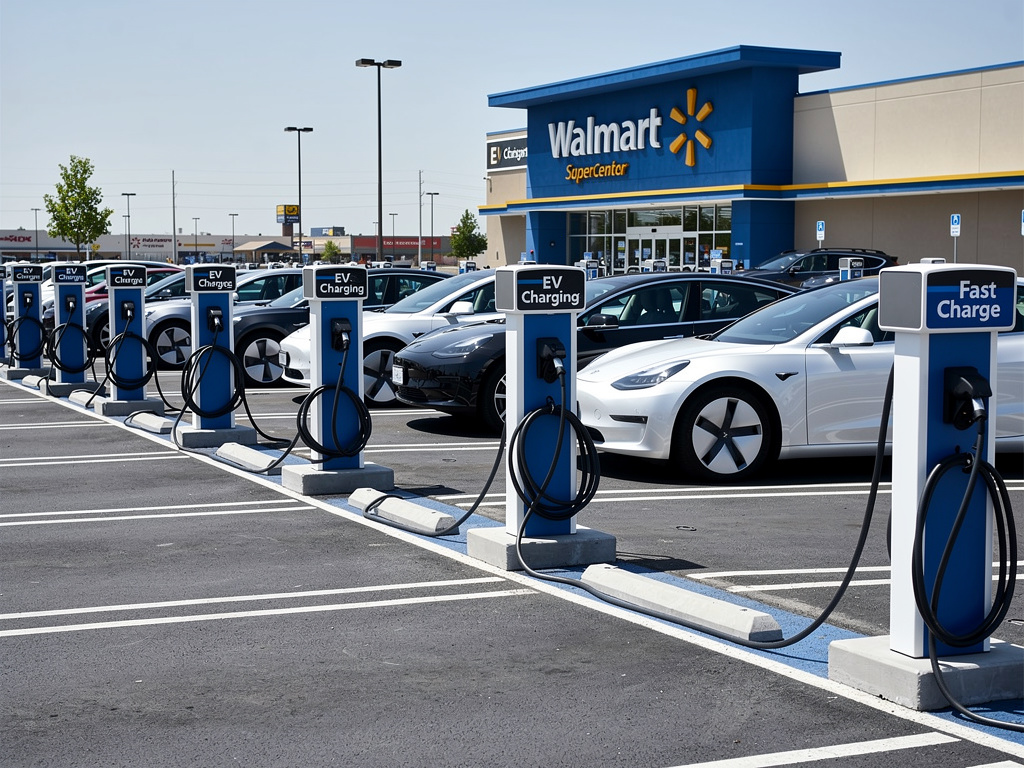
Walmart is embarking on one of the most ambitious retail-led infrastructure projects in recent American history, announcing plans to construct a comprehensive electric vehicle charging network spanning its stores nationwide. The initiative marks a significant pivot for the retail behemoth, positioning it not merely as a place to shop but as a critical node in America’s transition to electric transportation. According to Slashdot, this move represents Walmart’s most substantial commitment yet to supporting the electric vehicle revolution while simultaneously creating new revenue streams and enhancing customer loyalty.
The timing of Walmart’s announcement coincides with a broader industry shift as retailers recognize that EV charging stations can transform parking lots into profit centers. While competitors have dabbled in charging infrastructure, Walmart’s scale—with approximately 4,600 stores across the United States—gives it an unparalleled advantage in creating a truly national network. The company’s stores are strategically located within ten miles of approximately 90% of the U.S. population, making it an ideal anchor for a charging network that could rival purpose-built alternatives from Tesla and Electrify America.
Industry analysts suggest that Walmart’s entry into the EV charging market could accelerate adoption rates among hesitant consumers who cite range anxiety and charging availability as primary concerns. The retail giant’s ubiquitous presence in both urban and rural communities addresses one of the most significant gaps in current charging infrastructure: the availability of reliable charging options in smaller markets and along secondary travel corridors. This geographic advantage could prove decisive as the automotive industry continues its inexorable shift toward electrification, with major manufacturers committing billions to EV development.
Strategic Positioning in a Rapidly Evolving Market
Walmart’s charging network strategy extends beyond simple altruism or environmental stewardship. The company recognizes that EV owners represent a demographic with higher-than-average household incomes and spending power—precisely the customer segment that retailers covet. By offering charging services, Walmart can extend customer dwell time, potentially increasing in-store purchases while vehicles charge. This model has already proven successful in Europe, where retailers like IKEA and Lidl have reported increased basket sizes from customers who shop while charging their vehicles.
The financial implications of this infrastructure buildout are substantial. While Walmart has not disclosed the total investment required for its nationwide network, industry estimates suggest that installing DC fast-charging stations can cost between $100,000 and $200,000 per unit, not including ongoing maintenance, electricity costs, and grid connection fees. However, the company appears willing to absorb these upfront costs in exchange for long-term strategic positioning. Revenue from charging fees, combined with increased retail sales, could create a virtuous cycle that justifies the initial capital expenditure.
Moreover, Walmart’s move comes as federal infrastructure funding becomes available through the Bipartisan Infrastructure Law, which allocated $7.5 billion specifically for EV charging infrastructure development. Retailers and businesses that invest in charging stations may qualify for grants, tax credits, and other financial incentives designed to accelerate the buildout of America’s charging network. This favorable policy environment reduces Walmart’s financial risk while potentially accelerating its deployment timeline.
Technical Specifications and Implementation Challenges
The technical aspects of Walmart’s charging network remain partially undisclosed, but industry observers anticipate a mix of Level 2 and DC fast-charging stations tailored to different customer needs and store locations. Level 2 chargers, which can replenish an EV battery in several hours, make sense for stores where customers typically spend 30 minutes to an hour shopping. DC fast-chargers, capable of providing 80% charge in 20-30 minutes, would be more appropriate for highway-adjacent locations or stores catering to travelers.
Implementation challenges are considerable. Walmart must navigate a complex web of utility regulations, grid capacity constraints, and local permitting requirements across thousands of jurisdictions. Electrical infrastructure at many existing stores may require significant upgrades to support multiple high-power charging stations simultaneously. Peak demand management will be crucial; if dozens of customers attempt to charge vehicles during busy shopping periods, the strain on local electrical grids could be substantial. Walmart will likely need to invest in energy storage systems, smart charging management software, and potentially on-site renewable energy generation to mitigate these challenges.
The company must also decide whether to build and operate the network independently or partner with established charging network operators. Each approach carries distinct advantages and risks. Independent operation offers greater control over the customer experience, pricing, and data collection but requires developing entirely new operational capabilities. Partnerships with companies like ChargePoint, EVgo, or Electrify America could accelerate deployment and reduce operational complexity but would mean sharing revenue and customer relationships.
Competitive Dynamics and Market Implications
Walmart’s charging network announcement intensifies competition in the retail sector, potentially forcing rivals to accelerate their own EV infrastructure plans or risk losing customers to competitors offering charging convenience. Target, Kroger, and other major retailers have already begun installing charging stations at select locations, but none have announced initiatives matching Walmart’s scope. The pressure to keep pace could trigger a retail charging arms race, ultimately benefiting consumers through increased charging availability and potentially lower prices driven by competition.
The automotive industry is watching Walmart’s moves closely. Automakers have invested heavily in charging networks—Ford, General Motors, and others have formed partnerships or made direct investments in charging infrastructure—but retailer-led networks could prove more sustainable economically. Unlike purpose-built charging plazas that generate revenue solely from electricity sales and charging fees, retailer-integrated charging leverages existing real estate and customer traffic patterns, creating multiple revenue streams that improve overall project economics.
Tesla’s Supercharger network, long considered the gold standard for EV charging, may face its first serious competition from a non-automotive company. While Tesla has begun opening its network to other manufacturers’ vehicles, Walmart’s brand-agnostic approach from inception could prove advantageous. The retail giant’s network would serve all EV brands equally, potentially making it the preferred choice for non-Tesla owners who have historically faced more limited charging options.
Environmental and Social Considerations
Beyond business strategy, Walmart’s charging network aligns with the company’s stated environmental commitments. The retailer has pledged to achieve zero emissions across its global operations by 2040, and supporting EV adoption contributes to this goal by reducing transportation-related emissions from both customers and its own fleet operations. Walmart operates one of America’s largest private truck fleets, and the company has been gradually electrifying its delivery vehicles. A proprietary charging network could eventually support this fleet electrification while serving public customers.
The social equity dimensions of Walmart’s network deserve scrutiny. While the company’s stores serve diverse communities across income levels, EV ownership remains concentrated among wealthier households. Critics may question whether Walmart’s infrastructure investment primarily benefits affluent customers while communities facing more pressing needs receive less attention. However, proponents argue that building charging infrastructure in underserved areas—where Walmart often operates—could democratize EV access over time as vehicle prices decline and used EV markets develop.
Rural communities stand to benefit disproportionately from Walmart’s initiative. These areas have been largely overlooked by existing charging networks, which concentrate on urban corridors and interstate highways. Walmart’s presence in small towns across America means that communities previously lacking any public charging infrastructure could suddenly gain access to reliable charging options, potentially accelerating EV adoption in regions where it has lagged.
The Road Ahead for Retail-Led Infrastructure
Walmart’s charging network represents a test case for whether retailers can successfully operate large-scale infrastructure projects beyond their core competencies. Success would demonstrate that America’s retail infrastructure can be repurposed to support the energy transition, potentially inspiring similar initiatives in other sectors. Failure, conversely, could discourage other retailers from making comparable investments, slowing the overall pace of charging network development.
The project’s timeline remains uncertain. Building out thousands of charging locations will require years, not months, given the complexity of electrical upgrades, permitting processes, and equipment procurement. Walmart has not announced specific deployment targets or completion dates, suggesting the company is taking a measured approach to this substantial undertaking. Industry observers anticipate a phased rollout beginning with high-traffic locations in EV-friendly markets before expanding to secondary and tertiary markets.
As America’s transportation sector undergoes its most significant transformation in a century, Walmart’s charging network initiative positions the company at the intersection of retail, energy, and mobility. Whether this gambit succeeds in creating a profitable new business line while advancing environmental goals will influence how other major retailers approach infrastructure investment. For now, Walmart is betting that the convergence of shopping and charging represents the future of retail—a future where parking lots become power stations and shopping trips double as refueling stops for an increasingly electric America.


 WebProNews is an iEntry Publication