
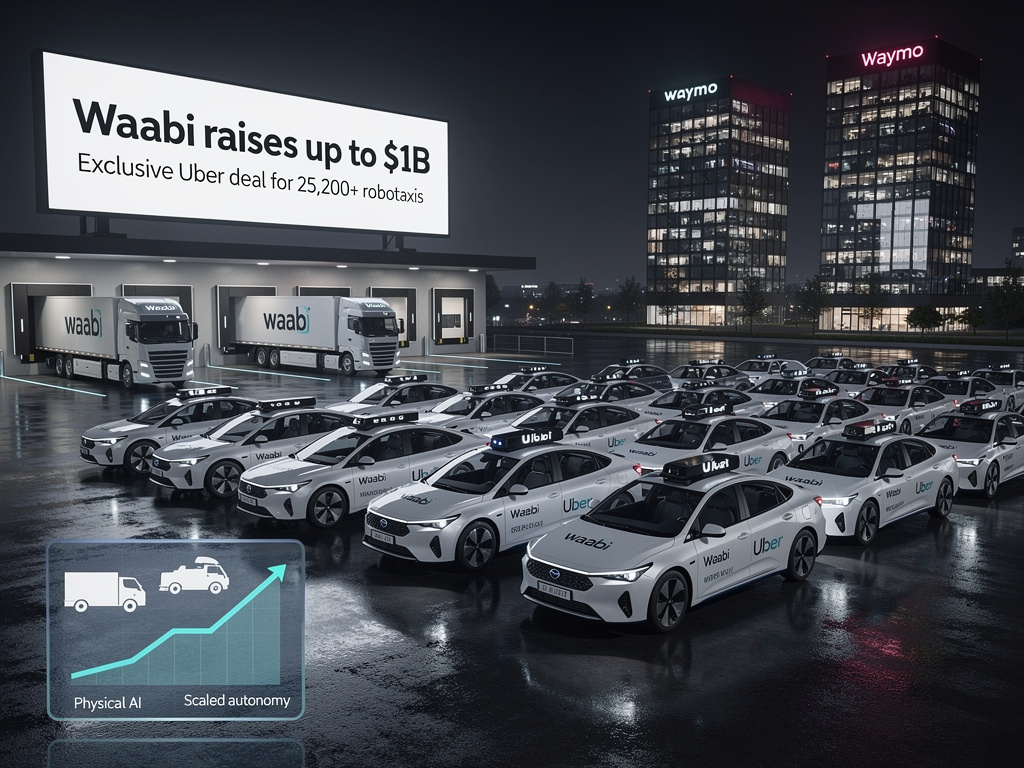
Toronto-based Waabi, a pioneer in physical AI for autonomous vehicles, has secured up to $1 billion in fresh capital, marking Canada’s largest-ever tech funding round and propelling the startup into the fiercely contested robotaxi arena through an exclusive Uber partnership. The oversubscribed $750 million Series C, co-led by Khosla Ventures and G2 Venture Partners, pairs with Uber’s milestone-tied $250 million commitment to deploy at least 25,000 Waabi Driver-powered robotaxis on Uber’s ride-hailing platform. This move builds on Waabi’s trucking foundation, adapting its end-to-end AI model—trained in the Waabi World simulator—to light-duty passenger vehicles.
Founded in 2021 by Raquel Urtasun, a former Uber Advanced Technologies Group chief scientist and University of Toronto professor, Waabi has raised over $1.3 billion total across rounds, including a $200 million Series B in 2024 led by Uber and Khosla with Nvidia, Volvo Group Venture Capital, and Porsche Automobil Holding SE. Urtasun emphasized the shared AI brain: “Our current self-driving capabilities across highways and generalized surface streets have unlocked a new direct-to-customer model that for the first time solves the pain points of the industry.” CNBC reported the round’s scale, while Waabi’s press release detailed the Uber exclusivity.
Uber’s investment underscores its pivot back to autonomy partnerships after shuttering its in-house AV unit post-2018 fatality. Under the deal, Uber manages operations like cleaning and charging, freeing Waabi to refine its AI. Lior Ron, Waabi’s chief commercial officer and ex-Uber Freight CEO, highlighted synergies: “Everything is coming together for physical AI to have its moment, with self-driving as the first manifestation at scale.” FreightWaves via Yahoo Finance.
From Freight Lanes to Urban Streets
Waabi’s trucking roots trace to Texas routes between Dallas and Houston, where it partnered with Uber Freight since 2023 for safety-driver hauls, expanding to a new AV terminal. A 2025 Volvo Autonomous Solutions collaboration integrates Waabi Driver into purpose-built trucks, targeting driverless commercialization. Unlike retrofits by rivals, Waabi’s factory approach promises scalability. Urtasun noted in 2024: “We’ve already seen with our Waabi driver, in quite a few instances, that it is actually better than our extremely experienced truck drivers.” The Globe and Mail.
The robotaxi pivot leverages trucking maturity—highway expertise aiding urban navigation, and vice versa. Waabi’s multi-sensor fusion (lidar, cameras, radar) and generative AI enable generalization to unknowns, validated mathematically in simulation. Vinod Khosla praised: “Waabi has taken a ‘capital efficient’ approach to ‘physical AI,’ and has a late mover’s advantage.” This contrasts billion-dollar predecessors, positioning Waabi for rapid deployment. The Verge covered the Uber team-up.
Progress in one domain bolsters the other: robotaxi volume cuts sensor costs for trucks, while trucking’s scale tests edge cases. Waabi eyes a “driver as a service” model, charging per mile without owning fleets. Ron added: “High robotaxi volume allows Waabi to drive scale and cost efficiency with Tier 1 suppliers.”
Physical AI’s Edge in Crowded Autonomy Race
Waabi’s Physical AI Platform features Copilot4D, an end-to-end model paired with Waabi World, the industry’s most advanced neural simulator. This slashes real-world miles needed—rivals log billions—by generating infinite scenarios with AI agents for pedestrians and vehicles. Urtasun explained: “Waabi has created a new generation of foundational models that are able to understand and interpret what they see… and this gives the system the ability to really generalize to the unknown.” Nvidia integrates DRIVE Thor for 1000 teraflops compute. Waabi.
Safety drives design: diverse sensors mitigate failures, with verifiable reasoning. Waabi ranked 35 on CNBC’s 2025 Disruptor 50, lauding its trucking focus amid driver shortages—70% of U.S. freight moves by truck in a $900 billion market. Yet trucking faltered for others: Waymo paused in 2023, TuSimple collapsed.
Robotaxi entry pits Waabi against Waymo’s 100,000+ weekly rides, Tesla’s Cybercab promises, Cruise setbacks, China’s WeRide/BYD, and Uber allies like Nuro. Waabi’s truck-honed AI claims advantage in complex ops, with Urtasun declaring: “For me, it’s been 16 years in self-driving. But this is — it’s finally here, scale is here.”
Strategic Alliances Fueling Scale
Volvo and Peterbilt partnerships yield AV-ready trucks; Uber Freight’s billions of committed miles test in Southwest U.S. Ron’s hire in 2025 boosted go-to-market, drawing Fortune 500 pilots. Investors like NVentures (Nvidia) and Scania reinforce hardware-software synergy. Total funding now exceeds $1.3 billion, valuing Waabi at unicorn status post-Series C.
The Uber exclusivity accelerates adoption: 25,000+ vehicles signal massive scale, with Uber’s ops expertise enabling focus on AI. Dara Khosrowshahi backed early: “Raquel is a visionary… Waabi’s AI-first approach provides a solution that is extremely exciting.” GlobeNewswire.
Waabi plans U.S. expansion, eyeing warehouse robotics and humanoids, but trucking/robotaxi duality sets it apart. Urtasun: “Trucking is only the beginning. We’re going to do so much more.” TechCrunch.
Rivals Stumble, Waabi Accelerates
Autonomy’s toll: Embark shuttered, Aurora/Kodiak burn cash amid regulatory hurdles. Tesla eyes Semi FSD in 2026, but Waabi’s simulation efficiency—avoiding road-heavy training—promises faster, cheaper paths. FreightWaves noted: “The significant capital raise builds confidence among logistics customers that Waabi will be a long-term partner.”
Regulatory tailwinds in Texas aid launches; Waabi targets driverless trucks end-2025, robotaxis soon after. Economic upside: labor/fuel savings, sustainability via efficiency. Challenges persist—urban chaos, public trust post-Cruise—but Waabi’s verifiable safety and partnerships position it strongly.
Urtasun’s vision culminates: from Uber ATG to Waabi’s $1B war chest, redefining mobility with one AI brain for trucks and taxis.


 WebProNews is an iEntry Publication