
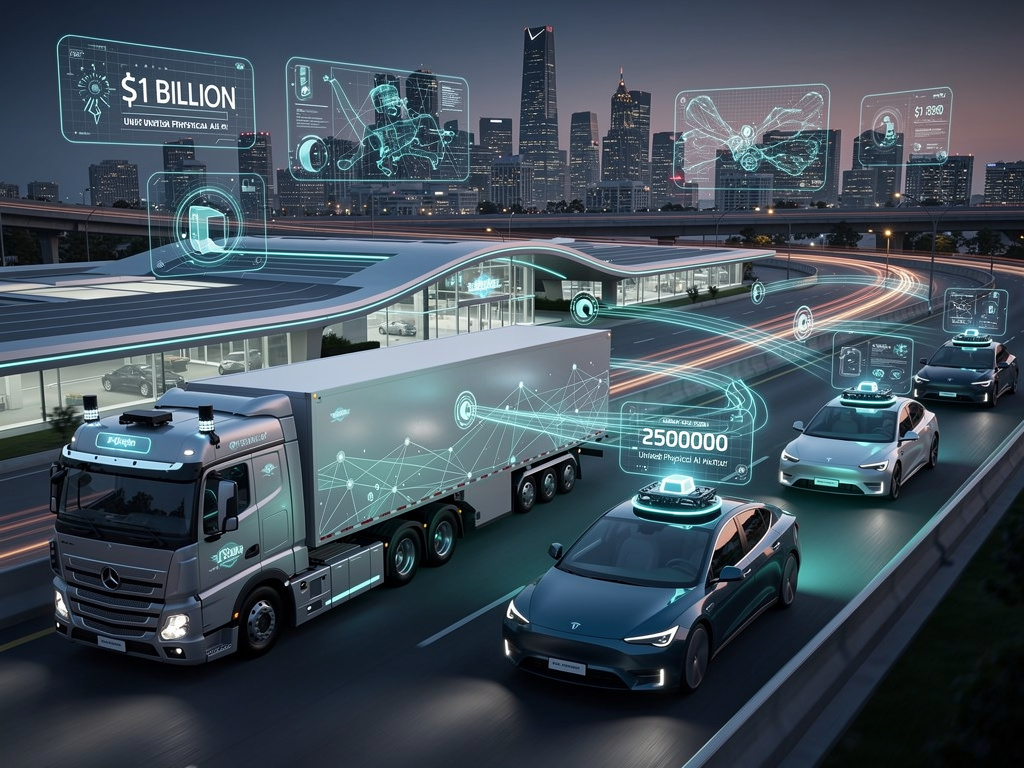
Toronto-based Waabi Innovation Inc. has vaulted into the top tier of autonomous-vehicle developers, closing an oversubscribed $750 million Series C funding round that, combined with a milestone-based $250 million commitment from Uber Technologies Inc., brings its total new capital to $1 billion. The raise, the largest in Canadian tech history, crowns Waabi as the country’s newest unicorn and fuels its pivot from trucking to robotaxis, with plans to deploy at least 25,000 Waabi Driver-powered vehicles exclusively on Uber’s platform.
Co-led by Khosla Ventures and G2 Venture Partners, the round drew heavyweights including NVentures, Volvo Group Venture Capital, Porsche Automobil Holding SE, BlackRock-managed funds, Radical Ventures, HarbourVest Partners—a subsidiary of the Abu Dhabi Investment Authority—Linse Capital, Incharge Capital, BDC Capital’s Thrive Venture Fund, Export Development Canada, TELUS Global Ventures, and BMO Global Asset Management. “Waabi has developed a truly groundbreaking Physical AI platform that represents a fundamental leap forward in how next generation driverless technology is being developed,” said Vinod Khosla, founder of Khosla Ventures.
This capital accelerates Waabi’s Physical AI Platform, a verifiable end-to-end AI model paired with its neural simulator, Waabi World, enabling a “shared brain” for trucks and robotaxis. Founded in 2021 by Raquel Urtasun—former chief scientist at Uber’s Advanced Technologies Group—the company has raised over $1.28 billion total, building on a $200 million Series B in June 2024 led by Uber and Khosla.
Physical AI’s Simulator Edge
Waabi’s approach diverges from legacy AV stacks reliant on hand-coded rules and modular software. Its end-to-end model processes raw sensor data—lidar, radar, cameras—directly into driving actions, trained largely in simulation to slash real-world testing costs. “What predecessors achieved with thousands of engineers and billions of dollars, Waabi can do for a fraction,” Vinod Khosla told CNBC, citing Waabi’s capital efficiency and late-mover advantages from AI advances.
“Our current self-driving capabilities across highways and generalized surface streets have unlocked a new direct-to-customer model,” Urtasun said in the company’s press release. The platform generalizes across form factors, geographies, and environments, with progress in robotaxis boosting trucking and vice versa. Waabi ranked 35th on CNBC’s 2025 Disruptor 50 list for its generative AI-driven simulator, which exposes vehicles to millions of scenarios virtually.
Lior Ron, Waabi’s chief commercial officer and former Uber Freight CEO, emphasized readiness: “The moment is here… Hardware, technology and customers are all ready,” per FreightWaves. This simulation-first method positions Waabi in the “AV 2.0” wave, learning holistically from data unlike rivals’ segmented systems, as described by Fortune.
Trucking Foundations Take Shape
Waabi’s trucking focus yielded pilots with Uber Freight since 2023, hauling cargo between Dallas and Houston with safety drivers. It integrated with Volvo’s autonomous trucks for Texas highways, Norway, and Sweden mining sites—still with drivers but “quarters away” from full validation, per CEO Urtasun to Forbes. A 10-year Uber Freight deal commits billions of driverless miles.
The company opened a Texas terminal in 2024 for pilots using Peterbilt trucks, eyeing Southwest U.S. rollout by late 2025 sans drivers. Commercial trucking deployment targets 2027, extending beyond highways to urban streets, distribution centers, and stores. Volvo, an investor since 2023, tests Waabi tech for imminent large-scale U.S. semis, BetaKit reported.
“Customers want trucks to go everywhere,” Ron told FreightWaves. Waabi’s shift to a “driver-as-a-service” model lets carriers deploy seamlessly via Uber Freight’s network, optimizing routes and maintenance for higher utilization.
Uber Robotaxi Leap Accelerates Scale
The Uber partnership marks Waabi’s robotaxi entry, with the ride-hailing giant handling operations—cleaning, charging, scaling—while Waabi supplies AI. Uber CEO Dara Khosrowshahi hailed it as “an important milestone for their team and the AV industry,” per Waabi’s release and BetaKit.
This builds on Urtasun’s Uber roots, closing the loop post-2020 sale of its AV unit to Aurora. High robotaxi volumes will cut sensor costs, aiding trucking. No vehicle models or launch cities disclosed, but Urtasun promised rollout “super fast” to Fortune. Uber’s AV Labs supports 20+ partners, including Waabi, via NVIDIA-powered data factories.
“Self-driving is happening. The technology is ready now,” Urtasun told BetaKit, eyeing unprecedented scale.
Investor Backing Signals Confidence
Returning backers like Uber (board seat since Series A), Khosla, and Volvo underscore momentum. Strategic bets from NVIDIA and Porsche highlight hardware synergies; NVIDIA’s DRIVE Thor powers Waabi rigs. Brook Porter of G2 Venture Partners noted: “Their simulation-first end-to-end AI is a powerful enabler, accelerating commercial adoption while dramatically reducing capital needs,” via GlobeNewswire.
Canadian support via EDC and BDC validates national leadership, per Urtasun. Pre-money valuation neared $3 billion pre-close, per BetaKit and prior Globe and Mail reports, though undisclosed officially.
The all-primary round equips Waabi for growth without dilution pressures, unlike secondary-heavy peers.
Navigating Rivals and Hurdles
Trucking foes include Aurora, Kodiak, and Tesla Semi; robotaxi leaders Waymo (500,000 weekly rides) and Cruise loom. Waabi’s unified stack offers synergies rivals lack with siloed trucking/passenger tech, FreightWaves noted. Tesla trails at Level 2; Waabi eyes Level 4.
Regulatory wins in Texas aid rollout, but scaling demands validation. Waabi’s efficiency—fewer engineers, simulation-heavy—avoids TuSimple/Embark pitfalls. Ron joined as COO in 2025 from Uber Freight, bolstering ops, per CNBC.
“For me, it’s been 16 years in self-driving… scale is here,” Urtasun told CNBC. X reactions hailed the raise as a robotaxi disruptor.
Path to Commercial Dominance
Waabi eyes trucking revenue first, robotaxis second for synergies. OEM partnerships loom; Volvo deploys soon. Sustainability gains—efficiency, lower emissions—align with backers like Porsche. Urtasun: “We’re excited to be at the forefront of this movement,” per BetaKit.
The $1 billion war chest positions Waabi to transform supply chains and urban mobility, leveraging Uber’s network for the largest self-driving deal yet.


 WebProNews is an iEntry Publication