
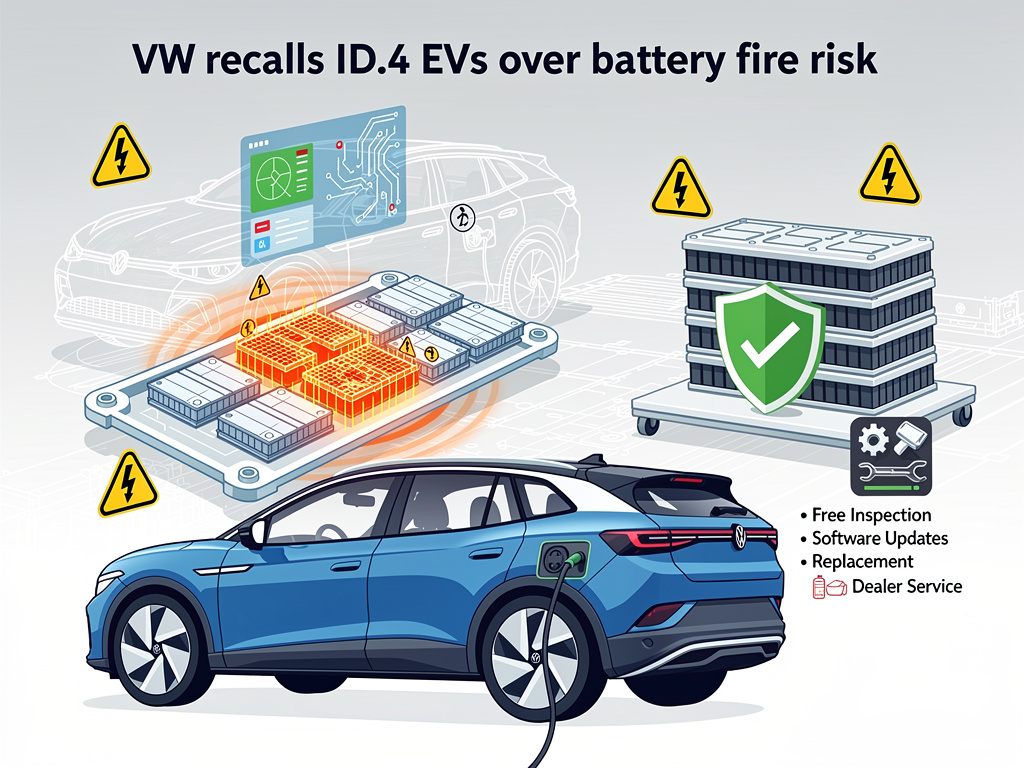
Volkswagen Group of America has launched a massive recall of 43,881 ID.4 electric vehicles from model years 2023 to 2025, citing a high-voltage battery flaw that could spark fires even when parked. The National Highway Traffic Safety Administration assigned recall number 26V030 on January 21, 2026, targeting vehicles built from September 2, 2022, through April 10, 2025. This action follows months of scrutiny over battery anomalies traced to supplier SK Battery America Inc.
The core issue stems from high-voltage battery cell modules prone to shifted electrode conditions, triggering self-discharge and overheating. Lacking Self-Discharge Detection software, these packs can’t flag problems early. Volkswagen pegs the defect rate at about 1% of the fleet, but thermal propagation risks remain severe in rare cases. The EV Report detailed how joint analysis pinpointed production deviations at the supplier, including a shifted electrode uncovered in a September 2025 teardown and another hardware glitch identified from December 2025 to January 2026.
Thermal Events Ignite Probe
Investigators zeroed in after three key failures: May 22, June 23, and October 31, 2025, all originating inside the high-voltage battery. These incidents, reported across multiple states, echoed earlier thermal runaway cases in 2024 that prompted smaller recalls. Dealers will conduct free battery health checks, install updated Self-Discharge Detection software, and swap faulty modules. Vehicles with 82kWh packs built after January 17, 2024, already carry improved software, while 62kWh production wrapped before the fix.
Owner letters roll out by March 20, 2026, with VIN lookups live on NHTSA.gov since January 23. Call Volkswagen at 1-800-893-5298, referencing 93EA, for details. Those noticing range loss or performance dips should seek dealer diagnosis immediately. Reuters noted the high-voltage battery ‘may overheat, increasing the risk of a fire,’ bundling this with a separate 670-unit recall for misaligned electrodes in 2023-2024 models.
Supplier Scrutiny Mounts
SK Battery America supplied the suspect modules, where manufacturing slips allowed electrode misalignment to compromise cell integrity. A prior recall hit 311 ID.4s from 2023-2024, produced September 16, 2022, to September 22, 2024, after thermal events starting early 2024—some during parking, others on roads. Autoblog reported Volkswagen advising owners to park outdoors, skip Level 3 DC charging, and cap state-of-charge at 80% pending module replacements.
This escalation builds on that campaign (NHTSA 25V836), where misaligned electrodes from quality deviations raised fire odds. Supplier probes, including January 2025 camera installs for cell stacking, aimed to contain spread, but data reviews continue. No injuries reported yet, but the pattern underscores battery reliability pressures in EV scaling.
Recall Cascade in Focus
Owners face inspections and potential full module swaps at no cost, with post-January 2024 82kWh units spared software needs. NHTSA VIN tools empower checks now. The Car Guide highlighted related actions: 325 units needing module replacements and 8,526 for checks plus software, as cells ‘may not have been manufactured properly, which could cause the battery to overheat—even when the vehicle is parked.’
Volkswagen’s ID.4, a U.S.-built mainstay from Chattanooga, now grapples with this amid prior woes like door handles, rollaway risks, and 12-volt charging glitches. Production tweaks post-2024 mitigated some risks, but this broad pull tests supplier chains. X posts from insiders like @alex_avoigt flagged similar cell discharge issues in ID.3/ID.4 since 2022, urging vigilance.
Broader EV Battery Pressures
The defect ties to pouch or prismatic cell vulnerabilities, contrasting cylindrical formats elsewhere. Audi e-tron recalls for voltage losses echo this, per past KBA actions. Volkswagen prioritizes fixes to sustain ID.4 momentum—once a top U.S. EV seller—amid rivals’ advances. Dealers prioritize urgent cases, with software enabling proactive detection.
For insiders, this exposes supply chain frailties: SK’s Georgia plant ramps faced quality hiccups, delaying root-cause closure despite teardowns. NHTSA filings stress ‘thermal propagation in rare circumstances, potentially resulting in a vehicle fire.’ Owners parking away from structures mitigate interim risks.
Path Forward for Owners


 WebProNews is an iEntry Publication