
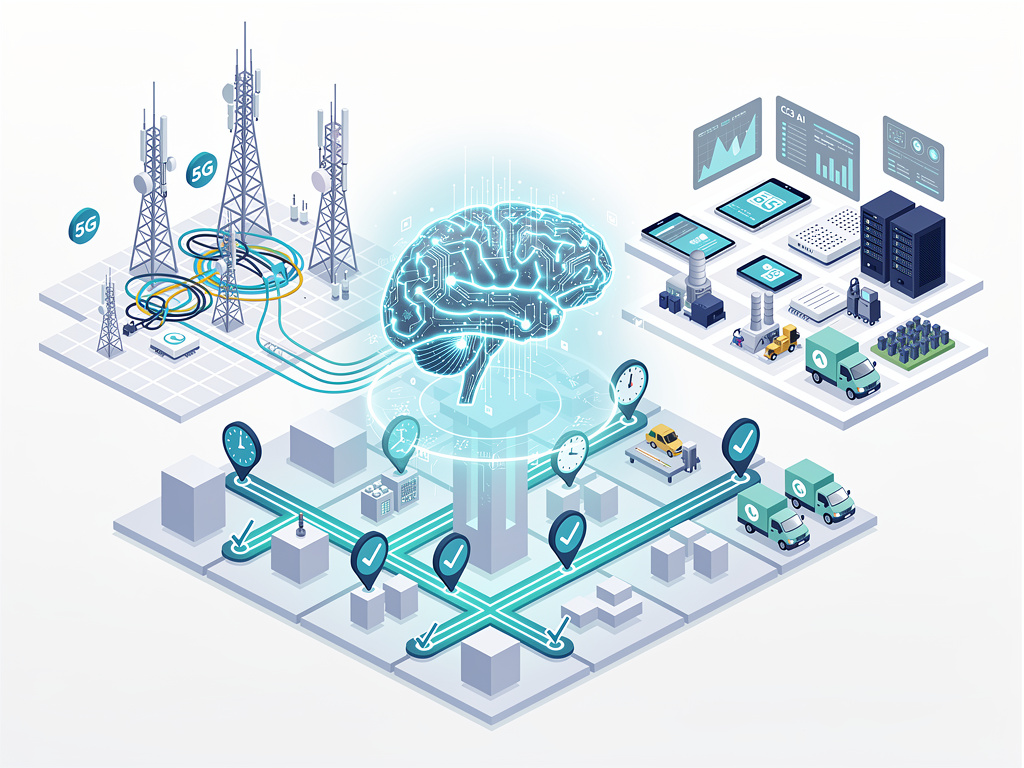
In a move that signals the accelerating convergence of enterprise communications, artificial intelligence, and next-generation network capabilities, Vonage — the cloud communications subsidiary of Ericsson — has announced a strategic collaboration with C3 AI to develop a network-enabled, agentic AI solution purpose-built for mobile field service workforces. The partnership, unveiled on February 11, 2026, aims to harness the power of 5G network APIs, real-time data analytics, and autonomous AI agents to fundamentally transform how enterprises manage dispatching, scheduling, and on-site service delivery.
The announcement, first reported by Yahoo Finance Singapore, outlines a joint solution that combines Vonage’s Network APIs — which tap directly into the capabilities of underlying telecom infrastructure — with C3 AI’s enterprise AI platform, including its C3 Generative AI and agentic AI technologies. The result is a field services platform designed to operate with a level of intelligence and autonomy that goes well beyond traditional workforce management software.
The Architecture of an Agentic Field Services Platform
At the core of the partnership is the concept of “agentic AI” — artificial intelligence systems that can autonomously perceive their environment, make decisions, and take actions without constant human oversight. In the context of field services, this means AI agents that can dynamically reroute technicians based on real-time traffic and network conditions, predict equipment failures before they occur, and automatically escalate or de-escalate service tickets based on evolving situational data.
Vonage’s contribution centers on its suite of Network APIs, which are part of the broader CAMARA initiative — an open-source project backed by the GSMA and the Linux Foundation that standardizes access to telecom network capabilities. These APIs allow applications to query and leverage network functions such as quality-on-demand bandwidth allocation, device location verification, number verification, and SIM swap detection. For field service operations, this means the AI platform can, for example, verify a technician’s precise location using network-level data rather than relying solely on GPS, or ensure that a video-assisted remote repair session receives prioritized bandwidth allocation in congested network areas.
Why Field Services Is the Beachhead for Enterprise Agentic AI
The choice of field services as the initial use case for this collaboration is far from arbitrary. The global field service management market has been on a steep growth trajectory, driven by increasing equipment complexity, labor shortages, and rising customer expectations for rapid, first-time-fix resolutions. According to industry estimates, the market is expected to exceed $8 billion by 2028, with AI-driven optimization representing the fastest-growing segment.
Field service operations are uniquely suited to agentic AI because they involve a high volume of real-time, variable decisions — which technician to dispatch, what parts to pre-stage, how to reroute when a job runs long, and when to escalate to a specialist. Traditional rule-based scheduling systems struggle with this complexity. C3 AI’s platform, which has been deployed across industries including energy, manufacturing, defense, and financial services, brings a proven enterprise AI architecture capable of ingesting massive volumes of operational data and generating predictive and prescriptive insights at scale.
Ericsson’s Broader Network API Strategy Takes Shape
For Ericsson, the parent company of Vonage, this partnership represents another critical step in its strategy to monetize 5G network capabilities through programmable APIs. Since acquiring Vonage in 2022 for approximately $6.2 billion, Ericsson has been working to position the communications platform as a bridge between telecom infrastructure and enterprise application developers. The Network API initiative is central to this vision — transforming the mobile network from a passive connectivity pipe into an active, intelligent platform that applications can programmatically interact with.
Niklas Heuveldop, Head of Business Area Global Communications Platform at Ericsson and CEO of Vonage, has previously articulated this vision in terms of creating a “global network API marketplace” that allows developers to access capabilities from multiple operators through a single integration point. The collaboration with C3 AI represents one of the most concrete enterprise use cases to emerge from this strategy, demonstrating how network-level intelligence can be embedded directly into business-critical AI applications rather than remaining siloed within the telecom domain.
C3 AI’s Enterprise Positioning and the Agentic AI Arms Race
For C3 AI, led by founder and CEO Thomas Siebel, the partnership with Vonage extends the company’s push into agentic AI — a category that has become one of the most fiercely contested battlegrounds in enterprise technology. C3 AI has been building out its agentic capabilities through its C3 Generative AI platform, which enables enterprises to deploy AI agents that can reason across structured and unstructured data, interact with enterprise systems of record, and execute multi-step workflows autonomously.
The company has been positioning itself against a crowded field of competitors including Salesforce’s Agentforce, Microsoft’s Copilot ecosystem, ServiceNow’s AI agents, and a host of startups. What differentiates the C3 AI-Vonage approach is the deep integration with network-level telemetry and capabilities — a dimension that pure software AI platforms typically cannot access. By combining C3 AI’s enterprise reasoning engine with Vonage’s real-time network data, the joint solution can make dispatching and routing decisions informed not just by business logic and historical patterns, but by the actual state of the communications network that field workers depend on.
Real-World Implications for Mobile Workforces
Consider a practical scenario: a utility company managing hundreds of technicians across a metropolitan area responding to storm damage. The agentic AI system could ingest real-time data from IoT sensors on grid equipment, cross-reference it with network quality data from Vonage’s APIs to identify areas where communications infrastructure is degraded, factor in technician skill sets and parts inventory from the enterprise resource planning system, and autonomously generate an optimized dispatch plan that accounts for all of these variables simultaneously. If conditions change — a new outage is reported, a road becomes impassable, or a technician’s device loses reliable connectivity — the system can re-optimize in real time without human intervention.
This level of autonomous, context-aware decision-making represents a significant leap beyond current field service management tools, which typically require human dispatchers to interpret dashboards and manually adjust schedules. The potential efficiency gains are substantial: industry studies have consistently shown that AI-optimized field service operations can improve first-time fix rates by 15-25%, reduce average response times by 20-30%, and lower operational costs by 10-20%.
The Telecom-AI Convergence Accelerates
The Vonage-C3 AI partnership also reflects a broader trend of telecommunications companies seeking to position themselves as essential infrastructure providers for the AI era, rather than being relegated to commodity connectivity. Ericsson, along with peers like Nokia, Deutsche Telekom, and others, has been investing heavily in network API platforms as a way to capture value from the AI boom. The GSMA’s Open Gateway initiative, which now has more than 60 operator groups participating, provides the standardization framework that makes partnerships like this one scalable across multiple markets and network operators.
The timing of the announcement is also notable in the context of the broader enterprise AI market, which has seen a surge of activity around agentic AI in late 2025 and early 2026. Gartner, Forrester, and other analyst firms have identified agentic AI as one of the top strategic technology trends, with enterprises increasingly moving beyond chatbot-style generative AI toward autonomous systems capable of executing complex business processes. The field services vertical, with its combination of physical-world complexity and data-rich decision-making, is widely seen as one of the most promising early adoption domains.
What Comes Next for the Partnership
While the initial announcement focuses on field services, the underlying architecture of the Vonage-C3 AI collaboration has obvious extensibility to other mobile workforce scenarios — including logistics and delivery operations, healthcare home visits, insurance claims adjustments, and infrastructure inspection. Both companies have signaled that the field services solution is a starting point rather than an endpoint, with plans to expand the joint offering as the Network API ecosystem matures and additional telecom capabilities become programmable.
For enterprise technology buyers, the partnership raises important questions about the evolving role of telecommunications infrastructure in AI-driven operations. As network APIs make it possible to embed real-time connectivity intelligence directly into business applications, the traditional boundaries between communications platforms, AI engines, and operational technology systems are blurring rapidly. The Vonage-C3 AI collaboration offers an early glimpse of what this convergence looks like in practice — and suggests that the most transformative enterprise AI applications may be those that understand not just the business context, but the network context in which mobile workers operate.
The solution is expected to become available through both Vonage and C3 AI’s go-to-market channels, though specific pricing, availability timelines, and initial customer deployments have not yet been disclosed. Industry observers will be watching closely to see whether the combination of agentic AI and network-enabled intelligence delivers on its considerable promise — or whether the complexity of integrating telecom infrastructure with enterprise AI platforms proves to be a more formidable challenge than either company anticipates.


 WebProNews is an iEntry Publication