
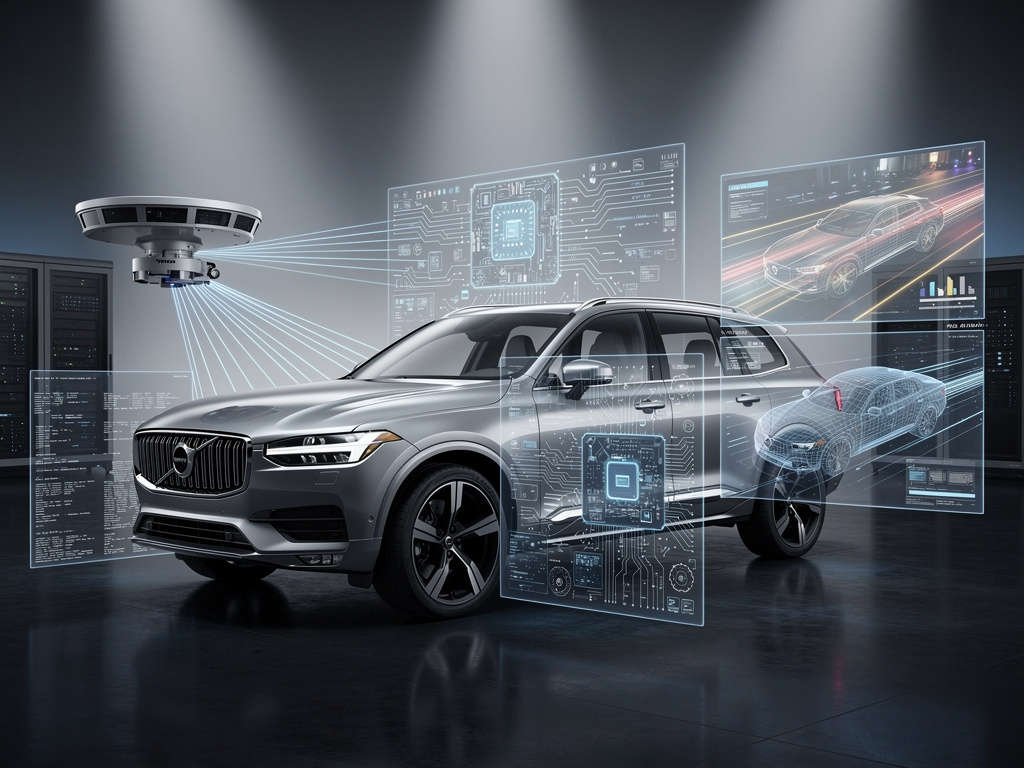
GOTHENBURG, Sweden – In the fiercely competitive electric vehicle market, simply launching a new battery-powered SUV is no longer enough to command attention. For Volvo Cars, a brand built on a century of safety innovation, the impending arrival of its flagship EX90 represents a fundamental strategic pivot. The seven-seat electric SUV is not merely a vehicle; it’s a meticulously engineered ecosystem on wheels, a rolling testament to the idea that the future of the automobile will be defined by silicon, not just steel.
Volvo is betting its reputation, and a significant portion of its future, on a complex tapestry of technologies woven together by partners more commonly associated with smartphones and video games than with premium automobiles. By integrating core computing from Qualcomm, advanced visualization from Epic Games’ Unreal Engine, and a sophisticated perception system headlined by Luminar’s LiDAR, Volvo aims to leapfrog competitors, including Tesla, in the race to create the software-defined vehicle. Yet, this ambitious strategy has already encountered the harsh realities of execution, with software complexity pushing back its production timeline, a clear signal of the immense challenges inherent in this technological reinvention.
A New Foundation of Safety and Perception
At the heart of the EX90’s technological suite is a system that Volvo executives refer to as an “invisible shield of safety.” Central to this shield is the standard inclusion of a roof-mounted Iris LiDAR unit from Palo Alto-based Luminar. This sensor actively scans the environment with a laser, capable of detecting objects with precision far beyond what is typically possible with cameras and radar alone. According to a detailed report from Digital Trends, the system can spot a black tire on a black road at a distance of 120 meters and pedestrians at 250 meters, day or night. This data provides the high-fidelity environmental model necessary for more reliable advanced driver-assistance systems (ADAS) and, eventually, autonomous driving.
This commitment to LiDAR as a standard feature places Volvo in direct strategic opposition to competitors like Tesla, which has famously pursued a vision-only approach. While camera-based systems have proven capable, Volvo’s multi-sensor fusion—combining LiDAR with eight cameras, five radars, and 16 ultrasonic sensors—is designed to create a level of redundancy and environmental understanding that is critical for building consumer trust in automated systems. In a statement following the EX90’s reveal, Luminar CEO Austin Russell hailed the vehicle as the beginning of a “new era of safety,” underscoring the belief that making the technology standard, rather than a high-priced option, will be a key market differentiator, as noted in a Luminar press release.
The Centralized Brain and a Software-First Architecture
Processing the immense amount of data generated by this sensor suite requires a radical departure from traditional automotive electronics. For decades, vehicles have relied on a distributed network of dozens of electronic control units (ECUs), each responsible for a specific function. The EX90 consolidates these functions into a centralized core computing system, a move that mirrors modern computer architecture. This “brain” is powered by high-performance chips from Qualcomm’s Snapdragon Cockpit Platform, a system-on-a-chip (SoC) designed to handle everything from critical safety functions to the in-car infotainment.
This centralized approach is a cornerstone of the industry-wide push towards the software-defined vehicle. By decoupling software from specific hardware, automakers can develop, deploy, and update features over the air (OTA) throughout the vehicle’s life. This allows the car to improve over time, adding new capabilities and enhancing existing ones long after it has left the showroom. Qualcomm’s integrated “Digital Chassis” concept provides the powerful, scalable hardware foundation necessary for this vision, enabling the EX90 to manage the complex interplay between ADAS, battery management, and the user interface, according to Qualcomm.
Redefining the Human-Machine Interface
The most visible manifestation of the EX90’s computing power is its user interface. Volvo has partnered with Epic Games to use its Unreal Engine—the same 3D creation tool behind blockbuster video games like Fortnite—to render the graphics on the vehicle’s 15-inch center touchscreen and driver display. This collaboration delivers real-time, high-definition graphics with a level of fluidity and visual fidelity previously unseen in a production vehicle. The system can render photorealistic visualizations of the car and its surroundings, clearly indicating to the driver what the car’s sensors are “seeing,” a critical component for building trust in its ADAS features.
The use of a gaming engine is more than a cosmetic upgrade. It provides Volvo with a powerful and flexible platform for creating an intuitive and context-aware human-machine interface (HMI). For example, the display can seamlessly transition between media controls, navigation, and ADAS visualizations without the lag or clunky animations common in traditional automotive systems. As detailed in a blog post by Unreal Engine, this technology enables developers to create rich, interactive experiences that can be easily updated and customized, turning the car’s cabin into a responsive and intelligent environment. The underlying operating system is Google’s Android Automotive OS, which brings familiar apps like Google Maps and Google Assistant directly into the dashboard, ensuring a seamless connection to the driver’s digital life through what the tech giant calls “Google built-in,” a system now being adopted by multiple automakers according to Google’s Android site.
The Sobering Reality of Software Integration
While the technological promise of the EX90 is immense, its journey to production highlights the profound challenges of this new automotive paradigm. Volvo was forced to delay the start of production from late 2023 into mid-2024, a setback the company attributed directly to the intricacy of its software. In a statement reported by Reuters, CEO Jim Rowan cited the “complexity of the software code,” particularly related to integrating the LiDAR system, as the primary reason for the delay. This admission serves as a cautionary tale for the entire industry: assembling best-in-class hardware from multiple tech partners is one thing, but making it all work together seamlessly in a safety-critical application is another order of magnitude more difficult.
This challenge is not unique to Volvo. Across the industry, automakers are discovering that the transition from being hardware manufacturers to software integrators requires a fundamental shift in corporate culture, talent, and development processes. The EX90’s delay underscores that the core competency for the next generation of automakers will be software validation and integration. Getting it right is non-negotiable, as software glitches in a vehicle can have far more severe consequences than in a smartphone or a gaming console. The delay, while frustrating for customers and investors, reflects a prudent decision to prioritize safety and system stability over a hasty market launch.
A Glimpse into the Automotive Future
The Volvo EX90, with its ambitious fusion of technologies from disparate industries, represents a bold vision for the future of personal mobility. It is a vehicle conceived around a central nervous system, designed to perceive its environment with unprecedented accuracy and interact with its occupants through a rich, intuitive interface. This tech-forward strategy is Volvo’s answer to a market being rapidly reshaped by new players who treat the car as a connected device first and a mode of transportation second.
Success, however, will be measured not by the sophistication of its individual components, but by the coherence and reliability of the final product. The production delays demonstrate that the path to the software-defined vehicle is fraught with complexity. If Volvo can overcome these integration hurdles and deliver on the promise of a safer, smarter vehicle that improves over time, the EX90 will not only redefine the Volvo brand for the electric age but also provide a crucial blueprint for how legacy automakers can successfully navigate the industry’s most significant transformation in a century.


 WebProNews is an iEntry Publication