
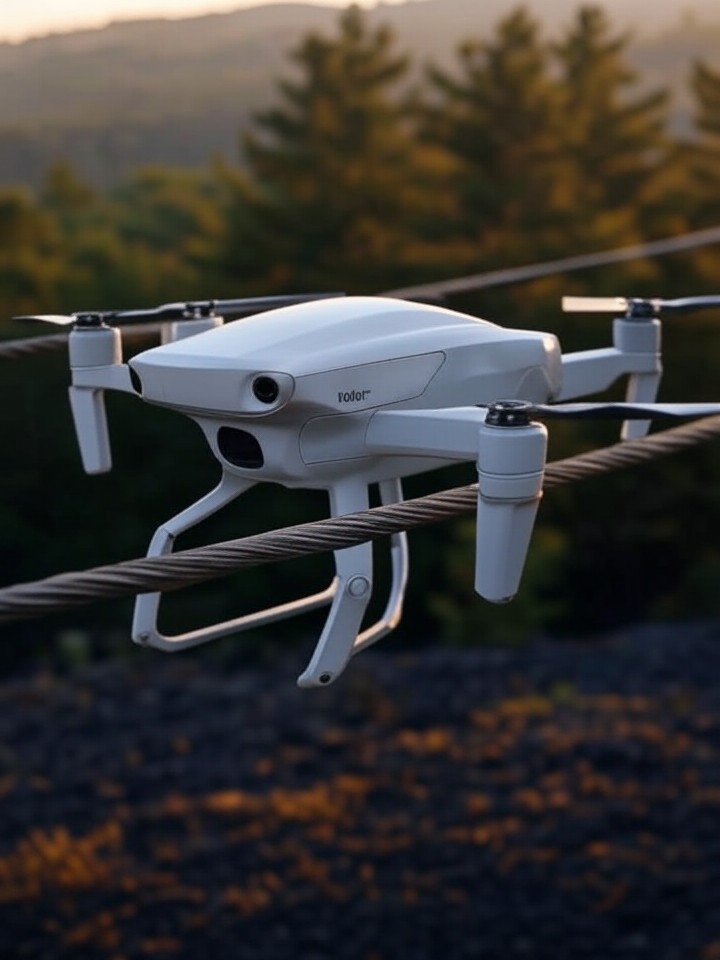
In the fast-evolving world of energy infrastructure, a San Francisco-based startup is redefining how power grids are monitored and maintained. Voltair, founded in 2025 by a team of engineers with backgrounds in aerospace and defense, has captured attention for its innovative approach to drone technology. Backed by the prestigious accelerator Y Combinator, the company is developing self-charging drones that can perch on transmission lines like birds, drawing power directly from the grid to enable indefinite flight ranges. This breakthrough addresses a critical bottleneck in autonomous aerial vehicles: the need for frequent battery swaps, which has long hindered large-scale deployment in industries like utilities.
At its core, Voltair’s technology stems from the founders’ experiences building drones for high-stakes clients, including the U.S. Air Force and the Defense Advanced Research Projects Agency (DARPA). Co-founder Ronan Nopp, who previously worked on advanced UAV systems, realized that true autonomy required eliminating human intervention in recharging. The drones use specialized grippers to attach to power lines, converting the electrical current into usable energy without disrupting grid operations. This parasitic recharging method not only extends operational time but also allows for continuous data collection on grid health, fault detection, and even wildfire risks.
Early pilots have shown promise in preventing disasters. In regions prone to wildfires, such as California, these drones can patrol vast stretches of power lines, using onboard sensors to spot overheating components or vegetation encroachment that could spark blazes. By integrating artificial intelligence for real-time analysis, Voltair’s system alerts operators before issues escalate, potentially saving billions in damages and outages. The startup’s website, Voltair Labs, details how their autonomous fleets have already been tested in simulated environments, detecting hazards with over 95% accuracy.
Pioneering Autonomy in Grid Management
Voltair’s entry into the market comes at a pivotal time for the energy sector, where aging infrastructure meets surging demand from data centers and electric vehicles. According to recent coverage in TechCrunch, venture investors remain bullish on climate tech despite economic headwinds, citing innovations like Voltair’s as key to scaling sustainable solutions. The company’s five-person team, based in San Francisco, is actively hiring for roles in engineering, marketing, and operations, signaling rapid growth ambitions. Founders Hayden Gosch, Avi Gotskind, Nopp, and Warren Weissbluth bring a mix of expertise from robotics and software, positioning Voltair to compete with established players in drone-based inspections.
What sets Voltair apart is its focus on integration with existing power systems. Unlike traditional drones that require ground stations for recharging, these units treat the grid itself as an infinite energy source. This design draws from biomimicry—emulating how birds rest on wires—combined with advanced materials that ensure safe, non-conductive perching. Industry insiders note that this could reduce operational costs by up to 70%, as fleets operate without downtime. Posts on X have highlighted the buzz, with users describing it as a “parasitic autonomy” that turns infrastructure into a deployment layer for continuous monitoring.
Beyond wildfire prevention, Voltair’s drones target broader grid faults, such as corrosion or structural weaknesses in transmission towers. In a 2026 context, where global energy demands are projected to rise 15% annually, per data from energy analysts, this technology could play a crucial role in maintaining reliability. The startup’s participation in Y Combinator’s batch has provided not just funding but also mentorship, helping refine their go-to-market strategy for utilities companies.
Investor Optimism and Market Potential
Venture capital’s enthusiasm for energy innovations is evident in lists like those from Y Combinator’s energy startups directory, which features 33 companies tackling similar challenges. Voltair stands out for its hardware-software synergy, where AI algorithms process visual and thermal data in real-time. This capability was showcased indirectly at events like CES 2026, where power innovations dominated discussions, as reported in Power Electronics News. There, advancements in ultra-low-power systems and battery-free technologies echoed Voltair’s ethos, though the startup itself wasn’t exhibiting.
Investors point to the massive market opportunity: the global power grid inspection sector is valued at over $10 billion, with drones poised to capture a significant share. TechCrunch’s investor roundup emphasized how data center-driven electricity demands are fueling interest in efficient monitoring tools. Voltair’s model aligns perfectly, offering utilities a way to preemptively address issues amid climate-driven extreme weather. One X post from a robotics enthusiast noted how these drones could create “self-sustaining ecosystems,” allowing infinite-range operations that traditional UAVs can’t match.
Challenges remain, however. Regulatory hurdles, such as FAA approvals for beyond-visual-line-of-sight flights, could slow deployment. Additionally, ensuring the drones’ perching mechanisms don’t interfere with high-voltage lines requires rigorous testing. Voltair has addressed this through partnerships with grid operators, conducting field trials that demonstrate minimal impact. Their approach contrasts with competitors who rely on solar or ground-based charging, which limit range in remote areas.
Technological Edge and Future Expansions
Delving deeper into the tech, Voltair’s drones incorporate proprietary power conversion tech that safely taps into alternating current without shorts or surges. This involves micro-inverters and insulating materials developed in-house, drawing from DARPA-inspired resilience. The result is a drone that can recharge in minutes, resuming patrols seamlessly. For industry experts, this represents a shift toward “edge computing” in the skies, where data is processed onboard to reduce latency in critical alerts.
Expansion plans include scaling to international markets, where grid vulnerabilities are acute. In Europe, for instance, aging networks face similar wildfire and fault risks, and Voltair’s tech could integrate with renewable-heavy systems. Coverage from Interesting Engineering at CES 2026 highlighted solar-powered automation trends that complement Voltair’s grid-perching model, suggesting hybrid applications in off-grid scenarios. Meanwhile, Y Combinator’s broader startup directories, like those for artificial intelligence, underscore how AI enhancements could evolve Voltair’s predictive capabilities.
Critics, however, question scalability. Producing these specialized drones at volume requires manufacturing partnerships, and supply chain issues for rare materials could pose risks. Voltair counters this by focusing on modular designs, allowing easy upgrades. Posts on X reflect mixed sentiment, with some praising the innovation’s potential for utility inspection at unprecedented scales, while others speculate on broader applications like environmental monitoring.
Strategic Alliances and Industry Impact
Strategic alliances are key to Voltair’s trajectory. Collaborations with energy giants could accelerate adoption, providing real-world data to refine algorithms. For instance, integrating with smart grid systems would enable predictive maintenance, reducing outages that cost the U.S. economy $150 billion yearly. This aligns with trends in Startup News FYI‘s CES 2026 roundup, which spotlighted innovations for founders in hardware and AI, areas where Voltair excels.
The founders’ vision extends beyond utilities. Potential adaptations include agricultural monitoring or disaster response, where infinite-range drones could survey vast areas without refueling. Warren Weissbluth, with his operations background, emphasizes cost efficiencies, projecting that widespread adoption could lower inspection expenses by half within five years. This optimism is echoed in TechCrunch’s list of clean tech startups from Disrupt Startup Battlefield, where energy efficiency plays a starring role.
Looking ahead, Voltair’s success hinges on navigating intellectual property landscapes and securing patents for their perching tech. With Y Combinator’s backing, they’ve already attracted seed funding, positioning them among top active investors like Andreessen Horowitz and Sequoia, as detailed in Crunchbase News. Industry watchers see this as a bellwether for how startups can disrupt entrenched sectors.
Broader Implications for Energy Innovation
As energy demands intensify, innovations like Voltair’s highlight the intersection of robotics and infrastructure. By enabling autonomous, perpetual operations, the startup addresses pain points that have plagued grid management for decades. This could inspire similar advancements in other fields, such as transportation or telecommunications, where self-sustaining devices reduce human oversight.
Voltair’s story also underscores the role of accelerators in fostering breakthroughs. Y Combinator’s energy cohort provides a fertile ground for such ideas, with alumni often scaling rapidly. Posts on X capture public excitement, describing it as a game-changer for wildfire-prone regions, though they caution that real-world efficacy remains to be proven at scale.
Ultimately, Voltair represents a bold step toward resilient energy systems. As the company hires and iterates, its impact could ripple through global grids, making preventive maintenance not just feasible but routine. With ongoing trials and investor support, the startup is poised to lead in an era where technology meets the urgent need for sustainable power oversight.


 WebProNews is an iEntry Publication