
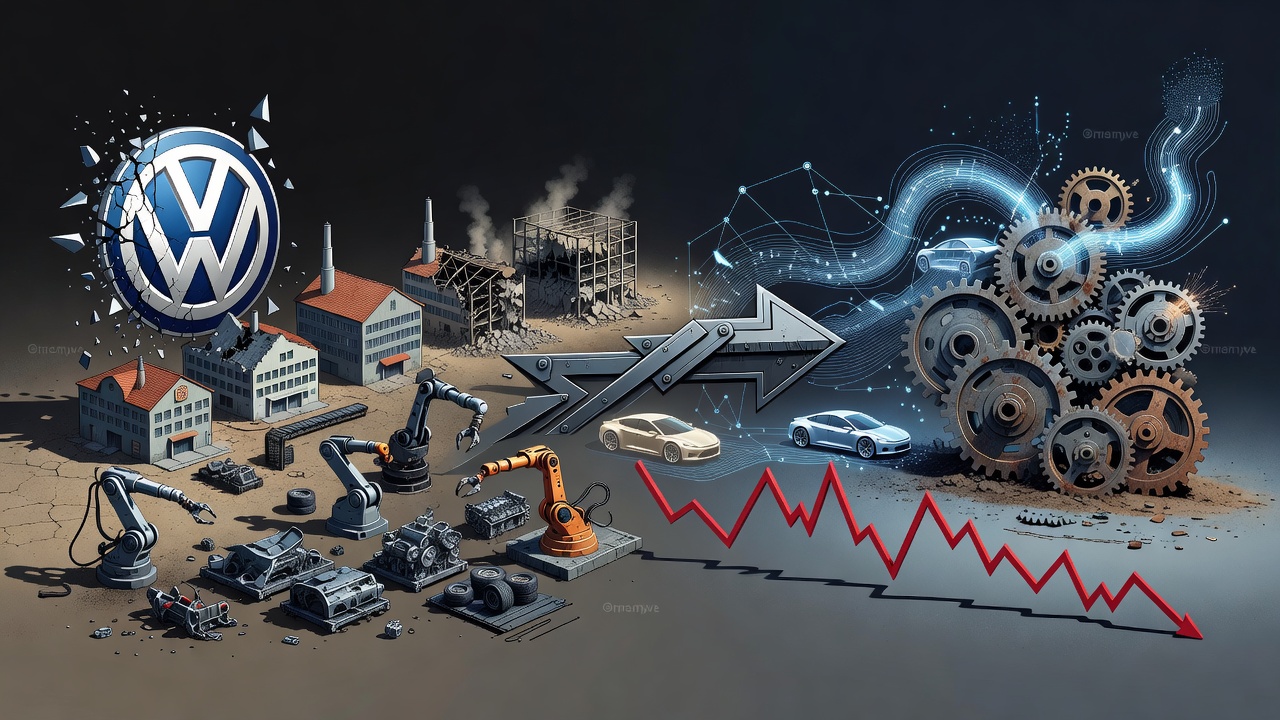
BERLIN — Volkswagen stands at the edge of its most sweeping transformation in nearly nine decades. The German automaker is weighing plans to eliminate up to 100,000 positions worldwide and shutter four domestic factories, according to people familiar with the discussions. The scale would dwarf prior rounds of belt-tightening and mark one of the largest corporate restructurings in automotive history.
Chief Executive Oliver Blume presented the outline to senior leaders this week. The proposal builds on earlier targets but accelerates them sharply. It reflects mounting pressure from high labor expenses in Germany, softening demand in Europe, U.S. tariffs, and the rapid advance of lower-cost Chinese competitors. Shares slid toward 15-year lows in recent trading as the details leaked.
The targeted sites — plants in Hanover, Zwickau and Emden, plus Audi’s facility in Neckarsulm — together employ more than 45,000 workers. Closing them or sharply reducing output would compound the pain. Add in roughly 50,000 positions already slated for removal by 2030, and the total approaches 100,000, or about 15 percent of the group’s global headcount of roughly 657,000.
Pressure From Beijing Reshapes the Industry Map
Chinese brands have flooded European showrooms with affordable electric vehicles while legacy manufacturers struggle with the transition. Volkswagen’s own EV sales have lagged expectations. Profit margins have thinned. Investment plans face a reported 15 percent cut over five years to preserve cash.
Blume, who took the top job in 2022, has spent the past year warning that the current business model is unsustainable. On June 11 he told investors the company would still deliver 19,000 job reductions in Germany by year-end as previously agreed. Yet internal assessments now show those steps fall short. “Never has the risk situation been so high,” one executive told Reuters.
But resistance is fierce. The works council, powerful union IG Metall and the state of Lower Saxony — Volkswagen’s second-largest shareholder — have vowed to fight any forced layoffs or plant closures. Negotiations promise to be bruising. Past deals relied on attrition, early retirement and buyouts rather than outright dismissals. This time the numbers may force harder choices.
And the pain isn’t isolated. Other German carmakers are trimming as well. The Financial Times reported this week that the country’s auto sector has embarked on historic job reductions driven by the same Chinese surge. Volkswagen’s move, if realized, would stand as the starkest example yet.
Analysts say the company must shrink its German footprint to compete. Domestic plants carry some of the world’s highest production costs. Meanwhile Chinese rivals benefit from scale, vertical integration and government support. Even with tariffs, their vehicles undercut VW offerings on price.
Blume has floated selling non-core brands to raise capital. The Financial Times noted that the brutal job cull has already sparked talk of parting with crown jewels. No decisions have been made, but the option sits on the table.
Earlier this month Reuters reported that more than 28,000 job reductions had been locked in through 2030. The new proposal would more than triple that pace in some scenarios. Managers Magazine first broke the expanded target on June 26, citing insiders. The story quickly rippled across global outlets.
CNN detailed the 15 percent workforce reduction and factory closures. CNBC called it a “radical overhaul.” The Wall Street Journal highlighted additional thousands of losses beyond the 50,000 already negotiated. Axios framed the downsizing as a direct response to Chinese competition reshaping the global industry.
On X, reaction mixed shock with recognition of broader trends. One analyst noted Volkswagen shares testing multi-year lows while another linked the cuts to the parallel rise of advanced AI models that reduce the need for certain manufacturing roles. The conversation underscored a larger economic shift: legacy industries contracting as technology accelerates.
Volkswagen declined to comment on the specific figures when asked by reporters. A spokesman reiterated commitment to consultation with employee representatives. The company has long prided itself on social partnership. That tradition now faces its sternest test.
The proposed plants hold deep symbolic weight. Zwickau once churned out Trabants before reunification; today it builds electric ID models. Emden assembles Passats and ID.4 SUVs for export. Hanover produces commercial vans. Neckarsulm turns out premium Audi models. Each site anchors local economies. Job losses there would echo far beyond factory gates.
Union leaders warn of strikes if talks collapse. Politicians in affected states voice concern over deindustrialization. Lower Saxony’s premier has signaled readiness to use the state’s 20 percent voting stake to block moves deemed too aggressive.
Yet delay carries risks too. Volkswagen’s earnings have disappointed. Cash flow must fund massive spending on software, batteries and new platforms. Without meaningful cost relief, the group could lose ground to both Chinese upstarts and nimbler Western rivals investing heavily in next-generation vehicles.
Blume’s strategy rests on simplification. Fewer models. Shared platforms across brands. Faster decision-making. The job and plant proposals form one piece of that reset. Whether unions accept the scale remains uncertain. History shows German labor negotiations often produce compromise — but rarely at the speed executives now demand.
The coming weeks will reveal how far Volkswagen pushes and how much pushback it absorbs. One thing looks clear. The era of steady expansion and stable German employment at Europe’s largest automaker is ending. A smaller, leaner Volkswagen may emerge. The human cost of getting there will dominate headlines and boardroom battles for months.
Additional reporting from recent coverage by CNBC and The Wall Street Journal underscores the acceleration since initial 2024 announcements. The Yahoo Finance summary of the Manager Magazin report provided the original catalyst for wider discussion.


 WebProNews is an iEntry Publication