
Voice AI’s Enterprise Reckoning: Barriers Shattered, Builders Empowered
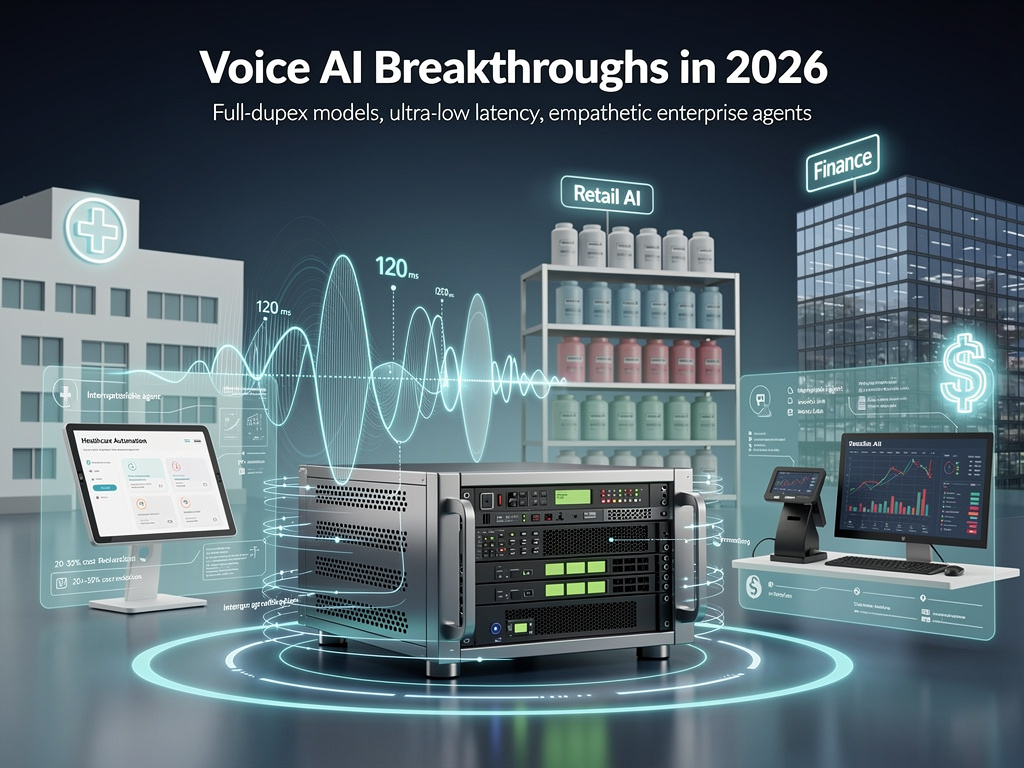
Despite years of hype, voice AI remained trapped in a rigid request-response cycle: users spoke, cloud servers transcribed input, processed it through large language models, and spat back scripted replies. That paradigm shattered in early 2026 with breakthroughs in latency, fluidity, efficiency, and emotional intelligence, handing enterprise AI builders the tools to craft truly conversational systems. Nvidia’s PersonaPlex-7B full-duplex model enables simultaneous listening and speaking, while Inworld TTS 1.5 delivers sub-120ms latency with viseme synchronization. As VentureBeat detailed, these advances solve the four ‘impossible’ problems that plagued voice interfaces.
Enterprises now stand at the threshold of deploying voice agents that mimic human dialogue—interruptible, emotionally attuned, and scalable. SoundHound AI’s Amelia 7 platform, unveiled at CES 2026, orchestrates multiple agents for tasks like food ordering and parking payments via voice in vehicles and TVs. ‘At CES 2026, SoundHound is showcasing a whole ecosystem of AI agents that perform tasks and transactions on behalf of consumers,’ said Keyvan Mohajer, CEO of SoundHound AI, per their press release. This agentic shift promises to embed voice AI into core operations across automotive, retail, and healthcare.
Gartner’s forecast underscores the momentum: 40% of enterprise applications will integrate task-specific AI agents by year-end, up from under 5% in 2025, as noted by Famulor. Global enterprise AI spending hit $391 billion, with 92% of firms planning generative AI investments, according to NextLevel.ai. Voice AI’s evolution from novelty to infrastructure demands strategic deployment.
Latency Conquered: Sub-200ms Responses Redefine Interaction
Inworld TTS 1.5 achieves P90 latency under 120ms, aligning with human conversational pauses around 200ms, eliminating the uncanny ‘thinking’ delays of prior systems. FlashLabs’ open-source Chroma 1.0 interleaves text and audio tokens for end-to-end real-time processing, available on Hugging Face. These models enable field technicians on spotty 4G to interact seamlessly with AI for diagnostics or inventory checks.
VoiceRun’s $5.5 million seed round, led by Flybridge Capital, funds a full-stack platform for code-first voice agents tailored to enterprise reliability and governance needs, as reported by PR Newswire. With 85% of enterprises expected to use AI agents by late 2025, control over development stacks becomes paramount.
Speechmatics saw real-time usage surge 4x in 2025, with medical models up 15x, processing over 30 million minutes to return hours to healthcare workers via ambient scribes. Their 2026 push includes English-Arabic bilingual models for global scaling, per Speechmatics.
Full-Duplex Fluidity: Interruptions and Backchannels Go Native
Nvidia’s PersonaPlex-7B, a 7B-parameter full-duplex model, uses dual streams—Mimi for listening, Helium for speaking—to handle interruptions and backchanneling like ‘uh-huh’ without rigid turn-taking. Open weights under Nvidia’s license make it accessible for enterprise fine-tuning. This fluidity transforms customer service from scripted bots to dynamic partners.
Sadie leads with human-like contextual memory for multi-turn dialogues, integrating multimodal inputs for richer enterprise workflows, as outlined in their 2026 trends blog. Edge processing ensures privacy and sub-second responses, critical for regulated sectors.
In contact centers, voice agents now manage 11-minute conversations resolving issues once needing multiple humans, yielding 3.7x ROI per dollar invested, per NextLevel.ai data. Y Combinator’s latest cohort saw 22% voice-first startups, with funding up eightfold to $2.1 billion.
Efficiency Unlocked: SLMs and Tokenizers Slash Costs
Alibaba’s Qwen3-TTS employs a 12Hz tokenizer for high-fidelity speech with minimal data, outperforming rivals on metrics like MCD and WER, hosted on Hugging Face. Small language models (SLMs) emerge as enterprise staples: ‘Fine-tuned SLMs will be the big trend… matching larger models in accuracy for business applications, and superb in cost and speed,’ said AT&T Chief Data Officer Andy Markus in TechCrunch.
Picovoice’s on-device platform processes voice data locally for HIPAA/GDPR compliance, ideal for healthcare intake or finance verification. Enterprises report 20-30% operational cost cuts and 35% faster call handling.
ElevenLabs hit $330M ARR, with enterprises deploying for 50,000+ monthly calls, blending voice generation and agents with HIPAA options, per TechCrunch.
Emotional Intelligence: The Human Edge in AI
Google DeepMind’s licensing of Hume AI’s emotional data, plus hiring its CEO, pivots emotion from gimmick to foundation. New Hume CEO Andrew Ettinger noted, ‘Emotion isn’t a feature; it’s a foundation,’ detecting frustration to de-escalate calls and boost satisfaction by 30%, as in VentureBeat.
NextLevel.ai’s emotional detection cuts escalations 25%, with healthcare saving $150B annually by 2026. Hume inked 8-figure deals across healthcare and finance.
Rajeev Dham of Sapphire Ventures predicts voice agents as ‘system-of-record’ in healthcare and sales, enabled by Anthropic’s Model Context Protocol (MCP), now standard with OpenAI and Microsoft support.
Agentic Orchestration: Workflows Go Autonomous
SoundHound’s Amelia supports MCP/A2A for mixing self-built and external agents, powering drive-thru and reservations. 80% of firms plan voice integration in customer service by 2026.
VoAgents’ multi-model platform accesses OpenAI and Anthropic for self-learning agents handling inbound/outbound calls, per Enterprise News.
Cognigy excels in contact centers for banking and healthcare, pulling records mid-call with enterprise accuracy.
Sector Transformations: From Healthcare to Retail
Healthcare leads with 81% consumer adoption; Speechmatics’ scribes yield 21x ROI. Retail sees 71% using voice for research, with 50% queue reductions.
BFSI holds 32.9% share; voice biometrics curb fraud. Manufacturing gains from multilingual SKU handling.
ServiceNow’s AI products eye $1B ACV by 2026. VCs like Greycroft eye voice as primary interface.
Deployment Strategies: Edge, Hybrid, Secure
Hybrid architectures blend on-device spatial awareness with cloud reasoning, per Kardome. Platforms like Deepgram offer VPC/edge for compliance.
Start with high-volume workflows, per BCG’s 10-20-70 rule: 70% people/processes. Measure containment, handle time for 6-12 month ROI.
Multilingual baselines handle 55+ languages, code-switching for global ops.


 WebProNews is an iEntry Publication