
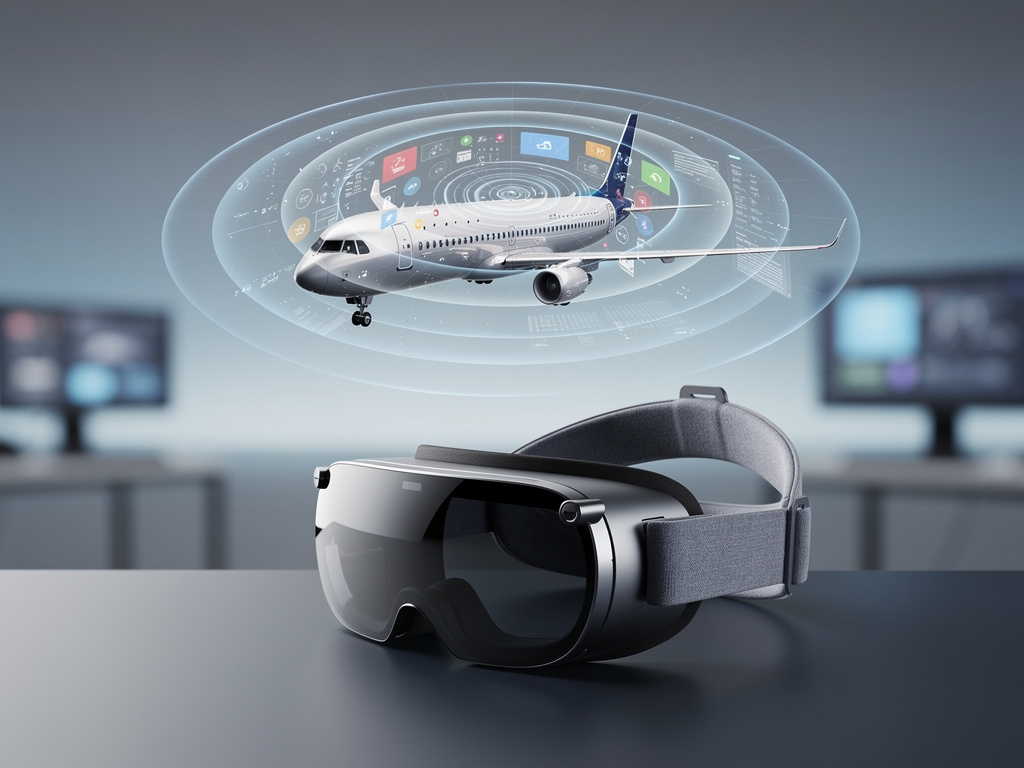
Apple just gave its spatial computing headset its most compelling argument yet for mainstream adoption. With the release of visionOS 26.4, Apple Vision Pro now supports Microsoft Flight Simulator 2024 — widely regarded as the world’s most advanced flight simulation — running natively in mixed reality. Not streamed. Not emulated. Native.
The update, first reported by 9to5Mac, represents a significant technical milestone for Apple’s headset, which has struggled to attract the kind of heavyweight software titles that justify its $3,499 price tag. Microsoft Flight Simulator 2024, developed by Asobo Studio in partnership with Microsoft, is one of the most computationally demanding consumer applications ever built, streaming petabytes of photogrammetry data from Azure cloud servers to render a photorealistic replica of Earth in real time.
Getting it to run on Vision Pro is no small feat.
The technical underpinning here is a new set of APIs introduced in visionOS 26.4 that dramatically expand what developers can do with the M2 chip and R1 coprocessor inside the headset. Apple has opened up lower-level GPU access, improved memory management for large-scale 3D asset streaming, and — critically — added support for adaptive foveated rendering at a system level. That last piece matters enormously. Foveated rendering concentrates GPU power on the exact spot where your eyes are looking while reducing detail in the periphery, and Apple’s eye-tracking hardware is among the best in any consumer headset. By making this a system-level feature rather than something each developer has to implement independently, Apple has effectively given every app on the platform a significant performance boost for free.
Microsoft and Asobo confirmed the partnership in a joint statement, noting that the Vision Pro version of Flight Simulator 2024 will support the full simulation experience including live weather, real-time air traffic, and the complete global scenery library. Players can use compatible Bluetooth flight peripherals — yokes, throttle quadrants, rudder pedals — or a new hand-tracking control scheme designed specifically for spatial computing.
That hand-tracking option is interesting. And potentially transformative for how people think about simulation software on headsets.
Rather than mapping traditional joystick inputs to hand gestures (which tends to feel awkward and imprecise), Asobo built what they’re calling “spatial cockpit interaction.” You reach out and grab the actual virtual yoke. You flip overhead switches by reaching up. You adjust the throttle by pushing a physical-feeling lever forward in space. According to early hands-on impressions shared by aviation YouTuber and beta tester reported by 9to5Mac, the experience is “the closest thing to sitting in a real cockpit that I’ve ever felt outside of a Level D full-motion simulator.”
Why this matters beyond gaming
Flight simulation has always occupied an unusual space between entertainment and professional training. Airlines, military organizations, and flight schools already use Microsoft Flight Simulator as a supplementary training tool. The Vision Pro version could accelerate that trend significantly. A $3,499 headset running a $70 piece of software is orders of magnitude cheaper than even the most basic certified flight training device, which typically starts around $50,000.
Apple clearly sees this. The company’s press materials for visionOS 26.4 lead with enterprise and professional use cases, not gaming. They highlight partnerships with Boeing and Airbus to develop Vision Pro-compatible procedural training modules built on top of the Flight Simulator engine. Neither aerospace company has confirmed timelines, but the intent is clear: Apple wants Vision Pro in corporate training centers, not just living rooms.
But let’s be honest about the challenges. Vision Pro’s roughly two-hour battery life on the external pack is a real constraint for extended simulation sessions. Thermal management is another concern — pushing the M2 chip to its limits with a compute-intensive application strapped to your face generates heat, and prolonged sessions could trigger thermal throttling. Apple says visionOS 26.4 includes improved thermal management algorithms, but real-world performance under sustained load remains to be seen.
There’s also the question of competition. Meta’s Quest 3S costs $299 and already runs a version of Microsoft Flight Simulator via Xbox Cloud Gaming, albeit streamed rather than native. The visual quality doesn’t compare — Quest 3S has roughly one-third the pixels per eye — but for casual users, “good enough at one-tenth the price” is a compelling pitch. And Sony’s PlayStation VR2, now PC-compatible, offers another sub-$500 path to VR flight simulation.
Still, none of those devices match Vision Pro’s display quality, eye tracking precision, or passthrough fidelity. For professional applications where visual clarity and spatial accuracy matter, Apple’s headset remains in a class of its own.
The timing of this announcement isn’t accidental. Apple’s Worldwide Developers Conference is three months away, and persistent rumors suggest a second-generation Vision Pro with an M4 chip is on the horizon. Demonstrating that the current hardware can run something as demanding as Flight Simulator 2024 serves a dual purpose: it validates the existing product for buyers on the fence today, and it sets expectations for what the next generation could handle.
So what should industry professionals actually take away from this?
First, Apple’s developer tools for Vision Pro are maturing fast. The APIs in visionOS 26.4 represent a meaningful leap in what third-party developers can build. Second, the enterprise play is becoming more explicit — Apple isn’t being subtle about wanting Vision Pro in workplaces. Third, Microsoft’s willingness to invest in a native Vision Pro port of one of its flagship titles signals growing confidence in the platform’s commercial viability. Microsoft doesn’t allocate Asobo’s engineering resources on a whim.
The Flight Simulator port arrives as a free update for existing owners of the PC version, with a standalone Vision Pro purchase option at $69.99. It goes live on March 24. Pre-downloads start this Friday.
For a headset that’s been searching for its killer app since launch, this might be it. Not because everyone wants to fly planes. But because it proves the hardware can handle software that actually demands everything it’s got.


 WebProNews is an iEntry Publication