
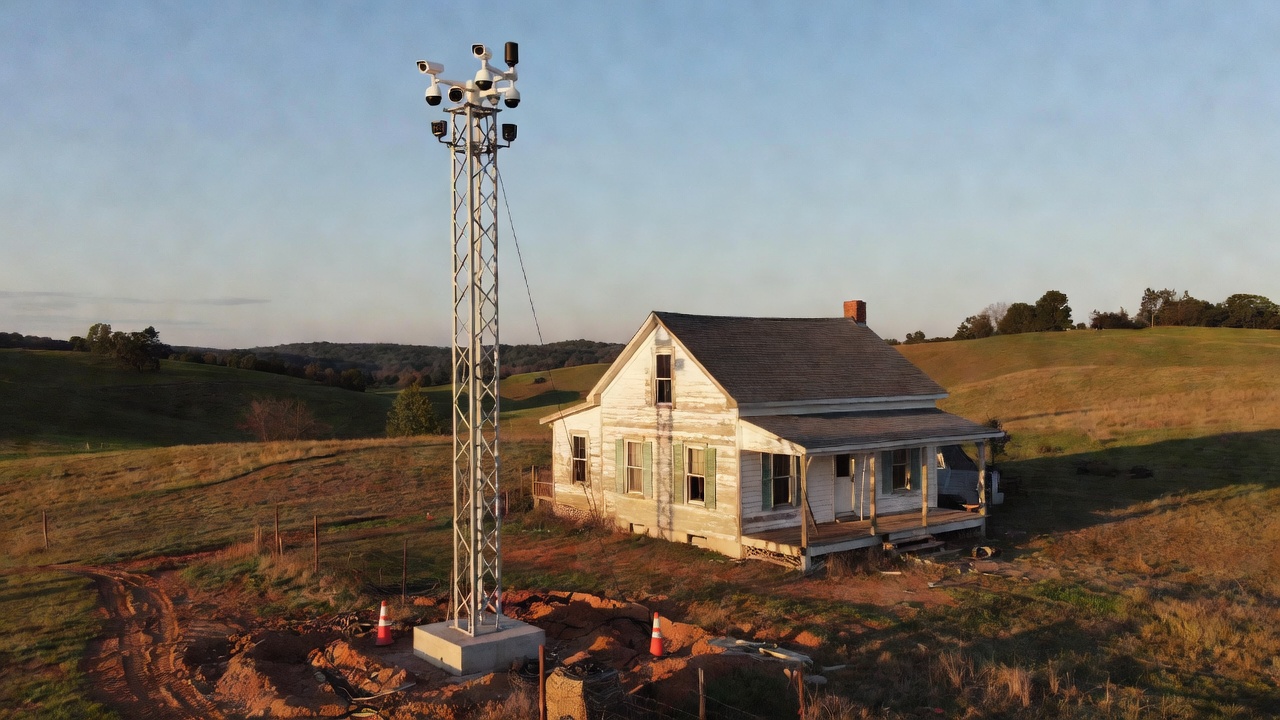
A woman living in rural Virginia discovered that a towering surveillance structure had appeared on neighboring property without any advance warning or community discussion. The incident, first reported by Futurism, quickly drew attention because it highlighted how rapidly private surveillance technology can spread across American landscapes and how little legal protection exists against it.
The structure in question stands roughly 200 feet tall, equipped with multiple high-resolution cameras, thermal imaging sensors, and wireless transmission equipment. From a distance it resembles a cell tower, yet closer inspection reveals its true purpose: constant monitoring of the surrounding countryside. The woman, who asked to remain anonymous out of fear of retaliation, first noticed survey markers on the adjacent land several months earlier. She assumed they indicated routine utility work or perhaps a new barn. Instead, construction crews arrived one morning and began erecting the massive pole within view of her kitchen window.
Local officials appeared equally surprised. County administrators confirmed that no building permit had been filed for the tower, yet they also admitted that current zoning ordinances contain significant gaps regarding surveillance equipment. Virginia law treats many forms of private monitoring apparatus similarly to standard utility poles, meaning property owners enjoy broad latitude to install them. This regulatory blind spot has allowed companies to deploy sophisticated observation networks across suburban and rural areas with minimal oversight.
The company behind the tower identifies itself as Flock Safety, an Atlanta-based firm that markets automated license plate readers and neighborhood surveillance systems to homeowners associations, private developers, and individual landowners. Their devices capture vehicle plates, facial characteristics when visible, and movement patterns, feeding the data into a centralized cloud database. Law enforcement agencies can request access to this information, often without warrants, creating what privacy advocates describe as a privatized extension of police surveillance capabilities.
Flock Safety maintains that its technology helps reduce crime and provides peace of mind for communities. The company points to statistics showing decreased vehicle thefts and faster case resolutions in areas where their systems operate. Yet the Virginia case demonstrates the tension between these claimed benefits and the reality of unannounced installation next to private homes. The affected woman described feeling constantly watched, explaining that the tower’s cameras can see directly into multiple rooms of her house depending on time of day and lighting conditions.
This situation reflects a broader pattern across the United States. Similar towers have appeared in Colorado, California, and several southeastern states, often sparking the same mixture of confusion and outrage from nearby residents. What distinguishes the Virginia incident is how clearly it illustrates the collision between property rights and personal privacy expectations. The neighbor who authorized the tower exercised what he viewed as his absolute right to install equipment on his own land. The woman next door found her reasonable expectation of privacy in her own home suddenly compromised.
Legal experts note that Fourth Amendment protections against unreasonable searches apply primarily to government action. When private entities conduct surveillance, different rules govern the interaction. Courts have generally upheld the right of individuals to record activities visible from public spaces or from their own property. The question becomes murkier when technology amplifies that capability to extreme degrees, allowing one person to maintain 24-hour observation of another’s daily life.
The woman has explored multiple avenues for recourse. She contacted the county sheriff’s office, which confirmed that no laws were broken by the installation. Attorneys specializing in privacy matters advised her that civil claims would face steep challenges given current precedents. Some states have begun considering legislation that would require notification to adjacent property owners before erecting surveillance towers above certain heights, but Virginia has not yet joined that movement.
Meanwhile, the psychological impact appears substantial. The woman reports sleeping less, avoiding her backyard during daylight hours, and experiencing heightened anxiety whenever she sees vehicles slowing near the tower. Her experience mirrors reports from other communities where Flock systems or similar technology have been deployed. Researchers studying the effects of pervasive surveillance have documented increased stress levels, decreased outdoor activity, and altered behavior patterns among people who know they are being watched.
Flock Safety argues that their cameras do not record continuously in most installations. Instead, the systems typically activate when motion is detected or when a specific license plate enters a database of interest. The company also emphasizes encryption and access controls designed to prevent unauthorized viewing of footage. Critics counter that even if footage is not constantly streamed, the mere presence of such powerful equipment creates a chilling effect that cannot be easily measured or litigated.
The incident raises questions about how society should balance competing interests in an age when sophisticated monitoring equipment has become relatively affordable and easy to deploy. Property owners understandably want to protect their investments and families from theft or vandalism. Yet their neighbors just as reasonably expect to maintain some degree of privacy within their own homes and yards. Current legal frameworks, developed long before digital cameras could be mounted on 200-foot poles, struggle to address these conflicts.
Some communities have responded by creating their own rules. Several homeowners associations now prohibit surveillance equipment that extends beyond property boundaries or captures images from neighboring lots. A few municipalities have updated zoning codes to classify tall surveillance structures as conditional uses requiring public hearings. These measures represent attempts to restore some measure of democratic control over technologies that can fundamentally alter the character of residential areas.
The woman in Virginia continues advocating for greater transparency and accountability. She has spoken with local news outlets and connected with privacy organizations working to establish clearer guidelines for private surveillance. Her case has attracted attention from the American Civil Liberties Union, which views such installations as part of a troubling expansion of warrantless monitoring across the country.
Technology companies like Flock Safety operate within a rapidly expanding market. The global surveillance equipment sector grows each year as both governments and private entities seek more comprehensive ways to track people and vehicles. Artificial intelligence improvements allow these systems to identify patterns, predict behavior, and cross-reference data from multiple sources with increasing sophistication. What began as simple security cameras has evolved into networked observation platforms capable of creating detailed profiles of community activity.
For the average person, this evolution can feel invisible until it arrives in their backyard. The Virginia woman had no reason to anticipate that her peaceful rural property would soon sit in the shadow of a corporate surveillance tower. Her experience serves as a cautionary example for others who might assume their neighborhoods remain untouched by these trends.
As more towers appear across the American countryside, conversations about appropriate limits become increasingly urgent. Lawmakers face pressure from both privacy advocates concerned about civil liberties and law enforcement agencies that value the investigative tools these systems provide. Finding middle ground requires acknowledging that security and privacy need not function as opposing forces, yet also recognizing that unlimited private surveillance carries genuine social costs.
The woman continues living with the tower outside her window. She has installed additional curtains, adjusted her daily routines, and joined online groups of people facing similar situations. Her story demonstrates how abstract debates about surveillance translate into concrete changes in ordinary lives. When powerful monitoring equipment can be erected with little notice and even less accountability, the boundary between public space and private sanctuary begins to erode.
Other residents in the area have expressed mixed feelings. Some appreciate the potential deterrent effect against property crime in a region where methamphetamines and theft have presented ongoing challenges. Others worry that normalizing such structures will lead to even more intrusive technology in the future, perhaps including audio recording, facial recognition, or drone integration.
The company maintains that its systems have helped solve numerous cases and return stolen vehicles to their owners. They point to partnerships with police departments across dozens of states as evidence that their approach delivers measurable results. Yet the absence of meaningful community input before deployment remains a sticking point for many observers.
This Virginia case ultimately highlights a gap between technological capability and regulatory framework. Society has developed remarkable tools for observation but has not yet established clear standards for when and how those tools should be used by private parties. Until lawmakers address these questions directly, incidents like this one will likely continue occurring, leaving individual citizens to cope with the consequences through limited legal options and personal adaptation.
The woman says she refuses to move from the home she has occupied for decades. Instead, she hopes her experience will prompt changes that prevent others from facing the same unwelcome surprise. Her determination reflects a belief that ordinary people should not have to sacrifice their sense of security and comfort simply because technology has made constant watching easier than ever before. As similar cases emerge across different states, the conversation she helped spark may eventually lead to more balanced approaches that respect both safety concerns and fundamental privacy rights.


 WebProNews is an iEntry Publication