
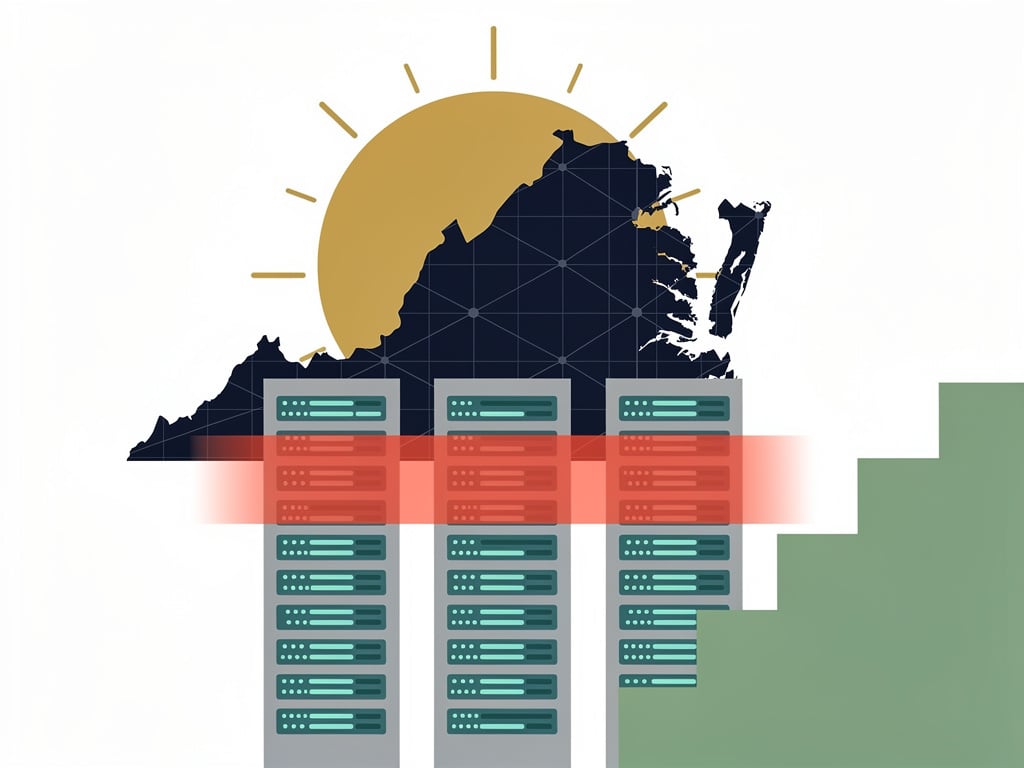
Virginia lawmakers reached a hard-fought budget deal this week that imposes the nation’s first statewide tax on electricity consumed by data centers. The measure, part of a roughly $205 billion biennial spending plan, charges qualifying facilities 1.1 cents per kilowatt-hour. Yet it stops short of dismantling the industry’s long-standing sales-tax exemption worth nearly $2 billion a year.
The compromise ends months of partisan wrangling that once threatened a government shutdown. It also marks a turning point for the state long known as Data Center Alley. Northern Virginia hosts the densest concentration of such facilities on the planet. Their appetite for power has grown explosive with the rise of artificial intelligence training and inference workloads.
And the numbers tell a stark story. In fiscal 2025 the sales-and-use tax exemption for data center equipment and software cost Virginia $1.9 billion in forgone revenue, according to state tax department figures cited by Cardinal News. That figure dwarfs early 2008 projections of roughly $1.5 million annually. The exemption was meant to lure investment. It succeeded beyond anyone’s imagination.
Yet success bred new problems. Data centers now drive massive electricity demand. Dominion Energy, the state’s dominant utility, has warned of peak load increases exceeding 75 percent by 2039 largely because of these facilities. Grid upgrades run into the billions. Residential customers fear they will foot much of the bill if nothing changes.
So lawmakers acted. The new electricity consumption fee applies monthly. Collections are capped at $600 million per year. Excess revenue gets refunded to operators on a pro-rata basis. The tax takes effect July 1, 2026. Over the two-year budget window it is projected to generate about $1.2 billion.
“For the first time anywhere in America, Virginia will institute a statewide energy consumption tax on data centers,” Gov. Abigail Spanberger said in a statement reported by ARLnow. “This ensures this industry pays its fair share and does not drive up costs for Virginia families.”
The deal preserves the sales-tax exemption through 2035. That concession satisfied House leaders who argued the incentive still delivers strong returns. A recent study by the Joint Legislative Audit and Review Commission found the exemption ranks as the state’s second-most effective economic development tool. It generates $6.10 in labor income for every $1 of tax relief, the analysis showed.
But the JLARC reports also highlighted shortcomings. They noted data centers create relatively few permanent jobs relative to their capital intensity. Many facilities operate with small on-site staffs. Localities shoulder increased demands on roads, water systems and emergency services.
Opposition has mounted. In Prince William County, residents and supervisors have blocked several large projects. Loudoun County, by contrast, has embraced them. Data centers there supply nearly half the county’s tax revenue, according to a recent Wall Street Journal analysis. The contrast could not be sharper.
Industry groups voiced disappointment with the new tax. The Data Center Coalition called the measure unnecessary given existing contributions. Operators already pay substantial property taxes and contribute to transmission upgrades. Some developers have begun to look elsewhere. Texas, in particular, is positioning itself to challenge Virginia’s dominance by 2030.
National trends reinforce the tension. U.S. construction spending on data centers topped $50 billion in April for the first time, Census Bureau data show. That figure now accounts for more than 2 percent of all construction activity. Bloomberg reports detail how AI-driven demand has sent power prices higher in multiple regions. Utilities argue data centers must cover their full incremental costs.
Virginia’s approach differs from outright bans or moratoriums seen in New York, Tulsa and other jurisdictions. Those pauses reflect outright local resistance to the noise, visual impact and land consumption of massive facilities. Virginia instead chose a targeted fee tied directly to energy use. The rate is modest. The cap limits industry exposure. Still, the precedent matters.
Other states are watching closely. At least six have considered scaling back similar incentives this year. Illinois paused new data center tax credits. Maryland and Michigan lawmakers have floated restrictions. The surge in hyperscaler capital spending, expected to approach $700 billion globally in 2026, has forced policy makers everywhere to reassess.
Power remains the central issue. A single large AI training cluster can consume as much electricity as a medium-size city. Cooling demands add further load. Virginia’s grid operator PJM has flagged reliability risks if new generation and transmission lag behind. The new tax aims to generate revenue that can offset some of those infrastructure needs without scaring off investment entirely.
Critics from environmental and consumer groups say the compromise does not go far enough. The Partnership for Economic and Community Progress urged a pause on new approvals and full repeal of the sales-tax exemption. They argue current pipeline projects already strain resources. Ratepayer protection must come first.
Proponents counter that abrupt policy reversals would damage Virginia’s reputation. The state spent nearly two decades building its position as the world’s leading data center market. Loudoun County economic development officials, including longtime advocate Buddy Rizer, once pitched hyperscalers with customized incentives. That courtship paid off handsomely.
Now the relationship has grown more complicated. The budget agreement also directs a fresh review of all data center tax policies. Future sessions could see tighter environmental standards, higher caps or additional fees. Nothing is settled permanently.
Developers have taken note. Brookfield’s Compass Datacenters recently walked away from a massive Prince William project after years of effort and millions spent. Local opposition combined with shifting state signals proved too much. Similar pullouts could follow if the new tax signals the start of steady increases.
Yet the industry retains powerful advantages here. Proximity to Washington, dense fiber networks, and a business-friendly climate still matter. Many operators view the 1.1-cent levy as manageable, especially with the sales-tax exemption intact. The refund mechanism above the $600 million cap adds predictability.
Even so, the political momentum has shifted. Democrats who control both legislative chambers and the governorship increasingly view data centers through the lens of equity and grid reliability. Republicans, once strong supporters, have grown wary of residential rate hikes. The budget standoff reflected that realignment.
Analysts expect the new tax to raise roughly $600 million annually once fully phased in. That money will help fund teacher raises, tax relief and other priorities in the final package. It also buys time for longer-term planning around generation capacity and transmission.
Virginia’s move could inspire copycats. States with growing data center footprints, from Georgia to Oregon, face similar pressures. A consumption-based fee tied to actual power draw offers a cleaner policy tool than broad sales-tax changes. It scales with usage. It focuses on the core externality.
Of course implementation details will matter. Regulators must define qualifying facilities, measurement protocols and refund procedures. Dominion will adjust its rate classes for large users starting in 2027. Those changes could interact with the new tax in complex ways.
For now, the deal represents pragmatic compromise. Virginia kept the incentives that built its leadership position. It added a new contribution from an industry whose growth now shapes the state’s entire energy future. The tension between economic development and infrastructure costs did not disappear. It simply found a temporary balance.
That balance will be tested soon enough. AI demand shows no signs of slowing. New facilities continue to break ground. And the next budget cycle will bring fresh debates over whether this first power tax was enough or merely the opening bid.


 WebProNews is an iEntry Publication