
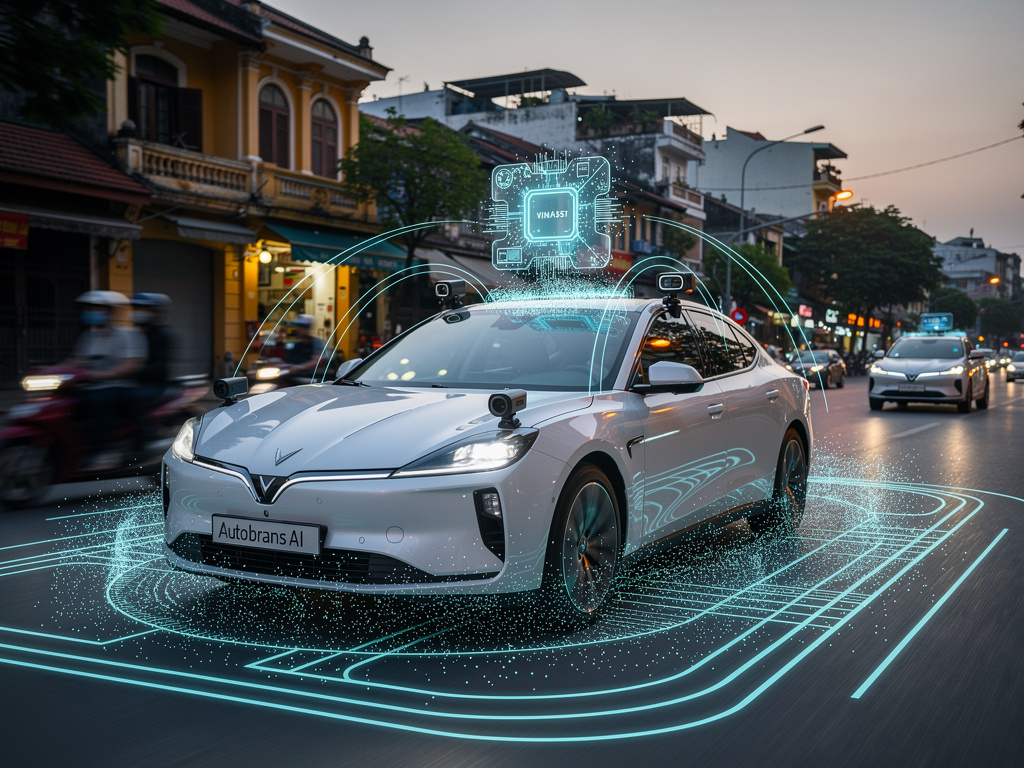
Vietnamese electric-vehicle maker VinFast Auto Ltd. has forged a strategic alliance with Israel-based AI specialist Autobrains to pioneer low-cost autonomous driving systems, marking a pivotal shift in its global expansion strategy amid intensifying competition. Announced on January 26, 2026, the partnership targets enhanced L2++ driver-assistance technologies and a groundbreaking “Robo-Car” architecture designed to deliver advanced autonomy without expensive sensors like LiDAR or radar arrays. Pilot testing is already underway in Hanoi on VinFast’s VF 8 and VF 9 SUVs, signaling rapid progress toward broader deployment.
The collaboration leverages Autobrains’ Agentic AI, powered by seven standard cameras and a high-performance chip processing 20 trillion operations per second. This setup fuses real-time visual data with satellite imagery for “Air-to-Road” localization, bypassing high-definition maps and enabling scalable Level 4 capabilities at a fraction of traditional costs. VinFast’s current lineup features Level 2 assistance, but the upgrade aims to integrate across its full battery-electric vehicle portfolio, prioritizing affordability for emerging markets. Just Auto detailed the testing in controlled Hanoi zones, while Reuters highlighted the camera-centric approach mirroring Tesla’s vision-only strategy.
VinFast’s Push for Mass-Market Autonomy
Nguyen Van Duong, VinFast’s Global Deputy CEO and Director of ADAS/AD Research, emphasized the deal’s transformative potential: “VinFast’s strategic partnership with Autobrains is helping to shape a disruptive approach to affordable autonomous driving that fits our long-term vision for global mobility. We aim to move advanced driving technology from early adopters to everyday drivers.” The initiative builds on VinFast’s existing Level 2 systems, with L2++ pilots demonstrating real-traffic performance. Autobrains CEO Igal Raichelgauz added: “The Robo-Car we’re developing with VinFast is performing autonomous driving in real traffic with confidence and precision. It marks meaningful progress toward a future where drivers everywhere can enjoy safety, comfort, and freedom through autonomy.” Pan African Visions reported the focus on L2++ for future EVs.
For VinFast, struggling with U.S. sales declines and technical hurdles, this partnership offers a cost-cutting lifeline. Autoblog noted the firm’s shaky American debut, with VF 8 and VF 9 models facing issues, positioning the Robo-Car as a competitiveness booster akin to Tesla’s Full Self-Driving. The system promises quicker development and lower hardware demands, crucial as VinFast eyes broader rollout post-Hanoi trials.
Autobrains’ Tech Edge in a Crowded Field
Autobrains, backed by investors including Temasek, BMW i Ventures, Toyota Ventures, and VinFast itself, deploys “Liquid AI”—a self-learning, signature-based architecture mimicking human brain processing. Protected by over 250 patents, it excels in edge cases with hyper-dimensional sparse representations, requiring minimal compute and offering sensor flexibility. The firm’s Munich office expansion in 2024 underscores European OEM ambitions, per its site. This tech disrupts AD1.0 limitations, enabling affordable ADAS to full autonomy.
The Robo-Car’s reliance on cameras and a compact chip contrasts with LiDAR-heavy rivals like Waymo or Cruise, slashing costs for mass adoption. VnExpress International echoed Reuters on the pilot progress, while X posts from Autoblog framed it as a Tesla challenger. VinFast’s prior autonomy efforts, including Level 2 in VF 9 SUVs with over-the-air updates, set the stage, per J.D. Power.
Strategic Implications for Global EV Race
This tie-up accelerates VinFast’s tech stack, complementing partnerships like its 2025 Tensor deal for Level 4 robotaxis using over 100 sensors—distinct from Robo-Car’s minimalist design, as reported by The Investor. Amid U.S. challenges, autonomy could differentiate VinFast in India and beyond, where it broke ground on factories. Vietnam Investment Review stressed mass-market viability.
Industry observers see parallels to Tesla’s cost efficiencies, potentially aiding VinFast’s Nasdaq-listed recovery (VFS.O). X discussions, including from Just Auto, amplify buzz around Hanoi tests transitioning to public roads. Risks remain—regulatory hurdles, validation in diverse conditions—but success could redefine accessible self-driving for non-premium segments.
Road Ahead: Pilots to Production
Next steps include expanding L2++ to production models and scaling Robo-Car for Level 4 in emerging markets. VinFast commits to “safer, smarter mobility,” per statements. Autobrains’ ISO 9001 compliance and OEM wins bolster credibility. As testing evolves, this duo eyes a paradigm shift, proving high autonomy need not demand high costs. NDTV outlined the sensor-free architecture’s promise.


 WebProNews is an iEntry Publication