
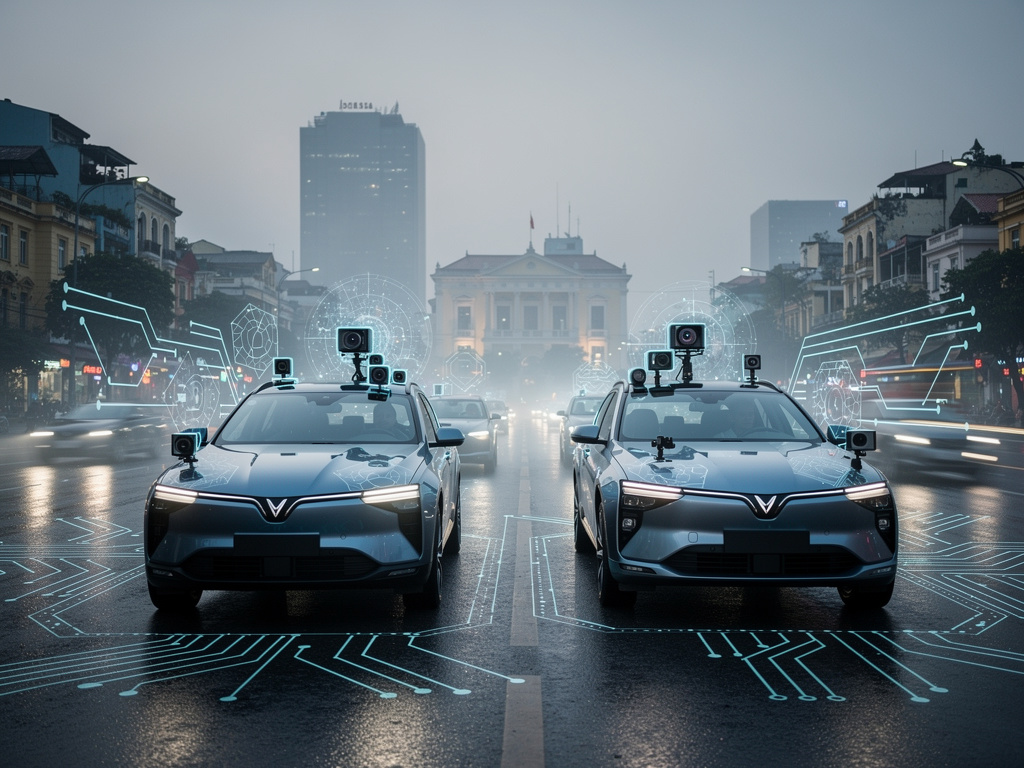
Vietnamese electric-vehicle maker VinFast Auto Ltd. is pivoting to a cost-slashing camera-based autonomous driving system through a new partnership with Israeli AI firm Autobrains Technologies Ltd., aiming to deploy advanced self-driving tech across its lineup faster and cheaper than rivals burdened by pricey sensors.
The collaboration, announced January 26, 2026, targets enhanced Level 2++ driver assistance for upcoming models and a groundbreaking ‘Robo-Car’ architecture targeting higher autonomy levels without LiDAR, radar or high-definition maps. Pilot testing of the upgraded assistance is already underway on VinFast’s VF 8 and VF 9 SUVs in controlled Hanoi zones, with plans to expand to broader cities and international markets, according to a Reuters report.
The Robo-Car system mirrors Tesla Inc.’s vision-only strategy, relying on seven standard cameras and a compact computing chip processing about 20 trillion operations per second. This setup promises autonomous capabilities ‘at a fraction of the cost and complexity of traditional systems,’ the companies stated. VinFast’s move comes after years of costly, delayed self-driving efforts, positioning the upstart to accelerate deployment amid U.S. market struggles.
VinFast’s Push for Affordable Autonomy
Prof.-Dr. Nguyen Van Duong, VinFast’s global deputy CEO and director of its ADAS/AD Research Institute, emphasized the partnership’s potential: ‘VinFast’s strategic partnership with Autobrains is helping shape a disruptive approach to affordable autonomous driving that fits our long-term vision for global mobility. We aim to move advanced driving technology from early adopters to everyday drivers,’ he said in statements covered by Just Auto and Vietnam Investment Review.
Autobrains CEO Igal Raichelgauz added: ‘The Robo-Car we’re developing with VinFast is performing autonomous driving in real traffic with confidence and precision. It marks meaningful progress toward a future where drivers everywhere can enjoy safety, comfort, and freedom through autonomy.’ The system leverages Autobrains’ Agentic AI architecture—protected by over 300 patents—which adapts to real-time scenarios with human-like precision while minimizing compute demands.
Powered by Liquid AI technology inspired by the human brain, the platform uses continuous self-learning signatures and hyper-dimensional sparse representations to handle edge cases more efficiently than end-to-end models from competitors like Tesla or compound systems from Mobileye, per Autobrains’ site details echoed in Pan African Visions.
Breaking Down the Robo-Car Tech Stack
At its core, Robo-Car ditches expensive hardware for vision-only perception fused with Autobrains’ Air-to-Road localization, blending real-time camera feeds with satellite imagery for centimeter-level accuracy without HD maps. This multimodal redundancy enables scalable Level 4 autonomy suited for emerging and advanced markets, as testing in Hanoi demonstrates real-traffic performance.
VinFast’s current EVs feature Level 2 assistance, but the L2++ upgrade expands features like enhanced lane control, collision mitigation and parking aid. The partnership builds a ‘strong foundation to progressively integrate more advanced autonomous capabilities across its full product portfolio,’ underscoring safer, smarter mobility, according to Yahoo Autos citing company releases.
For industry watchers, the chip’s 20 TOPS capacity—far leaner than LiDAR-heavy rivals—signals a hardware-agnostic path. Autobrains’ Skills product line, modular AI ‘skills’ for specific scenarios, optimizes for edge cases with logarithmic resource growth, contrasting exponential demands of monolithic neural nets, as outlined on Autobrains.ai.
VinFast’s Broader EV Struggles and Pivot
Publicly traded as VFS.O, VinFast grapples with U.S. sales declines and technical hiccups, per Autoblog. This tie-up ramps tech development to compete globally, integrating AI into EVs for smarter, cost-efficient solutions. Hanoi trials mark a pilot program, with VF 8 and VF 9 roaming streets in controlled settings, eyeing public roads soon.
Previously, VinFast pursued pricier autonomy paths, including a 2025 Tensor partnership for Level 4 Robocar production in Hai Phong, as noted by The Investor. The Autobrains shift emphasizes affordability, potentially rescuing overseas expansion amid Vingroup backing from Vietnam’s richest man, Pham Nhat Vuong.
Expansion plans include larger Vietnamese cities and overseas, aligning with VinFast’s global growth via production ramps and portfolio broadening. This positions the firm against Tesla’s Full Self-Driving and Waymo’s sensor suites, betting vision-plus-AI democratizes high autonomy.
Autobrains’ Edge in AI Autonomy Wars
Spun from Cortica in 2019, Tel Aviv-based Autobrains has raised $140 million, opening a Munich office and securing Chinese EV design wins with Liquid AI-powered ADAS. Its paradigm tackles AD1.0 pitfalls: edge-case misses, unsustainable compute, eroding trust. Skills decompose driving into optimized, explainable models versus Tesla’s black-box FSD or Mobileye bottlenecks.
Air2Road’s aerial-ground fusion eliminates map dependency, boosting safety. Backed by 250+ patents, the tech scales from L2++ to L4, hardware-flexible for OEMs. VinFast collaboration tests this in production intent, per VnExpress and NDTV.
Reactions on X highlight buzz: Posts praise the ‘Tesla-like’ cost cut, with users noting Hanoi’s chaotic traffic as a tough proving ground. Analysts see this accelerating VinFast’s U.S. rescue, blending Vietnamese manufacturing scale with Israeli AI prowess.
Rivals, Regulations and Road Ahead
Tesla’s camera pivot validates the approach, but skeptics question vision-only limits in fog or night. VinFast’s Hanoi focus tests robustness in unstructured environments, key for emerging markets. Regulatory hurdles loom: Level 4 needs approvals, though Vietnam’s EV push aids pilots.
Competitors like XPeng and Li Auto mix sensors; VinFast-Autobrains pure-vision play risks more but slashes BOM costs 50-70%, insiders estimate. Success could flood mass-market EVs with L3+ features, per Asia Business Outlook.
For insiders, this signals AD2.0: Modular, brain-mimicking AI enabling ‘robo-cars’ for everyday drivers. VinFast’s bet—bolstered by real-road data—could redefine affordable self-driving, if trials scale without interventions.


 WebProNews is an iEntry Publication