
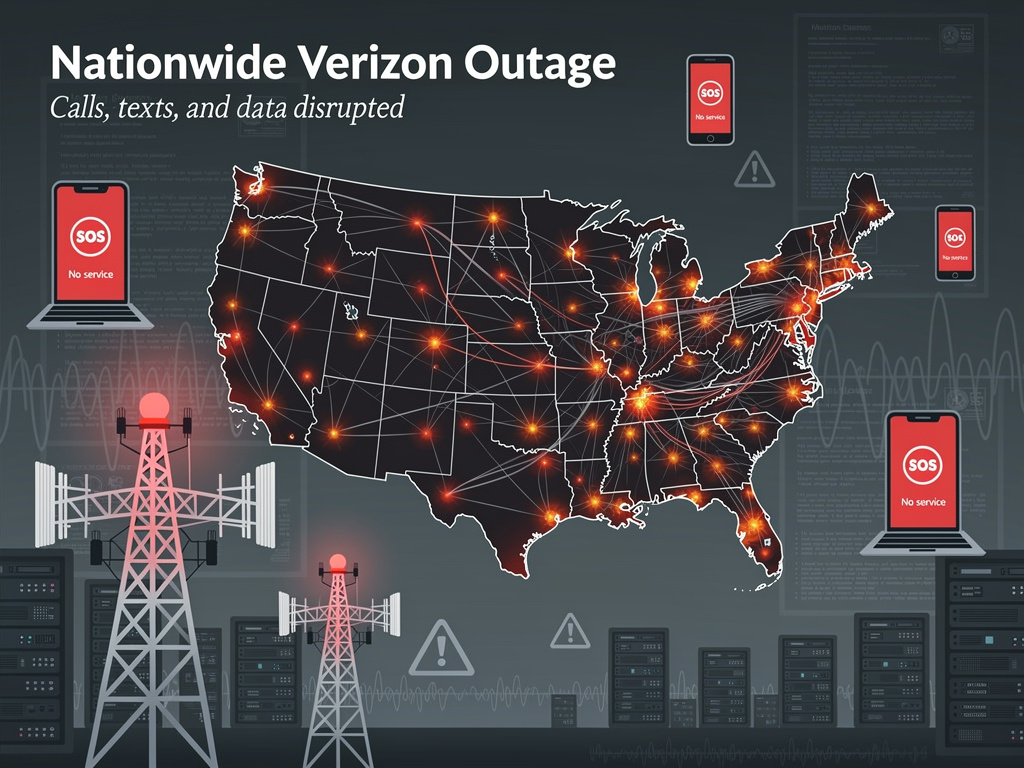
Verizon Communications Inc., the largest U.S. wireless carrier, grappled with a massive outage Wednesday that plunged tens of thousands of customers into SOS mode, severing voice calls, texts, and data across the nation. Reports surged on DownDetector starting around noon ET, with users from New York to Seattle unable to connect, prompting emergency alerts in major cities and exposing vulnerabilities in the carrier’s core infrastructure.
DownDetector charts showed peak complaints exceeding 180,000, concentrated in urban hubs like New York City and Washington, D.C. Customers described phones displaying ‘SOS’—a fallback allowing only 911 calls or satellite emergency features on compatible devices—leaving families disconnected and businesses halted. NBC News reported the disruptions triggered wireless emergency alerts, underscoring the outage’s severity.
Customer Panic and Real-World Fallout
One Pennsylvania user posted on social media: ‘Lines are down… son who is home sick in York, Pa and on our plan is unreachable as well when I call from landline,’ capturing the human toll as parents lost contact with ill children. Businesses reliant on mobile hotspots and point-of-sale systems ground to a halt, with ride-share drivers and delivery services particularly hard-hit.
Verizon’s automated support lines echoed the chaos, delivering messages about an ’emergency condition’ to callers seeking help. Posts on X from affected users flooded in, with Verizon Support responding en masse: ‘We are aware of an issue impacting wireless voice and data services for some customers. Our engineers are engaged and are working to identify and solve the issue quickly,’ as shared across multiple threads.
Official Response and Network Status Checks
Verizon directed users to its network status page, though many reported it showed no outages initially, fueling frustration. A spokeswoman told The New York Times the carrier was ‘working to resolve the issue,’ without specifying a cause or timeline. Engineers focused on core network elements, hinting at a backbone failure rather than localized cell tower issues.
Live updates from TechRadar detailed the outage’s scope: ‘Verizon is down, with many users seeing ‘SOS’ – here’s everything we know.’ The site noted this as the carrier’s first major disruption since October 2024, breaking a streak of relative stability. Android Authority confirmed nationwide impact, updating with Verizon’s statement.
Historical Echoes and Potential Triggers
This incident recalls Verizon’s December 2022 outage, blamed on a faulty software update, which affected 1.5 million lines and drew FCC scrutiny. Industry analysts speculated similar root causes—possibly a routing glitch, fiber cut, or cyber incident—though Verizon withheld details. Daily Mail highlighted fiber cuts in past Brooklyn disruptions, per Verizon Support posts on X.
DownDetector data revealed 70% of complaints tied to ‘no signal,’ 20% to mobile internet, and 10% to calls, per real-time spikes. Fox Business noted service degradation persisted into the evening, with partial restorations in some Midwest areas but East Coast blackouts lingering.
Regulatory Eyes and Competitor Spillover
The FCC, which fined T-Mobile $80 million for a 2024 outage, likely monitors closely; past probes demanded root-cause analyses within 30 days. Verizon’s MVNO partners like Spectrum Mobile and US Mobile reported collateral outages, amplifying reach to over 100 million lines. NBC New York pegged New York-area complaints at tens of thousands.
X posts from Verizon Support, such as replies to users like @tyler__sellers and @CrisTavarez29, emphasized ongoing engineering efforts: ‘Our engineers are aware and actively working to restore service asap.’ Sentiment on the platform turned from confusion to anger, with demands for compensation and transparency.
Technical Deep Dive into SOS Failover
SOS mode activates when devices lose LTE/5G attachment to the carrier’s Evolved Packet Core, forcing fallback to any available network for emergencies only—a design rooted in AT&T’s 2017 implementation but standardized industry-wide. Verizon’s 5G Standalone core, rolled out aggressively since 2023, may have introduced new failure points; experts cited potential EPC-to-5GC migration bugs.
Android Central outlined workarounds: Wi-Fi calling functioned for some, while eSIM swaps to AT&T or T-Mobile provided temporary relief. However, 5G mmWave users in dense areas faced total blackouts, as sub-6GHz midband offered partial coverage in fringes.
Business Disruptions and Economic Ripples
Wall Street shrugged initially, with VZ shares dipping just 0.5% in after-hours; analysts viewed it as operational rather than strategic. Yet, sectors like logistics and healthcare felt acute pain—hospitals rerouted 911 calls, per local reports. 9to5Google detailed Android-specific impacts, with Pixel and Samsung users universally affected.
Customer acquisition risks loom; rivals like T-Mobile touted ‘no outages here’ on X, potentially swaying switchers. Verizon’s $53 monthly unlimited plans face churn pressure if resolutions drag past 24 hours, per historical patterns from 2022.
Path to Resolution and Future Safeguards
As of 7:30 p.m. ET, Verizon reported progress in scattered markets, with DownDetector peaks easing to 50,000. Engineers likely deployed redundant routing and load balancing, standard for multi-homed carriers with peering to Level 3 and Zayo. Full restoration could span hours to a day, barring cascading failures.
Post-mortems will scrutinize automation gaps; Verizon’s AI-driven Network Intelligence Platform, touted in 2025 earnings, failed to preempt. Industry insiders anticipate bolstered redundancy investments, echoing post-2022 upgrades that cut mean-time-to-repair by 40%.
Broader Implications for 5G Reliability
This blackout tests Verizon’s ‘reliable 5G’ branding amid $20 billion C-band spectrum bets. With 5G penetration at 60% of its base, such events erode enterprise trust in private networks. Competitors’ relative stability—AT&T at minor blips—highlights Verizon’s scale as both asset and liability in national infrastructure.


 WebProNews is an iEntry Publication