
Orbiting Assembly Lines: Varda’s Quest to Turn Space Manufacturing into Everyday Business
In the vast expanse of low Earth orbit, a quiet revolution is underway, one that could redefine how we produce everything from pharmaceuticals to advanced materials. Varda Space Industries, a startup founded in 2020, is at the forefront of this shift, aiming to make in-space manufacturing as routine as shipping goods across oceans. According to a recent profile in TechCrunch, CEO Will Bruey emphasizes that Varda isn’t just another player in the space sector; it’s pioneering an “in-space industry” where orbit becomes merely another node in global supply chains. This vision comes at a time when the company has successfully demonstrated its technology through multiple missions, proving that microgravity can yield superior products unattainable on Earth.
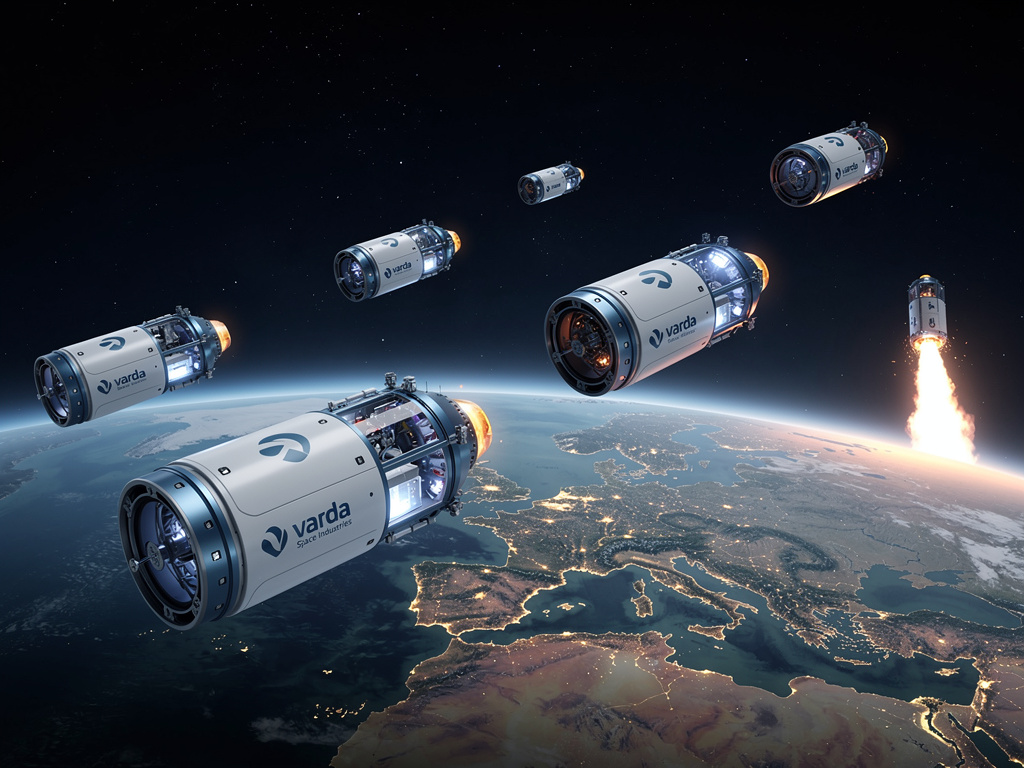
Varda’s approach hinges on autonomous capsules that launch into orbit, conduct manufacturing processes in zero gravity, and then reenter the atmosphere to deliver their payloads. The company’s W-Series missions have been pivotal. For instance, the W-1 mission in 2023 marked the first commercial in-space manufacturing of pharmaceuticals, producing crystals of the HIV drug ritonavir that exhibited unique structures due to the absence of gravity. Subsequent flights, like W-2 and W-3, built on this by incorporating advanced experiments, including hypersonic reentry data collection for the U.S. Air Force Research Laboratory (AFRL). As detailed in a Wikipedia entry updated in May 2025, these missions have not only validated the tech but also provided unprecedented spectroscopic data on reentry thermochemistry.
The economic rationale is compelling. On Earth, gravity interferes with crystal growth, leading to imperfections in materials like drugs or semiconductors. In space, uniform crystals form, potentially improving drug efficacy or enabling new formulations that extend patents. Varda’s co-founder Delian Asparouhov has long championed this, noting in posts on X that without such initiatives, space manufacturing might remain stagnant, tied to human-operated stations with limited scalability. By focusing on automated, cost-effective operations, Varda is betting on high-value, Earth-bound products to drive profitability.
From Proof of Concept to Operational Cadence
Recent developments underscore Varda’s momentum. In November 2025, the company launched its fifth mission, W-5, aboard SpaceX’s Transporter-15 rideshare, as reported in SpaceNews. This flight extends Varda’s collaboration with AFRL, testing reentry technologies while simultaneously hosting commercial payloads. It’s a dual-purpose endeavor: advancing military hypersonics and commercializing orbital production. Earlier in the year, W-4 introduced Varda’s in-house spacecraft bus, a significant milestone that reduces reliance on external providers like Rocket Lab, which supplied buses for prior missions.
Partnerships are accelerating this progress. A multi-flight agreement with United Semiconductors, announced in ISS National Lab’s ISS360 blog just a week ago, aims to produce orbital semiconductor materials. This collaboration leverages Varda’s reentry capsules to manufacture and recover high-purity crystals, potentially revolutionizing electronics. Funding has fueled these efforts; a $187 million Series C round in August 2025, covered in Yahoo Finance, brought Varda’s total capital to $329 million, with backers including Founders Fund and Khosla Ventures.
Challenges persist, however. Regulatory hurdles, such as FAA approvals for reentry, have been navigated successfully—Varda secured unlimited reentry operations in June 2025, as noted in X posts from industry observers like A. Pettit. Yet, scaling production requires consistent launch access and cost reductions. Bruey, in the TechCrunch piece, likens space to “just another place to ship to,” but achieving that banality demands overcoming the high costs of orbital logistics, currently dominated by rideshares like SpaceX’s Transporter series.
Technological Innovations Driving Reliability
At the heart of Varda’s tech is its reentry capsule, equipped with heat shields derived from NASA’s Conformal Phenolic Impregnated Carbon Ablator (C-PICA). Under a NASA Tipping Point agreement, Varda began producing these shields in-house for W-4, as explained in a June 2025 SpaceNews article. This material erodes controllably during atmospheric reentry, protecting payloads from Mach 25 speeds and extreme heat. The W-2 mission’s footage, released by Varda and highlighted in Futura-Sciences last month, showcased this fiery descent, capturing data that advances both commercial and scientific frontiers.
Automation is another key innovation. Varda’s capsules operate without human intervention, conducting experiments like crystal growth for pharmaceuticals. The company’s website, Varda.com, describes this as building the “world’s first orbital manufacturing & reentry platform,” emphasizing scalability. In a Reddit thread on r/RKLB from September 2024, users discussed Rocket Lab’s role in completing Varda’s second Pioneer spacecraft, noting how such collaborations build technological know-how without massive upfront R&D costs.
Looking ahead, Varda plans multiple missions in 2025 and beyond, as teased in X posts from the company itself in May 2025. CEO Bruey is set to speak at TechCrunch Disrupt 2025 in October, per Yahoo Tech, where he’ll outline strategies for integrating space into global supply chains. This includes targeting industries like biotech, where microgravity enables novel drug forms, potentially transforming medicine as suggested in Futura-Sciences’ coverage.
Market Potential and Competitive Dynamics
The broader market for in-space manufacturing is nascent but promising. An analysis in Aerospace America from October 2025 posits that while no true market exists yet, companies like Varda could create one by focusing on intellectual property gains, such as patent extensions through space-grown crystals. Varda’s model—autonomous, frequent, and cost-effective—contrasts with human-tended operations on the International Space Station, which Asparouhov critiqued on X in September 2024 as inefficient for scaling.
Competitors are emerging, but Varda’s first-mover advantage is evident. Its partnership with Rocket Lab, detailed in a September 2024 Business Wire release, has provided reliable spacecraft, while transitions to in-house designs signal maturation. On X, discussions like those from Jacob Keeton in November 2025 highlight Varda’s shift to proprietary buses starting with W-4, underscoring operational independence.
Economically, the payoff could be immense. Producing high-value items like reformulated drugs or advanced semiconductors in orbit might justify launch costs, especially as prices drop. Bruey told TechCrunch that Varda aims to make this “boring”—a synonym for reliable and ubiquitous. With two vehicles in orbit as of W-5’s launch, per Varda’s X announcement on November 28, 2025, the company is demonstrating multi-mission capability, serving multiple customers simultaneously.
Strategic Alliances and Future Trajectories
Collaborations extend Varda’s reach. The United Semiconductors deal, as per ISS National Lab’s blog, positions Varda in the semiconductor space, where microgravity could yield defect-free materials for next-gen chips. This aligns with global trends toward resilient supply chains, post-pandemic disruptions highlighting vulnerabilities in terrestrial manufacturing.
Internally, Varda’s team draws from elite backgrounds: Bruey from SpaceX, Asparouhov from Founders Fund. A 2023 X post from Alex LaBossiere recapped a podcast with Asparouhov, discussing microgravity’s potential and the role of media in tech innovation. Such expertise has enabled rapid iteration— from W-1’s proof-of-concept to W-5’s routine operations.
As 2025 unfolds, Varda’s plans include more launches, potentially on Transporter missions, as noted in X posts from Anu Bonthalapati in November 2025. The FAA’s approval for unlimited reentries, praised on X by A. Pettit in June 2025, removes a key bottleneck, allowing cadence to match production rates.
Pushing Boundaries in Orbital Industry
Ultimately, Varda’s story is about normalizing the extraordinary. By treating space as an extension of Earth’s industrial base, the company challenges traditional boundaries. Innovations like in-house heat shields and autonomous processing, as covered in SpaceNews, ensure reliability amid hypersonic challenges.
The path forward involves balancing ambition with pragmatism. While hype surrounds space ventures, Varda’s focus on tangible, high-value outputs sets it apart. As Bruey articulates in TechCrunch, the goal is ubiquity—making orbital factories as unremarkable as terrestrial ones.
With funding secured and missions multiplying, Varda is poised to lead this new frontier, potentially unlocking billions in value through space-enabled advancements. As industry insiders watch, the company’s trajectory suggests that what began as speculative is fast becoming standard practice.


 WebProNews is an iEntry Publication