
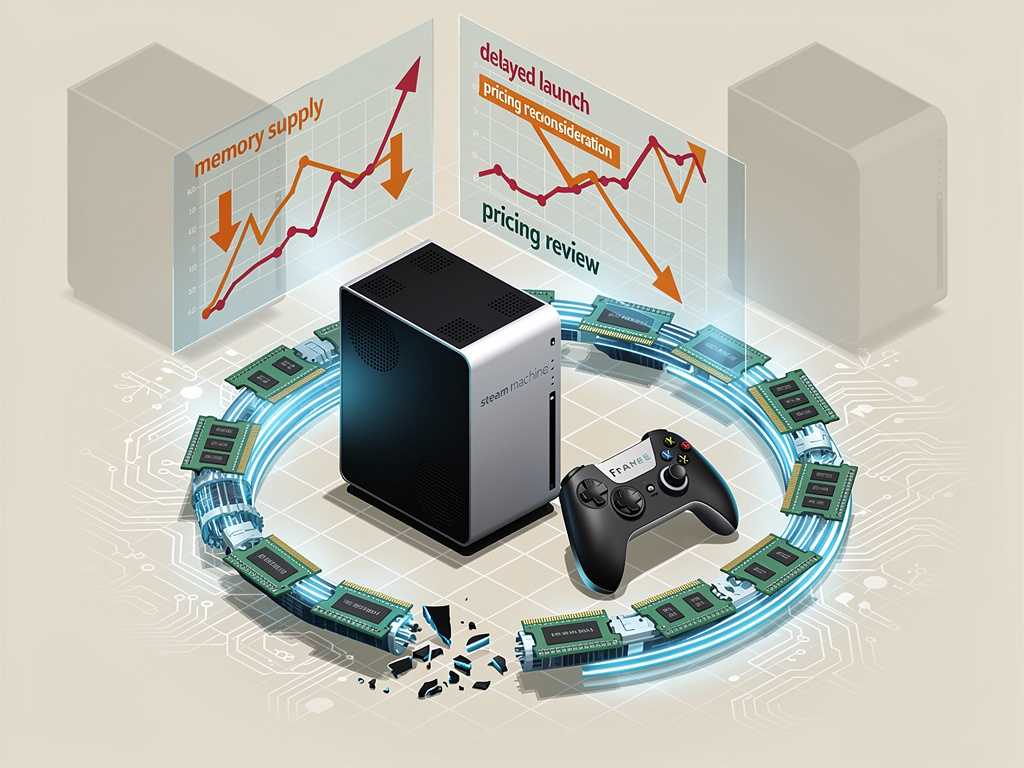
Valve Corporation’s ambitious return to hardware manufacturing has encountered significant headwinds, as the company announced substantial delays to its next-generation Steam Machine and accompanying Frame controller. The postponement, attributed to what the company describes as an unprecedented memory supply crisis, marks a critical juncture for Valve’s hardware ambitions and raises broader questions about the viability of premium gaming hardware in an increasingly constrained component market.
According to The Verge, Valve has pushed back the launch timeline for both products by at least six months, with the Steam Machine now targeting a late 2024 or early 2025 release window. The delay comes as memory manufacturers struggle to meet demand across multiple sectors, creating a ripple effect that has impacted everything from smartphones to gaming consoles. The company’s Frame controller, initially conceived as a companion device to the Steam Machine, faces similar production constraints that have forced Valve to reconsider both its pricing strategy and technical specifications.
The memory crisis affecting Valve’s production schedule reflects broader semiconductor industry challenges that have persisted since the pandemic era. Industry analysts point to a perfect storm of factors: increased demand for AI-focused hardware, ongoing geopolitical tensions affecting chip manufacturing in Taiwan and South Korea, and a fundamental mismatch between production capacity and market demand. For Valve, a company that has historically maintained tight control over its hardware releases—from the original Steam Controller to the widely successful Steam Deck—these external pressures represent an unfamiliar challenge to its product development philosophy.
The Economics of Premium Gaming Hardware in a Constrained Market
The financial implications of the delay extend beyond simple production timelines. Sources familiar with Valve’s internal discussions indicate that the company is grappling with a difficult decision: absorb increased component costs to maintain competitive pricing, or pass those costs onto consumers in a market already saturated with gaming hardware options. The original Steam Machine was reportedly positioned to compete in the $799-$999 price range, but current memory prices could push that figure significantly higher, potentially pricing the device out of its target market segment.
This pricing dilemma comes at a particularly inopportune moment for Valve. The gaming hardware market has become increasingly competitive, with Microsoft, Sony, and Nintendo all offering compelling options at various price points. Additionally, the success of Valve’s own Steam Deck has created internal questions about market cannibalization—would a premium Steam Machine simply compete with the company’s own successful portable device, or could it carve out a distinct niche among enthusiast gamers seeking a dedicated living room gaming solution?
Technical Specifications and the Memory Bottleneck
The memory crisis has forced Valve to reconsider the technical specifications that would differentiate the Steam Machine from competing products. Initial reports suggested the device would feature 32GB of high-speed GDDR6 memory, a configuration that would have positioned it as a true premium offering. However, the current shortage has made such configurations prohibitively expensive, forcing the company to explore alternatives including lower memory capacities or different memory technologies that might not deliver the performance profile Valve originally envisioned.
The Frame controller faces its own technical challenges. Designed to offer haptic feedback and adaptive triggers similar to Sony’s DualSense controller, the Frame requires specialized components that have also been affected by supply chain disruptions. Valve’s commitment to delivering a controller that could match or exceed the capabilities of console competitors has collided with the reality of component availability, leading to difficult compromises in the device’s feature set. Engineers at Valve are reportedly exploring alternative haptic solutions that might be less dependent on constrained components while still delivering a premium user experience.
Strategic Implications for Valve’s Hardware Division
The delays represent more than a temporary setback for Valve’s hardware ambitions. The company has invested heavily in building out its hardware division following the unexpected success of the Steam Deck, which has sold millions of units and demonstrated that PC gaming could successfully transition to new form factors. The Steam Machine was intended to build on that momentum, offering a stationary complement to the portable Steam Deck and reinforcing Valve’s position as a hardware manufacturer capable of competing with traditional console makers.
However, the current situation has exposed vulnerabilities in Valve’s hardware strategy. Unlike larger competitors such as Microsoft or Sony, Valve lacks the purchasing power and supply chain relationships that can help weather component shortages. The company’s relatively small hardware division, while nimble and innovative, cannot command the same priority from component suppliers as companies that order in volumes of tens of millions of units. This structural disadvantage may force Valve to reconsider its approach to hardware manufacturing, potentially seeking partnerships or alternative supply arrangements that could provide greater stability.
Market Reception and Consumer Expectations
The announcement of delays has generated mixed reactions within the gaming community. Enthusiast forums and social media platforms show a divide between those willing to wait for Valve to deliver a properly engineered product and those questioning whether the company should proceed with the Steam Machine at all. Some commentators argue that the market for dedicated gaming boxes has fundamentally shifted, with consumers increasingly favoring portable devices or simply upgrading their existing PCs rather than investing in new platform-specific hardware.
Consumer expectations have also been shaped by Valve’s track record of hardware releases. The Steam Controller, while innovative, never achieved mainstream adoption and was eventually discontinued. The Steam Link, a streaming device, similarly failed to gain significant market traction. Only the Steam Deck has proven to be a genuine hit, raising the stakes for any subsequent hardware releases. A delayed, expensive Steam Machine that fails to clearly articulate its value proposition could damage Valve’s credibility in the hardware space and make future product launches more challenging.
Industry-Wide Implications and the Future of Gaming Hardware
Valve’s struggles with the Steam Machine launch reflect broader challenges facing the gaming hardware industry. As component costs rise and supply chains remain unpredictable, the traditional model of releasing new gaming hardware on predictable cycles has become increasingly untenable. Companies are being forced to make difficult decisions about specifications, pricing, and launch timing—decisions that can significantly impact product success or failure.
The memory crisis specifically highlights the gaming industry’s dependence on components that serve multiple markets. Gaming hardware competes for the same memory chips used in smartphones, data centers, and AI accelerators. As demand for AI hardware continues to surge, driven by the rapid adoption of large language models and machine learning applications, gaming companies may find themselves perpetually competing for scarce resources against better-funded competitors with deeper pockets.
Valve’s Path Forward and Alternative Strategies
Despite the setbacks, Valve has several options for navigating the current challenges. The company could choose to launch a limited initial production run of the Steam Machine, targeting enthusiast early adopters willing to pay premium prices while building toward larger-scale production as component availability improves. This approach would allow Valve to maintain momentum and gather real-world feedback while managing supply constraints.
Alternatively, Valve might reconsider the Steam Machine’s positioning entirely, potentially repositioning it as a more modest upgrade to existing Steam Deck technology rather than a distinct premium product. This approach would leverage existing supply relationships and component specifications while still offering consumers a new option for Steam-based gaming. The Frame controller could similarly be repositioned as a standalone accessory compatible with multiple devices, reducing its dependence on the Steam Machine’s success.
The company might also explore partnerships with established hardware manufacturers who possess stronger supply chain relationships and greater purchasing power. Such partnerships could help Valve access components at more favorable prices while maintaining creative control over product design and features. However, this approach would represent a significant departure from Valve’s traditionally independent hardware development philosophy.
Long-Term Outlook for Valve’s Hardware Ecosystem
The Steam Machine delay, while frustrating for both Valve and eager consumers, may ultimately prove beneficial if it forces the company to develop more resilient hardware strategies. The gaming industry is entering a period of significant transition, with cloud gaming, portable devices, and traditional consoles all competing for consumer attention and dollars. Valve’s success in this environment will depend on its ability to clearly articulate why dedicated Steam hardware deserves a place in consumers’ homes and entertainment centers.
The memory crisis and associated production delays serve as a reminder that hardware manufacturing at scale requires more than innovative design and engineering talent. It demands sophisticated supply chain management, strategic component sourcing, and the financial resources to weather market disruptions. As Valve continues building its hardware division, developing these capabilities will be just as important as creating compelling products. The company’s response to the current challenges will likely shape its hardware strategy for years to come, determining whether Valve can establish itself as a lasting presence in gaming hardware or remains primarily a software and platform company that occasionally ventures into hardware with mixed results.


 WebProNews is an iEntry Publication