
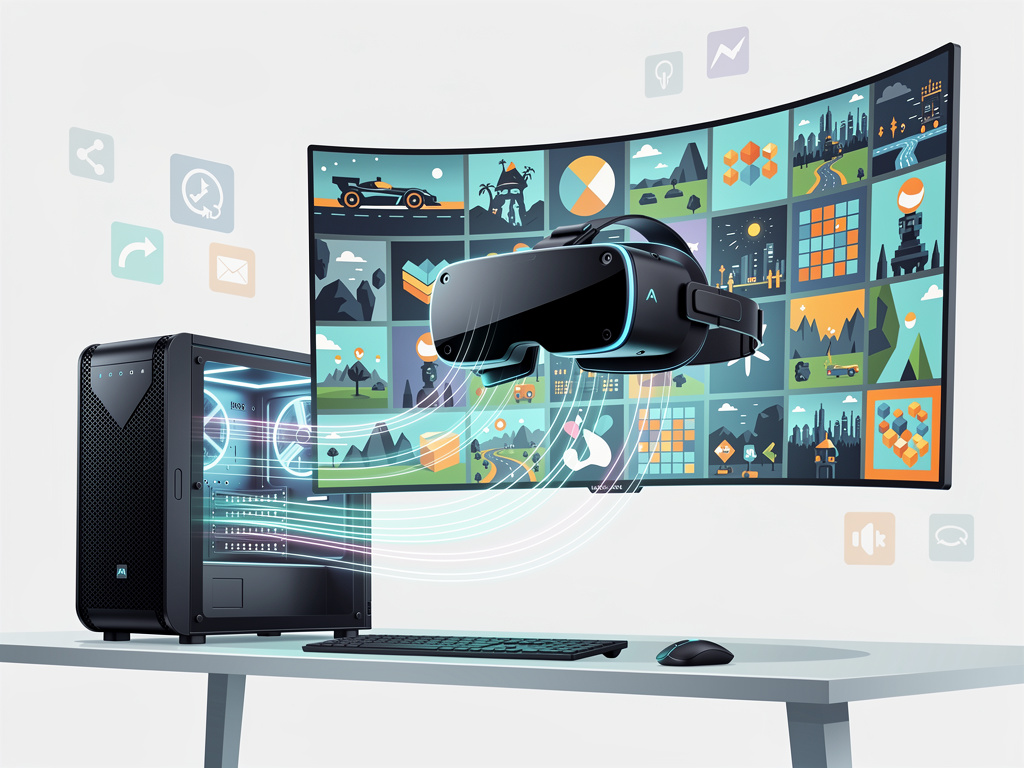
Valve has released a native Steam Link app for Apple’s Vision Pro headset, letting owners of the $3,499 spatial computer stream their entire PC game library onto a massive virtual screen floating in their living room. It’s a move that simultaneously validates Apple’s struggling hardware platform and highlights how far Valve is willing to reach to keep Steam relevant on every screen that matters — even one strapped to your face.
The app launched quietly on April 30, 2026, appearing in Apple’s visionOS App Store. As Ars Technica reported, this is a full native visionOS build, not the iPad compatibility mode that Vision Pro users had been forced to use previously. That distinction matters. The iPad version ran in a flat, fixed window with limited integration into visionOS’s spatial interface. The native version, by contrast, takes advantage of the headset’s capabilities to render a large, repositionable virtual display — the kind of cinema-scale screen that Vision Pro owners have been promised since Apple first unveiled the device.
Steam Link itself isn’t new. Valve has offered the streaming application across a wide range of platforms for years, including iOS, Android, Samsung TVs, and Meta Quest headsets. The technology streams gameplay from a local PC running Steam over a home network, encoding the video feed and transmitting controller inputs back with minimal latency. For Vision Pro, though, the implications are different. Apple’s headset has been starved for compelling content since its launch in early 2024, and access to Steam’s catalog of tens of thousands of PC games — even via streaming rather than native execution — gives owners something genuinely useful to do with the hardware during long sessions.
Valve didn’t offer much commentary around the launch. The company’s characteristic silence on strategic moves remains intact. But the timing is telling.
Apple has spent the past two years trying to build a case for Vision Pro as more than a tech demo. Sales have been modest by Apple standards, with analyst estimates from firms like IDC placing cumulative units shipped well below one million. The developer community has been cautious, with many studios treating visionOS as an experiment rather than a priority platform. And Apple’s own gaming ambitions on Vision Pro — centered largely on Apple Arcade titles and a handful of premium ports — haven’t generated the kind of enthusiasm the company clearly hoped for.
Into that gap steps Valve, a company with no hardware stake in Vision Pro’s success but every incentive to ensure Steam is accessible wherever gamers might be. The calculus is straightforward: if someone owns a gaming PC and a Vision Pro, Valve wants them playing through Steam, not browsing the App Store for alternatives. Steam Link is the tether.
The technical requirements are modest. Users need a PC running Steam, a stable Wi-Fi connection (Valve recommends 5 GHz or better), and a Bluetooth-compatible controller paired to the Vision Pro. The app supports Steam’s full Big Picture mode interface, which was designed for controller navigation on large screens. Resolution and frame rate depend on network conditions, but users on well-configured home networks report results that are more than adequate for single-player titles and many competitive games where millisecond-level input latency isn’t the deciding factor.
There’s a real question about how this fits into Apple’s broader strategy. The company has historically been protective of its platforms, preferring native applications that run locally and generate revenue through the App Store. Steam Link’s original iOS release in 2018 was famously blocked by Apple before being allowed months later with restrictions. That Apple now permits — and presumably approved — a native visionOS version of the app signals either a softening of its gatekeeping instincts or a pragmatic acknowledgment that Vision Pro needs every app it can get.
Probably both.
The competitive dynamics here are worth examining. Meta’s Quest headsets have supported Steam Link for some time, and the combination of a $500 Quest 3 with a gaming PC has proven popular among VR enthusiasts who want access to SteamVR content without being limited to Meta’s own store. Vision Pro isn’t a VR gaming headset in the same sense — it lacks the motion controllers and room-scale tracking optimized for immersive VR titles — but it does offer what many users describe as the best virtual display experience available in any headset. The micro-OLED panels, running at roughly 4K per eye, produce an image quality that makes text legible and games visually striking in ways that LCD-based competitors can’t match.
So for someone who wants to play Civilization VII or Baldur’s Gate 3 on what feels like a 100-inch screen while sitting on their couch, Vision Pro with Steam Link is arguably the best option available today. Not the cheapest. Not by a wide margin. But the best in terms of raw display fidelity.
Valve’s investment in streaming technology has been consistent. The company launched the original Steam Link hardware box in 2015, discontinued it in 2018 as the software app proliferated across other devices, and has continued refining the underlying protocol. The Steam Deck, Valve’s handheld PC released in 2022, can also function as a Steam Link client when connected to a more powerful desktop. Each new platform Valve supports extends the reach of its storefront without requiring the company to negotiate game-by-game licensing deals or build native ports. The games run on the PC. Steam Link just moves the pixels.
This approach does have limitations. Latency, even on excellent networks, introduces a perceptible delay that competitive multiplayer gamers will notice. Games that require precise timing — fighting games, fast-paced shooters, rhythm titles — suffer more than turn-based or narrative-driven experiences. And streaming is entirely dependent on having a capable PC nearby. Take the Vision Pro to a hotel room or a friend’s house without your gaming rig, and Steam Link is useless.
But for the target audience — people who already own both a high-end gaming PC and an Apple Vision Pro, a demographic that skews heavily toward affluent tech enthusiasts — these limitations are acceptable tradeoffs for the convenience and visual spectacle of gaming on a virtual cinema screen.
The release also raises questions about what comes next. Valve has been expanding Steam’s presence on non-traditional platforms aggressively. The Steam Deck proved that PC gaming could work as a handheld experience. Steam Link on Quest demonstrated viability in VR headsets. And now visionOS. If Apple releases a more affordable Vision headset, as has been widely reported by Bloomberg and others, the potential audience for Steam Link on Apple’s spatial computing platform grows considerably.
There’s also the matter of Apple’s own gaming push. The company has invested in porting AAA titles to Apple Silicon, with games like Death Stranding and Resident Evil Village running natively on M-series chips. Apple’s Game Porting Toolkit has lowered the barrier for developers bringing Windows titles to macOS and, by extension, visionOS. But the reality is that Steam’s library dwarfs what’s available natively on any Apple platform, and Steam Link gives Vision Pro users a backdoor to that catalog without waiting for individual developers to do the porting work.
Valve, for its part, seems content to let the app speak for itself. No press release. No launch event. Just a listing in the App Store and a brief mention in Steam client update notes. That’s the Valve way — ship it, let the community find it, and iterate based on feedback.
The early reception from Vision Pro owners on forums and social media has been enthusiastic, if qualified. Users on Reddit and X have praised the image quality and the ability to resize and reposition the virtual screen, while noting occasional stuttering on congested Wi-Fi networks and expressing hope for future features like multiple virtual monitors and integration with visionOS hand tracking for mouse-like input. Valve hasn’t commented on its roadmap for the app.
What’s clear is that this release sits at the intersection of two companies’ very different strategies. Apple wants to build a self-contained spatial computing platform with its own app economy. Valve wants Steam to be the universal interface for PC gaming, regardless of what device you’re looking at. Steam Link on Vision Pro serves both interests — for now. Whether that alignment holds as Apple’s platform matures and its own gaming ambitions sharpen is a question neither company seems in a hurry to answer.
For the moment, Vision Pro owners have a genuinely compelling new reason to strap on the headset. And Valve has planted its flag on yet another screen.


 WebProNews is an iEntry Publication