
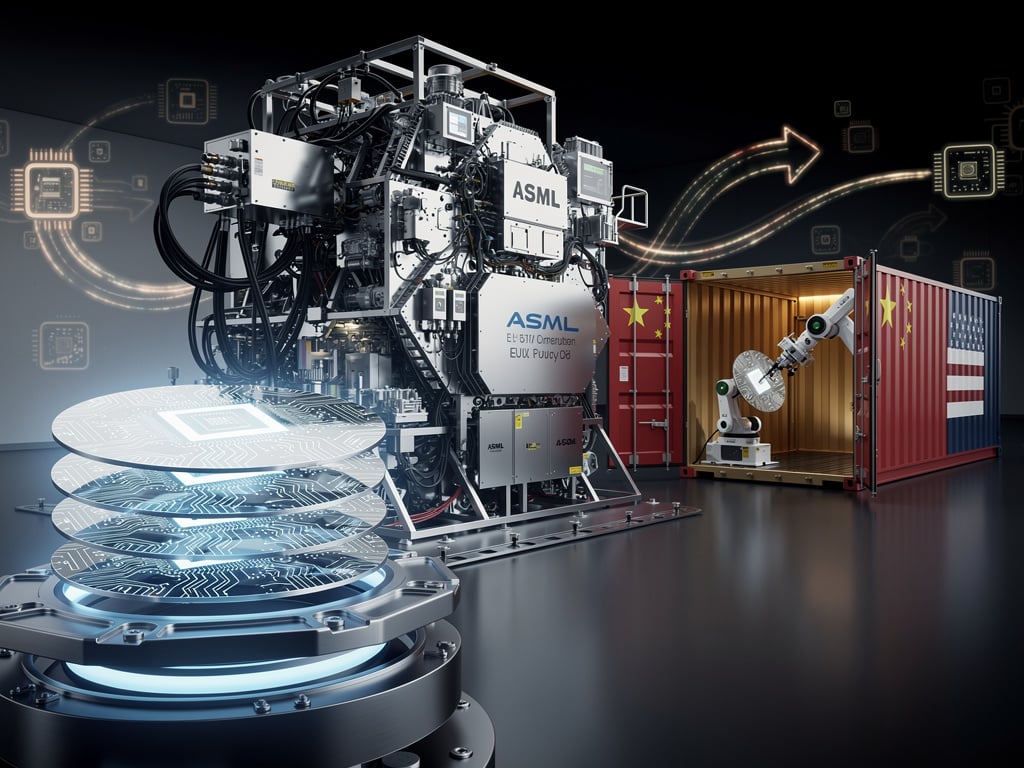
The United States government continues to tighten restrictions on advanced semiconductor manufacturing equipment headed for China, creating fresh tensions with both Beijing and key industry partners in Europe. A recent proposal from Howard Lutnick, the Commerce Secretary nominee under President-elect Donald Trump, has brought new attention to the long-running dispute over extreme ultraviolet lithography machines produced by Dutch company ASML.
Lutnick suggested during his confirmation hearings that Washington might consider allowing limited exports of these sophisticated tools to Chinese customers under strict conditions. The idea immediately sparked debate across technology supply chains and diplomatic circles. According to reporting from The Next Web, the comments reflect ongoing negotiations about how to balance national security concerns with commercial realities in the global chip industry.
ASML stands as the only company in the world capable of producing EUV lithography systems, machines essential for etching the smallest and most advanced semiconductor features. These devices use powerful lasers to create circuit patterns on silicon wafers at scales measured in single-digit nanometers. Without access to EUV technology, chipmakers face severe limitations in producing the highest-performance processors demanded by artificial intelligence, smartphones, and high-end computing applications.
The Dutch government, acting in coordination with American officials, has already imposed licensing requirements that effectively block most EUV shipments to China. ASML received approval to ship older deep ultraviolet machines to certain Chinese facilities, but the far more capable EUV systems remain largely off limits. This policy stems from fears that advanced chips could support military modernization efforts within the People’s Liberation Army, particularly in areas like supercomputing, missile guidance, and artificial intelligence applications.
Chinese leaders have repeatedly described these export controls as unfair trade practices designed to contain their country’s technological rise. Beijing has responded with its own measures, including export restrictions on rare earth minerals and gallium compounds critical for semiconductor production. The back-and-forth has created uncertainty throughout the global supply chain, forcing companies to reconsider their manufacturing footprints and investment strategies.
Industry analysts point out that Chinese semiconductor firms have made notable progress despite the restrictions. Companies like SMIC have successfully produced 7-nanometer chips using older equipment and creative engineering approaches. While these achievements demonstrate resilience, they still lag behind the 3-nanometer and 2-nanometer processes now entering commercial production in Taiwan and South Korea. The performance gap affects everything from smartphone battery life to the training speed of large language models.
The economic stakes could hardly be higher. The semiconductor industry supports trillions of dollars in downstream economic activity. ASML itself employs thousands of highly skilled workers in the Netherlands and maintains an extensive network of suppliers across Europe. Any significant change in export policy could affect employment, research budgets, and corporate revenues for years to come.
Lutnick’s suggestion that controlled EUV exports might be possible under certain circumstances represents a potential shift in approach. During his Senate testimony, the nominee indicated that the incoming administration wants to prevent China from developing its own advanced semiconductor capabilities while avoiding unnecessary damage to American and allied industries. This nuanced position acknowledges that complete decoupling may prove impossible given the interconnected nature of modern technology supply chains.
European officials have expressed mixed reactions to the American proposals. The Netherlands maintains its own national security review process for technology exports and has shown willingness to coordinate with Washington. However, Dutch companies and politicians also worry about losing market access in China, which represents a substantial customer base for many technology firms. ASML has publicly stated that it follows all applicable export regulations while continuing to serve customers in permitted markets.
The technical complexity of EUV systems adds another dimension to the policy debate. These machines represent decades of scientific advancement and billions of euros in development costs. A single EUV lithography tool can cost more than 200 million dollars and requires specialized infrastructure, including vibration-free cleanrooms and enormous amounts of power. Training engineers to operate and maintain them takes years, creating significant barriers to rapid technology transfer even if export licenses were granted.
Chinese research institutions and state-backed enterprises have poured resources into developing domestic alternatives. Programs like the National Integrated Circuit Industry Investment Fund have channeled tens of billions of dollars toward building local manufacturing capabilities. Progress remains slower than desired, particularly in the area of light sources and precision optics where ASML and its partners hold formidable technological leads.
Taiwan Semiconductor Manufacturing Company continues to serve as the world’s most advanced contract chip manufacturer, producing cutting-edge processors for Apple, Nvidia, and other major clients. TSMC’s factories in Taiwan operate multiple EUV machines and maintain strict security protocols to protect intellectual property. The geopolitical tensions surrounding Taiwan add yet another layer of complexity to semiconductor policy discussions in Washington and European capitals.
American lawmakers from both parties have generally supported strict controls on technology transfers to China. Bipartisan legislation has expanded the authority of the Commerce Department to review exports and scrutinize investments in sensitive technologies. The CHIPS and Science Act provided substantial funding for domestic semiconductor manufacturing while also creating new mechanisms to monitor supply chain security.
Critics of the current approach argue that overly broad restrictions may accelerate China’s efforts to achieve self-sufficiency. They suggest that targeted controls focused on specific military applications might prove more effective than blanket prohibitions. Supporters counter that the dual-use nature of advanced semiconductors makes such distinctions impractical, since the same production lines can serve both civilian and military customers.
The incoming Trump administration has signaled that it will take a firm stance on technology competition with China. Lutnick’s comments about potential EUV exports under strict oversight suggest that negotiations rather than outright bans may characterize the next phase of policy. Any such arrangement would likely require extensive verification mechanisms to ensure that the equipment serves only commercial purposes and that sensitive technical data remains protected.
ASML has maintained a careful public position throughout these discussions. The company emphasizes its commitment to compliance with international regulations while highlighting the importance of open markets for its long-term success. Its leadership has repeatedly noted that the development of EUV technology required global collaboration among scientists, suppliers, and customers across multiple continents.
The debate extends beyond immediate commercial considerations to fundamental questions about technological leadership in the twenty-first century. Nations that control the most advanced semiconductor manufacturing capabilities will likely enjoy significant advantages in artificial intelligence, quantum computing, biotechnology, and other emerging fields. This recognition drives intense competition among governments to support their domestic industries while restricting adversaries’ access to critical tools.
Supply chain experts recommend that companies prepare for continued volatility in technology trade policies. Many firms have begun diversifying their manufacturing locations, establishing facilities in multiple jurisdictions to reduce dependence on any single market. This approach increases costs but provides greater resilience against sudden regulatory changes.
Research and development efforts continue at full speed despite the export restrictions. ASML works on next-generation high-NA EUV systems that promise even smaller feature sizes and higher productivity. These machines, expected to enter production later this decade, will further widen the gap between permitted and restricted technologies for Chinese manufacturers.
Chinese companies have responded by investing heavily in older technologies and exploring alternative approaches such as multi-patterning techniques that can extract additional performance from existing equipment. While these methods can narrow the gap temporarily, they typically involve higher costs and lower yields compared with true EUV processing.
The outcome of current diplomatic discussions between Washington, The Hague, and Beijing will shape the semiconductor industry for years ahead. Companies throughout the supply chain watch carefully for any signals about potential policy adjustments under the new American administration. For now, the restrictions remain firmly in place, forcing chipmakers in China to work with available tools while their competitors in other regions gain access to the most sophisticated manufacturing platforms.
Industry observers expect that technological competition will intensify rather than diminish in coming years. Both sides appear committed to their respective strategies, with Western nations focusing on protecting sensitive technologies and China concentrating on developing independent capabilities. The resulting tension creates challenges for businesses caught between these competing priorities but also drives innovation as each side seeks competitive advantages.
ASML’s unique position as the sole provider of EUV lithography systems places the Dutch company at the center of these geopolitical currents. Its decisions about production schedules, customer allocations, and technology roadmaps carry implications that extend far beyond corporate balance sheets. The coming months will likely bring further clarification about how export policies may evolve and what conditions might accompany any potential changes in licensing procedures for these remarkable machines.


 WebProNews is an iEntry Publication