
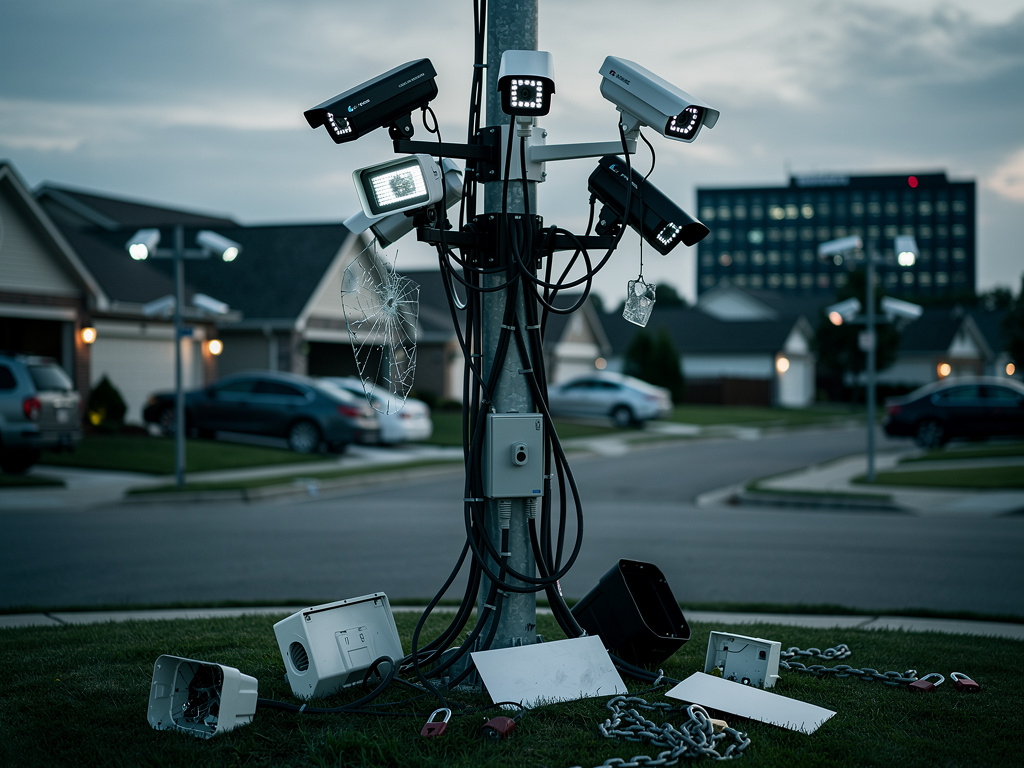
In the quiet suburbs of America, a new kind of rebellion is brewing—not with pitchforks or protests in the streets, but with concerned citizens banding together to challenge the unchecked spread of artificial intelligence-powered surveillance cameras. Companies like Flock Safety are at the forefront, deploying networks of license plate readers and AI-driven cameras that promise to enhance public safety by tracking vehicles and identifying potential threats in real time. Yet, as these systems proliferate, a groundswell of opposition is emerging, driven by fears of privacy erosion and overreach. Recent reports highlight how ordinary people are pushing back, from local petitions to outright sabotage, signaling a broader unease with technology that watches without consent.
Take the case in Lake County, Illinois, where Flock Safety’s cameras have sparked intense debate. Residents there have mobilized against what they see as an invasive “dragnet” that captures data on every passing car, regardless of suspicion. According to a detailed account in Futurism, locals are not just voicing concerns; some are taking direct action, such as covering cameras or lobbying city councils to remove them. This resistance isn’t isolated—similar stories are unfolding in cities across the U.S., where AI surveillance is marketed as a crime-fighting tool but criticized for creating a pervasive monitoring state.
The technology itself is sophisticated: Flock’s cameras use machine learning to scan license plates, cross-reference them with databases of stolen vehicles or persons of interest, and alert law enforcement instantly. Proponents argue this reduces response times and deters crime, with data showing decreases in auto thefts in some areas. But critics point out the lack of transparency—data is often stored indefinitely, shared with third parties, and used in ways that extend beyond initial promises, raising alarms about mission creep.
Rising Tensions in Urban Centers
Opposition groups are forming coalitions, blending privacy advocates, civil liberties organizations, and everyday homeowners. In places like Oakland, California, community meetings have turned heated as residents question the equity of surveillance that disproportionately affects minority neighborhoods. Drawing from insights in a Quartz piece on the global AI surveillance economy, these systems are part of a larger ecosystem where data flows to entities like U.S. Immigration and Customs Enforcement, amplifying concerns about government overreach.
Beyond the U.S., international developments underscore the stakes. In Ho Chi Minh City, Vietnam, AI cameras detected over 3,100 traffic violations in a single month, as reported by Vietnam News. While efficient, such deployments highlight how AI can enforce rules with unyielding precision, often without adequate oversight. Back home, a Brookings Institution analysis warns of geopolitical risks, noting that authoritarian regimes are adopting similar tech to suppress dissent, a model that democracies must guard against.
Privacy experts argue that the real danger lies in the aggregation of data. AI doesn’t just watch; it analyzes patterns, predicts behaviors, and creates profiles that could be misused. A study from MIT, detailed in MIT News, revealed inconsistencies in how AI interprets home surveillance footage, sometimes flagging non-crimes as threats and recommending police intervention erroneously. This inconsistency fuels distrust, as users worry about false positives leading to unwarranted intrusions.
Authoritarian Shadows and Legal Battles
The authoritarian potential of AI surveillance is a recurring theme in expert discussions. A Lawfare article explores how these tools enable control, with courts and lawmakers urged to intervene before they entrench in democratic societies. In the U.S., lawsuits are mounting; for instance, the American Civil Liberties Union has challenged Flock Safety’s data practices, arguing they violate Fourth Amendment protections against unreasonable searches.
Recent news amplifies these concerns. In Jackson, Wyoming, the installation of 28 license plate-reading cameras has ignited a privacy fight, with critics likening them to a “robot army,” as covered in Cowboy State Daily. Residents fear constant tracking erodes personal freedoms, turning public spaces into zones of perpetual scrutiny. Similarly, Berlin’s approval of sweeping police powers, including AI-driven surveillance, has drawn backlash for potential privacy erosion, according to WebProNews.
On social platforms like X, sentiment echoes this unease. Posts from users highlight fears of a “dystopian digital future,” with one Australian senator warning of smart city tech laying foundations for social credit systems and constant monitoring. Another post describes Shanghai’s “Urban Brain” as a chilling blueprint for Western adoption, where AI integrates with vast camera networks to enforce compliance. These online discussions reflect a growing public awareness, often framing AI surveillance as an existential threat to anonymity.
Industry Pushback and Ethical Dilemmas
Industry players, however, defend their innovations. A blog from Pelco touts AI cameras as the next generation of smart CCTV, emphasizing real-time monitoring and enhanced protection. Companies argue that with proper regulations, these tools can balance security and privacy. Yet, opposition groups counter that self-regulation is insufficient, pointing to cases where data breaches have exposed sensitive information.
In Durango, Colorado, editorial voices in The Durango Herald decry the “surveillance state,” invoking cultural histories of photography as an act of power taken without consent. This perspective resonates in ongoing debates, where ethicists question the moral implications of AI that judges human behavior algorithmically. A post on X from a technology analyst warns that by 2025, trust in visual evidence could crumble due to AI manipulation, complicating everything from court proceedings to personal interactions.
FBI inquiries into AI surveillance drones with facial recognition, as reported by The Intercept, raise stakes further, suggesting federal interest in expanding these capabilities amid concerns over protest suppression. Critics fear this could chill free speech, with AI flagging gatherings as potential threats based on biased datasets.
Grassroots Movements Gain Momentum
Grassroots efforts are gaining traction, with communities in states like Illinois and California successfully delaying or halting camera installations. In Lake County, as Futurism noted earlier, petitions have forced public hearings, compelling officials to address data retention policies. These victories inspire similar actions elsewhere, such as in India, where a Hindustan Times op-ed argues for AI integration in CCTV but stresses the need for ethical frameworks to prevent abuse.
X posts reveal a global chorus of concern, with users debating the erosion of mid-20th-century notions of urban anonymity. One thread discusses how existing surveillance already outstrips legal provisions, urging updates to privacy laws. Another highlights the sheer scale: cities like London with one camera per 14 people, and China’s 540 million units with live facial recognition, painting a picture of inevitable escalation.
Technologists warn of broader implications, such as AI’s role in inconsistent decision-making, as per the MIT study referenced before. If models apply varying norms to similar scenarios, the risk of discriminatory outcomes increases, particularly in diverse communities.
Policy Reforms on the Horizon
Policymakers are beginning to respond. In Europe, Brussels is rewriting rules to curb AI surveillance excesses, as Quartz detailed in its global overview. In the U.S., calls for federal guidelines grow louder, with Brookings recommending international cooperation to mitigate risks. Lawfare’s analysis suggests judicial interventions could set precedents, limiting AI’s authoritarian applications.
Yet, challenges persist. Industry expansion continues apace, with Flock Safety reporting rapid growth despite pushback. Opposition leaders emphasize education, urging citizens to demand transparency in how data is collected and used. X discussions often pivot to solutions, like advocating for opt-out mechanisms or community oversight boards.
As these battles unfold, the core tension remains: balancing innovation with individual rights. In Jackson, the “robot army” debate, as Cowboy State Daily reported, encapsulates this struggle, where technology’s promise clashes with fears of an omnipresent gaze. The outcome could redefine public spaces, determining whether AI serves society or subjugates it.
Voices from the Frontlines
Interviews with activists reveal personal stakes. One Lake County resident, quoted in Futurism, described feeling “hunted” by constant monitoring, prompting her to organize neighbors. Such stories humanize the resistance, contrasting corporate narratives of safety with lived experiences of intrusion.
Ethical debates intensify, with X users pondering AI’s magnification of existing surveillance capitalism. Posts note how governments and platforms already track vast data, amplified by AI’s speed, potentially leading to unchecked authoritarianism if not regulated.
Ultimately, the opposition to AI surveillance cameras represents a pivotal moment in technology governance. As developments accelerate— from Vietnam’s traffic enforcement to Berlin’s new powers—the need for robust safeguards becomes clear. Drawing from diverse sources like Vietnam News and WebProNews, it’s evident that without intervention, these systems could normalize a world where privacy is a relic, urging insiders to advocate for balanced progress.


 WebProNews is an iEntry Publication