
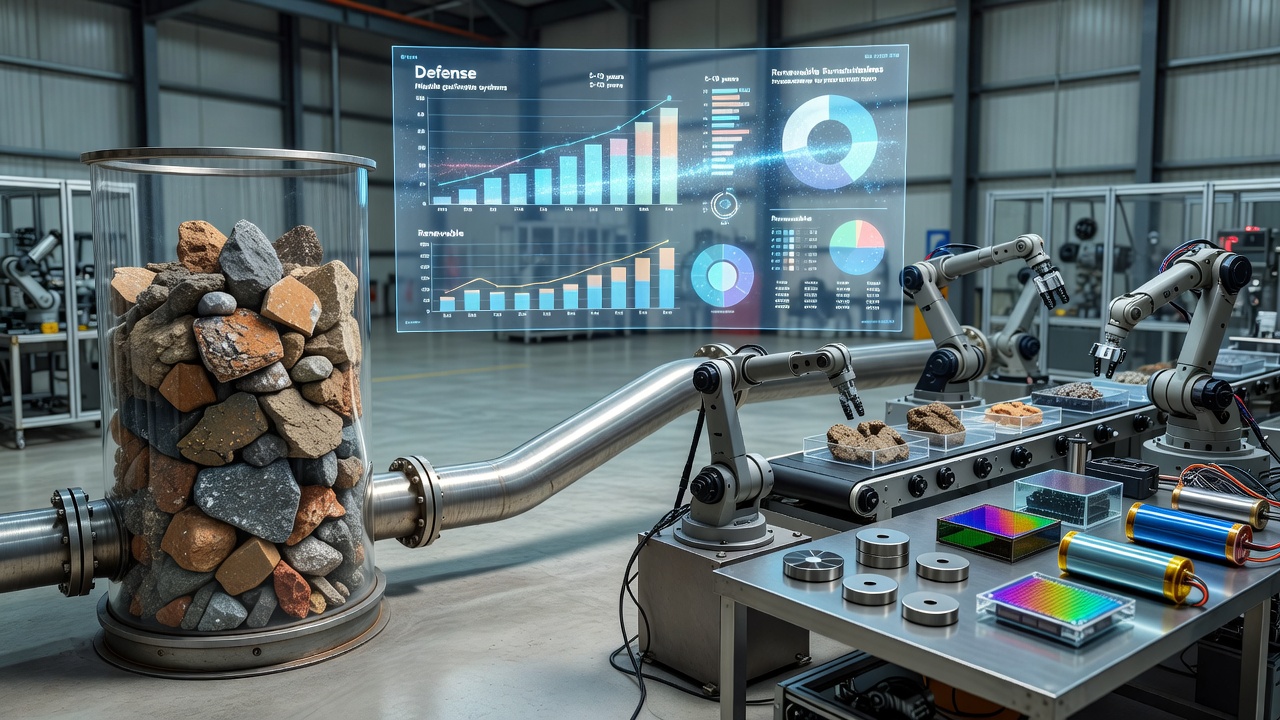
The United States continues to export the vast majority of its rare earth minerals to processing facilities in Asia even as federal and private efforts to build a domestic supply chain have gained new momentum in recent years. According to reporting from Ars Technica, shipments of raw and semi-processed rare earth materials from American mines flow primarily to facilities in China, Japan, and other Asian countries where separation and refining capacity remains concentrated. This pattern persists despite growing recognition that these seventeen elements serve as essential components in electric vehicle motors, wind turbines, defense systems, and advanced electronics.
Rare earth elements, which include neodymium, praseodymium, dysprosium, and others, appear more abundant in the Earth’s crust than their name suggests. Their chemical similarities make extraction and separation difficult and environmentally intensive. The Mountain Pass mine in California, operated by MP Materials, stands as the only active rare earth mine in the United States. The facility produces significant volumes of rare earth concentrate, yet most of that material travels across the Pacific for further processing. Chinese companies maintain control over approximately 85 percent of global refining capacity, a position built through decades of state-supported investment and lower environmental standards that allowed rapid scaling.
This dependence creates strategic vulnerabilities. Defense contractors require reliable supplies of these materials for precision-guided munitions, night vision equipment, and radar systems. The automotive industry needs neodymium-iron-boron magnets for electric motors that deliver high torque in compact packages. Renewable energy developers rely on similar magnets for direct-drive wind turbines that operate efficiently at low wind speeds. When supply chains concentrate in one geographic region, price volatility and potential export restrictions can disrupt entire industrial sectors.
Recent policy initiatives have attempted to address this imbalance. The Inflation Reduction Act and earlier defense production funding allocated billions toward domestic processing facilities. Companies such as Lynas Rare Earths, an Australian firm with U.S. government backing, have broken ground on a heavy rare earth separation plant in Texas. MP Materials itself has invested in downstream processing at Mountain Pass, aiming to produce separated oxides and eventually finished magnets within the United States. These projects face technical hurdles, high capital costs, and lengthy permitting timelines that have slowed their impact.
Market demand within the United States has not yet materialized at the scale needed to support a fully independent supply chain. Many manufacturers remain hesitant to switch suppliers when Asian processors offer established quality, competitive pricing, and reliable delivery schedules. Automotive original equipment manufacturers often specify magnet grades refined to exacting standards developed over years of collaboration with Asian partners. Changing those specifications requires extensive testing and validation that can stretch across multiple model years.
Environmental considerations add another layer of complexity. Rare earth separation generates significant volumes of toxic wastewater and radioactive tailings containing thorium and uranium. American regulators impose stricter standards than those applied in many overseas facilities, driving up compliance costs. Communities near proposed processing sites often express concern about potential contamination of water supplies and long-term health impacts. These legitimate worries have delayed or altered multiple projects, extending the timeline before domestic capacity can compete effectively.
The Defense Department has taken a more direct approach through its Industrial Base Analysis and Sustainment program. Contracts awarded to firms like USA Rare Earth and Energy Fuels aim to develop facilities capable of producing rare earth metals and alloys suitable for military applications. These efforts prioritize secure supply over commercial competitiveness in the short term. Pentagon officials have expressed particular concern about heavy rare earth elements such as dysprosium and terbium, which enhance magnet performance at high temperatures and appear in limited quantities outside of certain Chinese mines.
Private investment has followed government signals but remains cautious. Venture capital and private equity funds have backed several rare earth startups, yet many projects remain in pilot stages. The technical expertise required to master solvent extraction and other separation techniques takes years to develop. Few American engineers possess hands-on experience with commercial-scale rare earth processing, creating a knowledge gap that Asian competitors have exploited for decades.
International partnerships offer one pathway forward. Australia, which possesses substantial rare earth deposits, has emerged as a key ally. Lynas operates the Mount Weld mine and maintains processing facilities in Malaysia, providing an alternative to complete Chinese dependence. The United States has signed agreements with Australia, Canada, and several African nations to coordinate critical minerals strategy. These diplomatic efforts seek to create a network of trusted suppliers less vulnerable to geopolitical pressure.
China has demonstrated willingness to use its dominant position as leverage in trade disputes. Export quotas imposed in 2010 triggered sharp price increases and accelerated global efforts to develop alternative supplies. Although those quotas were later lifted following World Trade Organization challenges, the episode highlighted the risks of concentrated production. More recent export licensing requirements for certain rare earth technologies have renewed concerns about potential weaponization of supply chains.
Domestic magnet manufacturing represents a critical missing link. Even if the United States increases separation capacity, the ability to produce high-performance permanent magnets at scale remains limited. Vacuumschmelze, a German company, announced plans for a U.S. facility, while several smaller firms have received federal grants to develop magnet production lines. These facilities require specialized equipment and skilled operators familiar with powder metallurgy and sintering processes conducted under inert atmospheres.
The slow emergence of demand stems partly from uncertainty about policy continuity. Companies evaluating long-term investments in electric vehicle production or renewable energy infrastructure hesitate when future tax credits, tariffs, or procurement preferences remain subject to political change. Automakers must balance multiple objectives including cost, performance, and supply security when selecting motor technologies. Some have explored ferrite-based alternatives or induction motors that avoid rare earths altogether, though these options often sacrifice efficiency or power density.
Despite these challenges, progress continues on multiple fronts. Researchers at national laboratories and universities work to improve extraction efficiency, develop recycling technologies, and design magnets that require smaller amounts of critical elements. Innovations in direct recycling of end-of-life magnets could reduce pressure on primary mining while creating new economic opportunities. Several companies have demonstrated pilot-scale recovery of neodymium and dysprosium from hard drives, electric motors, and wind turbine generators.
The global market for rare earths continues to expand as electrification accelerates. Projections suggest demand for neodymium-praseodymium oxide could triple by 2035 if electric vehicle adoption meets current targets. This growth creates opportunities for new entrants but also intensifies competition for established producers. Chinese firms have responded by vertically integrating their operations and investing in overseas mines to secure feedstock.
American companies face the difficult task of building capacity while competing against heavily subsidized foreign producers. Government support through loan guarantees, tax credits, and purchase commitments will likely remain necessary for the foreseeable future. The Bipartisan Infrastructure Law and subsequent legislation have provided initial funding, yet sustained commitment across multiple administrations will prove essential.
Geological surveys indicate the United States holds substantial rare earth resources beyond Mountain Pass. Deposits in Wyoming, Alaska, and several western states could support expanded production if economic conditions align. Development of these resources requires balancing extraction potential against environmental protection and indigenous land rights. Many promising deposits lie near sensitive ecosystems or tribal territories, necessitating careful consultation and mitigation strategies.
The path toward reduced dependence on Asian processing will likely span decades rather than years. Each link in the supply chain—from mining to separation, refining, metal production, alloying, and magnet fabrication—requires specialized infrastructure and expertise. Building this chain demands coordination between government, industry, and academic institutions. Success will be measured not by complete self-sufficiency, which may prove unrealistic given global trade patterns, but by development of resilient supply networks that incorporate multiple trusted partners.
As electric vehicles become more common on American roads and renewable energy projects multiply across the landscape, the strategic importance of reliable rare earth supplies will only increase. The current pattern of exporting raw materials while importing finished components represents a missed opportunity for domestic manufacturing and job creation. Addressing this imbalance requires patience, sustained investment, and realistic expectations about technical and regulatory challenges.
Industry observers point to recent facility announcements as evidence of gradual change. MP Materials has expanded its Stage II separation capabilities and begun construction on a magnetics plant in Fort Worth, Texas. The company now supplies separated neodymium-praseodymium oxide to customers outside China. Similar progress at other projects suggests the foundation for a more balanced supply chain is slowly taking shape, even if full realization remains years away.
The persistence of material flows to Asia reflects both economic reality and the time required to alter established industrial patterns. Companies that have optimized their designs around Asian-sourced magnets face reengineering costs and validation timelines that discourage rapid change. Policy makers must therefore craft incentives that account for these practical constraints while maintaining pressure for long-term supply security.
Looking ahead, the convergence of defense requirements, clean energy targets, and advanced manufacturing initiatives creates a compelling case for continued investment. Whether that investment yields a competitive domestic industry depends on execution across technical, regulatory, and commercial dimensions. The coming decade will test America’s ability to translate policy ambition into industrial capability in a sector where competitors have established clear advantages through sustained focus and scale. The outcome will influence not only economic competitiveness but also national security and the pace of technological transition in multiple critical sectors.


 WebProNews is an iEntry Publication