
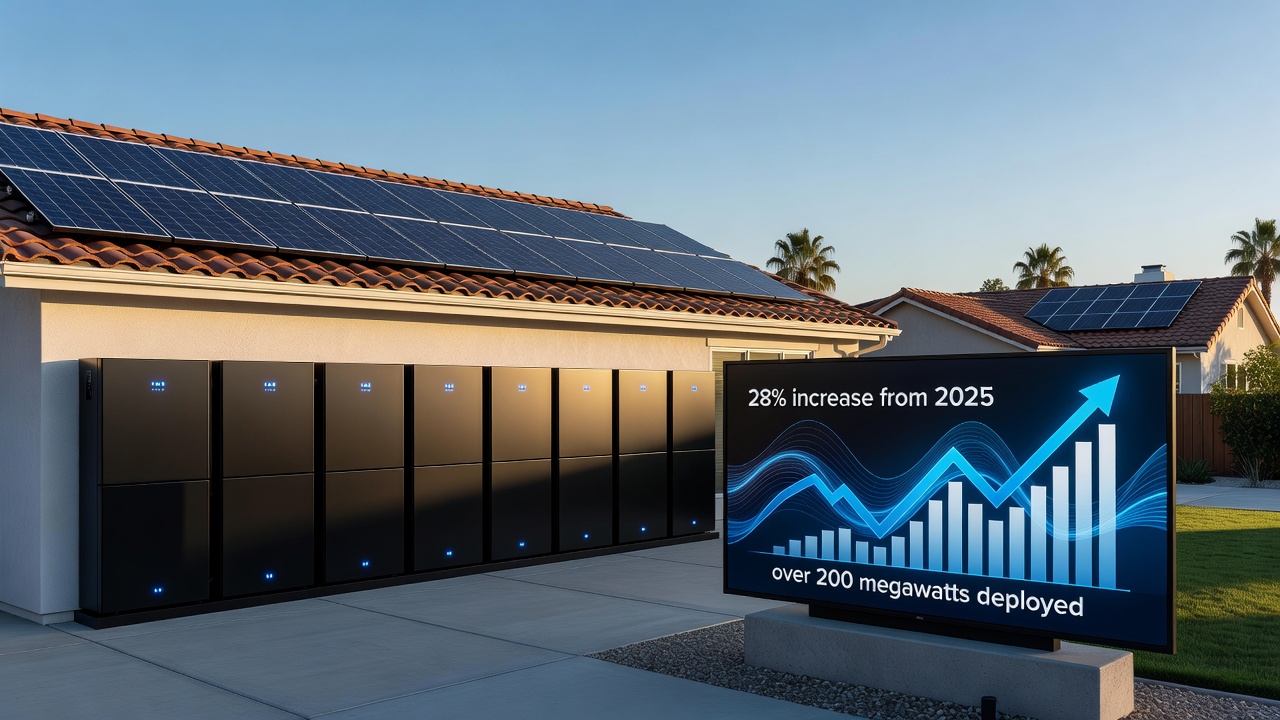
US home battery installations surged to a record high in the first quarter of 2026, according to fresh data that shows residential energy storage continuing its rapid expansion across the country. Ars Technica reported that installers placed more than 200 megawatts of battery capacity in American homes during those three months alone, marking a 28 percent jump from the same period in 2025. The numbers reflect growing consumer interest in protecting against power outages, lowering electricity bills, and supporting the wider adoption of solar power.
The increase arrives at a time when many households face higher electricity rates and more frequent grid disruptions caused by extreme weather. California led the nation with roughly 45 percent of all new installations, followed by Texas, Florida, and New York. Each of these states offers different combinations of incentives, high retail rates, and vulnerability to storms or wildfires. In California, the combination of net metering changes and wildfire-related shutoffs has pushed many residents to pair solar panels with batteries that can island the home from the grid when necessary.
Battery costs have fallen steadily since 2020. Lithium iron phosphate cells now dominate the residential market because they cost less than earlier nickel manganese cobalt formulations and offer longer cycle life. A typical 13.5 kilowatt-hour system that would have set a homeowner back $15,000 after incentives in 2022 can now be purchased and installed for around $9,000 in many markets. Federal tax credits under the Inflation Reduction Act still provide a 30 percent credit on the full cost of the battery and its installation, although those credits are scheduled to step down after 2032. Many states layer additional rebates or performance payments on top of the federal incentive, further improving payback periods.
payback calculations vary by location and usage patterns. In areas with time-of-use rates, a battery can charge during cheap midday solar hours or overnight when rates drop, then discharge during expensive evening peaks. A household in the Pacific Gas and Electric territory might save between $700 and $1,200 per year by shifting consumption and avoiding demand charges. When those savings combine with backup power value during multi-day outages, the investment becomes attractive for many middle-class families.
Installers report that whole-home backup systems now outsell partial-home configurations. Earlier adopters often chose to power only critical circuits such as refrigerators, lights, and internet routers. Today, most buyers want the entire house to remain energized, including air conditioning, electric vehicle chargers, and medical equipment. Modern inverters handle the surge loads associated with well pumps and central air compressors without difficulty. Enphase, Tesla, Generac, and Sonnen have all released new products that integrate more smoothly with existing solar arrays and smart home devices.
Tesla’s Powerwall 3 continues to capture significant market share because the unit combines the inverter and battery in one weatherproof cabinet. That design reduces installation time and cost. The company shipped more than 50,000 Powerwall units in North America during the first quarter, according to industry analysts. Meanwhile, Enphase’s IQ Battery line appeals to customers who already use the company’s microinverters. The modular design allows homeowners to start with one or two batteries and expand later without replacing the entire system.
Grid services are becoming another revenue stream. In several states, utilities and third-party aggregators pay battery owners to discharge during periods of high demand. California’s Virtual Power Plant programs have enrolled thousands of homes, offering monthly payments in exchange for occasional remote control of the batteries. Participants can still keep enough stored energy to cover an outage, but they earn extra income when the grid needs support. Similar pilot programs are expanding in Texas and Hawaii.
The rise in installations also highlights challenges in the supply chain and workforce. Lead times for certain battery models stretched to 10 weeks in early 2026 as demand outpaced factory output. Training enough certified installers remains difficult because the work requires electrical licensing, manufacturer-specific certifications, and knowledge of rapidly changing building codes. Some companies have responded by creating apprenticeship programs that combine classroom instruction with paid on-the-job training.
Environmental concerns around battery materials persist. Although lithium iron phosphate batteries avoid cobalt and nickel, they still require lithium and graphite. Manufacturers are investing in recycling programs that can recover more than 90 percent of the lithium, copper, and aluminum from old packs. The Department of Energy has funded several demonstration facilities that aim to make domestic recycling economically competitive with mining new materials. As the first wave of residential batteries reaches end of life around 2035, these recycling streams will become essential.
Consumer awareness has grown through multiple channels. Solar installers now treat batteries as a standard part of almost every proposal rather than an optional add-on. Online calculators let homeowners estimate payback based on their actual utility bills and local weather patterns. Social media groups share real-world performance data from different climates and utility territories. When neighbors see one house with solar panels and a sleek battery cabinet on the side wall, they often start asking questions.
Insurance companies have begun to adjust policies to reflect the added resilience that batteries provide. Some carriers offer discounts for homes equipped with whole-home backup because those properties are less likely to file claims after storms. In wildfire zones, certain insurers now require batteries and automatic transfer switches before they will issue a policy at all. These developments create another financial incentive that did not exist five years ago.
Policy decisions at both state and federal levels will shape the next phase of growth. California’s NEM 3.0 tariff reduced the value of exported solar, which made batteries more attractive because stored energy can be used on site instead of sold back at low rates. New York’s VDER tariff values exported energy differently depending on time and location, rewarding strategic discharge. Texas relies more on competitive retail providers and demand response programs. Each approach influences how homeowners size and operate their systems.
Utility-scale storage is expanding even faster than residential batteries, but the two segments complement each other. Large batteries smooth out renewable generation across entire regions, while home batteries respond to local needs and reduce strain on neighborhood transformers. When both layers operate together, the grid becomes more stable and less prone to cascading failures during heat waves or storms.
Looking ahead, industry observers expect annual residential installations to exceed one gigawatt by 2028. That growth will depend on continued cost reductions, clearer interconnection rules, and sustained policy support. Manufacturers are already testing sodium-ion and other chemistries that could further lower prices and reduce dependence on lithium. At the same time, smarter software will allow fleets of home batteries to behave like a single virtual power plant, automatically balancing supply and demand across thousands of homes.
Homeowners who install batteries today often mention several overlapping motivations. Some want to escape rising utility rates. Others worry about week-long outages after hurricanes or ice storms. A growing number see their battery as part of a larger effort to reduce carbon emissions and support the clean energy transition. The technology has matured to the point where it no longer feels experimental. Instead, it has become a practical tool that millions of households can use to gain greater control over their energy future.
The record numbers from early 2026 suggest that momentum is building. As more data becomes available throughout the year, analysts will watch whether the quarterly figures continue to climb or whether any policy changes or economic headwinds slow the pace. For now, the trend points toward wider adoption, lower costs, and a larger role for home batteries in the nation’s energy system. Homeowners, utilities, and manufacturers all have reasons to watch these developments closely as the market matures.


 WebProNews is an iEntry Publication