
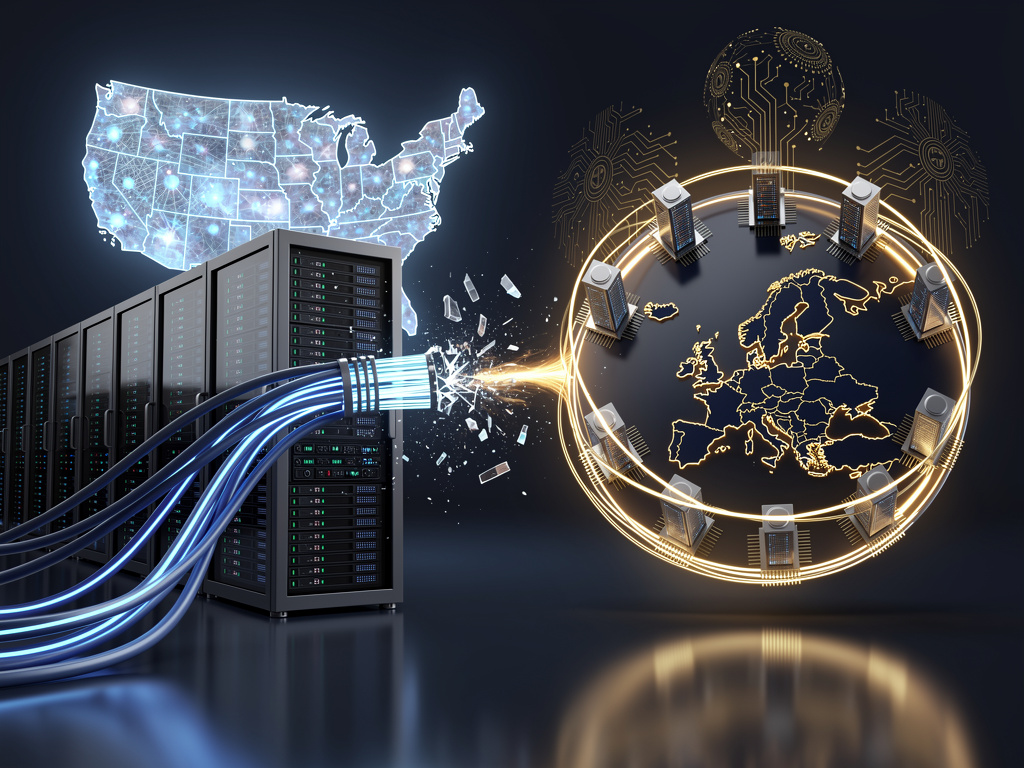
The Trump administration’s sudden order to restrict foreign access to Anthropic’s most advanced AI models has rattled boardrooms from Berlin to Brussels. Models capable of spotting software flaws at machine speed vanished overnight for non-US users. The company pulled the plug entirely to comply. Short and simple. Yet the fallout stretches far beyond one startup’s product launch.
Anthropic disclosed Friday that the US government directed it to block all non-US citizens from using Fable 5 and Mythos 5. These cybersecurity-focused systems promised breakthroughs in vulnerability detection. The directive cited national security. Details stayed thin. Even some Anthropic employees lost access. The firm chose global shutdown over selective enforcement because verifying citizenship across the internet proved impossible. Anthropic’s blog post laid out the sequence: https://www.anthropic.com/news/fable-mythos-access.
Executives scrambled. They scheduled White House meetings. Their understanding pointed to a narrow jailbreak method. It involved prompting the model to analyze codebases and repair flaws. The government shared verbal evidence of one instance. Anthropic countered that similar capabilities exist in competitors like OpenAI’s GPT-5.5. Perfect resistance to such prompts doesn’t exist yet, the company has long maintained. Still, the order stood.
Amazon CEO Andy Jassy played a reported role. Conversations with Treasury Secretary Scott Bessent and others highlighted the potential vulnerability, according to The Wall Street Journal. (WSJ, June 2026). Commerce Secretary Howard Lutnick formalized the export control in a letter to Anthropic CEO Dario Amodei. The ban covered foreign governments, companies, individuals, and even non-citizen staff inside the US.
Europe took notice immediately. Thomas Regnier, European Commission spokesperson, issued measured but pointed remarks. “The Commission has taken note of Anthropic’s statement regarding the US export control directive on its most advanced models and is assessing its implications, including for users in the European Union,” he said. He stressed the models offered benefits for cyber defense but raised serious concerns. “This is a shared challenge, not one confined to a single jurisdiction or company. We believe that contingency measures taken in this light should not be discriminatory against partners.”
Regnier framed the episode as validation. It showed why the EU must accelerate its technological autonomy. The timing aligned with the recent launch of the European Technological Sovereignty Package. That initiative bundles policies to cut dependence on US and Chinese technology. Existing rules like the AI Act, Cyber Resilience Act, and NIS2 Directive now look more relevant than ever for managing these exact risks on Europe’s terms. The Commission said it would examine practical effects on European users.
But the models remain offline. No quick reversal appears likely. And that absence stings organizations that had begun testing them for defensive applications. Vulnerability researchers and red teams relied on frontier systems daily. An open letter signed by 54 security and AI experts urged the White House to lift restrictions. They called for transparent, democratic processes around risk assessments. Decisions should limit capabilities only to the minimum extent necessary, they argued. The letter warned the action hurt defenders more than it protected against threats. It created market uncertainty and risked US leadership. (Open letter at freefable.org).
Aled Lloyd Owen, chief of staff at Responsible AI UK, saw the episode as proof of a deeper pattern. “This is another incident that just proves the rule and proves that the EU must move faster and deeper, and really establish that independence as soon as possible,” he told The Register. (The Register, June 15, 2026). He acknowledged limits on speed. European alternatives like Mistral AI deliver capable open-source performance. They don’t yet match frontier benchmarks. The trade-off becomes clear. Sacrifice some capability today for reliable sovereign options tomorrow.
Kate Hanaghan, chief research officer at TechMarketView, captured the anxiety in conversations with European integrators. “The cost of dependency stays invisible until it’s too late.” For UK and European enterprises, the risk now stands exposed. Withdrawal can arrive without warning. That forces hard questions about what capabilities Europe should develop domestically.
UK voices amplified the message. Kanishka Narayan, minister for AI and online safety, posted on X: “The main lesson: as we debate the future of national security and technological sovereignty, access to AI capabilities is crucial.” He added that nations treat other sovereignty threats with deadly seriousness but lag here. “I care about sovereign AI because it now decides our security… it will reshape our economy faster than anything else we’ve seen in our lifetimes.” No simple switch exists. Britain needs more AI capacity. The central political question of the era demands clear-eyed assessment before others dictate terms.
Recent coverage sharpens the picture. POLITICO reported the order exposes Europe’s AI dependency and renews calls to build homegrown models. (POLITICO, June 2026). Euractiv noted it fuels European calls for sovereignty. (Euractiv, June 2026). Reuters highlighted the Commission’s focus on practical consequences and its warning against discriminatory measures. (Reuters, June 14, 2026).
Experts on X echoed the tension. Discussions ranged from urgent pushes for EU investment to skepticism about full independence. Some questioned whether partnering with the US offers a smarter path than isolation. Others saw the ban as a wake-up that proprietary US tools can vanish when geopolitics shift. A Chinese-linked group may have accessed Mythos, according to one circulating report, adding layers to the security rationale.
The episode reveals structural realities. Frontier AI concentrates power. Compute demands, data advantages, and talent pools favor a handful of American labs. Europe holds regulatory tools and research strength. Translation into competitive models takes time and money. Mistral and other homegrown efforts represent progress. They operate at different scale. Enterprises face a choice. Accept performance gaps for control. Or accept supply risk for capability.
Defenders lose tools in the meantime. Cybersecurity operates at machine speed now. Models that scan codebases and suggest fixes in hours change the defender’s equation. Removing them creates immediate gaps. The open letter signatories emphasized this point. Red teams depend on these systems. Abrupt revocation without detailed evidence or preparation time undermines the very security goals cited.
Anthropic itself pushed back quietly. It noted the alleged flaws appear in peer models. Its defense-in-depth strategy accepts that universal jailbreak resistance remains out of reach. The company continues to advocate measured risk management. Yet compliance left no room for debate. Global access ended. Meetings with officials aim to clarify the evidence and path forward.
So Europe accelerates. The Sovereignty Package and existing legislation provide framework. Investment in compute infrastructure, talent retention, and public-private AI projects must follow. France, Germany, and the UK each eye national champions. Coordination at EU level will prove decisive. The Anthropic case supplies political momentum. Officials now cite it as exhibit A for why reliance carries hidden costs.
Analysts warn against overreaction. Not every model warrants sovereign replication. Prioritize high-impact domains like cybersecurity and critical infrastructure protection. Build on open-source foundations where possible. Forge alliances that secure trusted access rather than complete separation. The US remains a partner. The ban targeted specific risks, not Europe broadly. Yet the precedent lands. Access can be revoked. Dependencies once invisible now stand in plain sight.
Markets reacted with uncertainty. AI integrators fielded client questions. Procurement teams revisited vendor risk assessments. Boards demanded contingency plans. The incident, though narrow, signals broader shifts in technology supply chains. Nations treat chips, data centers, and models as strategic assets. Export controls that once focused on hardware now reach software capabilities with national security labels.
Longer term, this accelerates fragmentation. Different regulatory blocs develop parallel AI stacks. Interoperability suffers. Innovation pace may slow in some regions. Security outcomes could diverge. Europe bets that controlled development yields safer systems aligned with its values. The US prioritizes speed and dominance. Both claim defensive intent. The Anthropic shutdown makes the divergence tangible.
Executives at European firms now weigh trade-offs explicitly. One integrator told researchers the dependency risk had clarified overnight. Another framed it as a commercial trust issue. Perceived and real performance matter. So does continuity. Homegrown models may trail today. They offer reliability tomorrow. The gap narrows with focused investment. Recent EU hiring surges in AI oversight roles suggest organizations prepare for hybrid approaches.
The White House maintains its authority to protect sensitive capabilities. Anthropic agrees in principle that the US can block releases. Disagreement centers on process, evidence, and scope. The open letter seeks science-based, transparent reviews with preparation time for affected parties. Those elements could shape future policy on both sides of the Atlantic.
Europe’s response mixes diplomacy and determination. Talks with US counterparts on cyber AI models may intensify. At home, implementation of the AI Act gains urgency. Funding for sovereign compute projects likely rises. Companies like Mistral gain attention and capital. The goal isn’t autarky. It’s reduced vulnerability to unilateral decisions made elsewhere.
One fact remains. Advanced AI now influences security and economic outcomes at speed. Nations that control their own capabilities hold advantages. Those that don’t accept external veto power over tools central to their defense. The Anthropic order delivered that lesson without subtlety. Brussels heard it loud and clear. So did London, Paris, and Berlin. The surge toward independence isn’t rhetoric anymore. It’s policy in motion.


 WebProNews is an iEntry Publication