
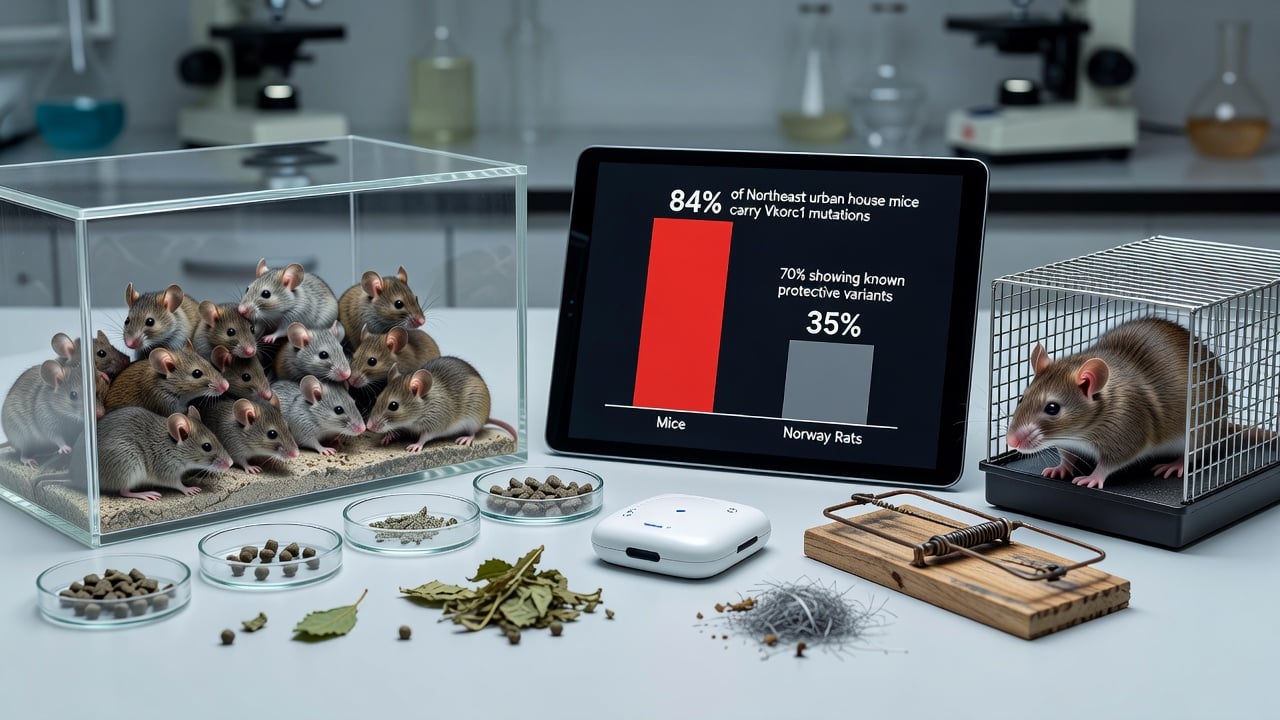
Rodents have long tested the limits of human patience in cities across the Northeast. Now they are testing the limits of chemistry too. A fresh study from Rutgers University reveals that house mice in places like Philadelphia, New York and Trenton carry genetic changes that let them shrug off the anticoagulant poisons pest managers have counted on for decades. The numbers stun. Eighty-four percent of the mice sampled showed at least one mutation in the Vkorc1 gene. Nearly seventy percent held variants already known to blunt the poison’s lethal effects.
Norway rats told a more mixed story. About thirty-five percent carried mutations in the same gene. Yet researchers remain unsure how many of those changes actually confer resistance. The findings, published in Pest Management Science, arrived after months of collecting specimens from urban traps and analyzing their DNA. Jin-Jia Yu, the postdoctoral fellow who led the work, heard the same complaint again and again from pest control crews. “Pest management professionals often told us that rodent control was becoming more difficult in some areas, even though they applied the effective rodenticides.”
So he decided to look closer. The team gathered one hundred forty-seven house mice and one hundred forty-three Norway rats from sites stretching from Manhattan to the Philadelphia suburbs, including Levittown, New Hope and Trenton. In Philadelphia alone, the majority of twenty-four mice tested positive for mutations. Five carried two. One held a rare variant. Ten of twenty mice from Trenton had double mutations. The pattern repeated across New Jersey, Pennsylvania, New York and even Washington, D.C. And the implications stretch far beyond annoyed building owners.
Anticoagulant rodenticides work by blocking vitamin K recycling. Without it, blood fails to clot. Internal bleeding follows. Slow action was supposed to be their strength. Rodents would not link the bait to sudden death and would keep eating. But natural selection does not wait. Mice, more willing to sample new food, encountered the poison often. Survivors passed on protective mutations. Rats, warier and slower to try novel baits, showed lower genetic resistance so far. “They’re pretty smart,” Yu told The Philadelphia Inquirer. He noted that rats learn to dodge traps after seeing others caught. They avoid new objects. That neophobia may buy them time while genetic resistance catches up.
The Gizmodo report on these mutant rodents captured the growing alarm. Gizmodo quoted Changlu Wang, the Rutgers urban pest specialist overseeing the lab. “As resistance becomes more common, it becomes even more important to use science-based management strategies that protect both public health and the environment.” Wang and Yu argue for integrated approaches. Seal entry points. Improve sanitation. Deploy traps strategically. Reduce blanket reliance on chemical baits that now feed resistant populations and risk harming wildlife when the compounds wash into waterways.
Recent coverage echoes the urgency. A June 2026 piece in BBC Science Focus warned that common rodent poisons may be losing ground as DNA mutations spread. The article highlighted the same Rutgers data and quoted Yu on the surprising breadth of resistance in house mice. It also stressed the public-health angle. Longer infestations mean more disease risk from rodents already known to carry pathogens. A follow-up report from SciTechDaily, published just days ago, reinforced the numbers. Eighty-four percent of tested mice. Thirty-five percent of rats. New mutations whose full effects remain unknown. The piece noted funding from USDA, HUD and NSF, underscoring the federal interest in what has become an urban arms race.
NewsNation picked up the story in late June. Its coverage of mutating rats and mice focused on the Northeast hotspot and the possibility that resistance could migrate elsewhere. NBC New York ran a similar report, pointing out that resistance now appears more widespread than previously thought. On X, the conversation exploded. Posts from mid-June onward shared images of sewer rats and warned of “super rodents” evolving past control measures. One viral thread from @interesting_aIl cited the Rutgers findings directly and racked up tens of thousands of views. Another from @TheCalvinCooli1 called it a nationwide sewer problem. The social chatter mixes fascination with frustration. Homeowners swap tips. Exterminators vent. A few users recalled older cases of resistance in the UK dating back to the early 2000s, showing this is not entirely new but has accelerated in American cities.
City statistics tell their own tale. Nationwide, about twelve percent of households report seeing rodents. In Philadelphia that figure jumps to twenty-nine percent. Washington sits at twenty percent. Manhattan hits fifteen percent. The higher urban density, abundant garbage and warm infrastructure give rodents steady food and shelter. They breed fast. A single pair of mice can produce dozens of offspring in months. When most of those offspring carry resistance genes, the population shifts quickly. “For the house mouse, we saw much more mutations rather than Norway rats,” Yu explained in the Inquirer interview. “Genetic mutation is not that special in these creatures. But we found that the house mouse shows a lot of genetic mutations related to rodenticide resistance.”
Some mutations are familiar. L128S and Y139C appeared in nearly seventy percent of the resistant mice. Both have been documented in earlier studies to reduce the poison’s binding power. Others are novel. Scientists still need to test whether those new variants truly protect the animals or simply hitchhike along. The uncertainty matters. Pest managers cannot afford to assume every genetic change equals full immunity. Yet the trend is clear. Decades of heavy rodenticide use have created selective pressure. The survivors now dominate. And the poisons that once cleared buildings in weeks now require repeated applications, raising costs, environmental loads and the chance that non-target species ingest the toxins.
Experts have seen hints of this before. A 2009 study in England flagged resistance in rats. American researchers tracked isolated cases in Chicago and other cities. But the Rutgers survey stands out for its scale and geographic spread. It sampled multiple metropolitan areas at once. It combined genetic sequencing with behavioral observations. The result paints a picture of adaptation happening in real time, right under city streets and inside apartment walls. Wang hopes the data will push planners to act. “Studies like this help us understand how rodent populations are changing and how our management strategies need to evolve with them,” he said.
That evolution will not come easy. Integrated pest management demands coordination. Building owners must seal cracks. Sanitation departments must keep trash contained. Exterminators must rotate between trap types and less toxic baits. Some cities already experiment with birth-control pellets or predatory birds. Others push stricter waste rules. Success will vary. Resistant mice will not vanish overnight. Yet continued dependence on failing poisons only speeds the spread of resistance. The cycle becomes self-reinforcing.
Public health officials watch closely. Rodents spread leptospirosis, salmonella and other illnesses. In dense housing, one unchecked infestation can affect dozens of families. Children and elderly residents face higher risks. The environmental toll adds another layer. Anticoagulants harm owls, hawks and other predators that eat poisoned rodents. Secondary poisoning has been documented in wildlife across the country. Reducing chemical use therefore protects more than just human comfort.
Yu and Wang stop short of declaring defeat. They frame the study as a call for smarter tools. Better monitoring of genetic markers could let managers know when standard baits will fail. New compounds that target different pathways might restore the upper hand, at least temporarily. Behavioral research on rat neophobia could improve trap design. The goal remains effective control with less collateral damage. “Ultimately, we want to help communities maintain effective rodent control, reduce unnecessary pesticide use and protect public health,” Yu concluded.
The rodents, meanwhile, keep moving. They tunnel through walls, ride subway cars and raise litters in hidden spaces. Their genomes have adapted faster than many expected. The question now is whether human strategies can catch up before the next wave of resistance appears. Recent coverage from outlets like SciTechDaily suggests the window for action is narrowing. Urban planners, pest professionals and residents will need to pay attention. The mutants are already here. And they are not going away quietly.


 WebProNews is an iEntry Publication