
Artificial intelligence (AI) has rapidly become the centerpiece of modern business analytics. From marketing attribution and revenue forecasting to operational reporting, organizations are increasingly relying on AI-powered tools to generate insights from massive datasets. But as adoption accelerates, a growing number of technology leaders say the reliability of those insights depends on something far less glamorous than machine learning models: the quality and structure of the underlying data.
In many organizations, business data is scattered across dozens of software platforms, including but not limited to advertising networks, CRM systems, analytics dashboards, financial tools, and internal databases. When those systems are not properly integrated, the datasets feeding AI tools can become incomplete, inconsistent, or outdated. The result: a growing reliability problem that many companies are only beginning to recognize.
AI Is Only as Reliable as the Data Behind It
“If AI is analyzing fragmented or inconsistent datasets, the conclusions it produces can be misleading,” said Sergiy Korolov, Co-Founder of Coupler.io, a data integration and AI analytics platform. “AI doesn’t magically fix data problems. In many cases, it can amplify them.”
That misconception, he argues, has only grown with the rise of generative AI.
“The rise of generative AI and conversational analytics tools has created the impression that organizations can simply layer artificial intelligence on top of their existing data systems and instantly gain new insights,” Korolov added.
The reality is that many companies don’t prepare their data, still relying on manual, raw data exports and ad hoc reporting processes to reconcile data from different platforms. These workflows often introduce inconsistencies between datasets that AI systems cannot easily detect.
Even small discrepancies, such as mismatched campaign names, delayed reporting updates, or spreadsheet formula errors, can distort analytics results. And the scale of the issue is significant. According to Gartner, poor data quality costs organizations an average of $12.9 million per year, reflecting lost productivity, flawed decision-making, and operational inefficiencies.
For chief marketing officers, the stakes are particularly high.
Marketing teams today operate across an increasingly complex technology ecosystem that may include Google Ads, Meta Ads, social media, CRM platforms, marketing automation systems, and multiple analytics tools. Each platform produces its own dataset, and reconciling those metrics into a single view of performance remains a persistent challenge.
As pressure grows for marketing leaders to demonstrate measurable return on investment, unreliable data pipelines can undermine confidence in performance reporting.
“Marketing leaders are under intense pressure to prove ROI, but many of the reporting systems they rely on are still built on fragile data pipelines,” Korolov said. “When AI tools are layered on top of fragmented datasets, they can generate insights that look sophisticated but don’t reflect reality.”
Why Data Infrastructure Is Becoming a Strategic Priority
As organizations experiment with AI-driven analytics, many are discovering that improving data infrastructure may be just as important as adopting new AI tools. Fortunately, a growing category of technology companies is focused on addressing this challenge by automating the integration, organization, and preparation of business data before it is analyzed. Coupler.io is one of those platforms.
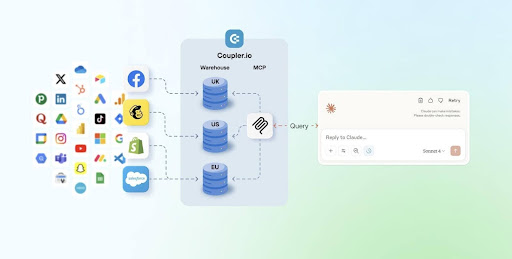
The company’s technology allows businesses to automatically connect data from hundreds of apps and structure it into centralized datasets that can be used for traditional BI reporting and AI-powered analytics. Rather than just automating data imports to AI tools, Coupler.io focuses on preparing the data layer for contextual, accurate AI analysis.
“The biggest barrier to reliable AI analytics isn’t a lack of algorithms,” Korolov said. “It’s the absence of structured, trustworthy data pipelines.”
According to Korolov, organizations that invest in automated data integration are significantly more likely to produce consistent analytics results because they eliminate many of the manual processes that introduce errors into reporting systems.
“Once data is connected, structured, and refreshed automatically, AI tools can actually begin to deliver the kind of insights businesses expect,” he said.
The Rise of AI Agents in Business Intelligence
Another emerging trend shaping the future of analytics is the rise of AI agents, software systems capable of interacting with business data through natural-language conversations. Rather than building complex dashboards manually, executives can ask questions such as:
- Which marketing campaigns generated the highest ROI this quarter?
- What caused our lead conversion rate to decline last month?
- Which sales channels are driving the fastest revenue growth?
These AI-driven interfaces promise to make data analysis more accessible to non-technical business leaders. However, their effectiveness depends heavily on the quality of the data they can access.
“If an AI agent is connected to fragmented or inconsistent data flows, it can produce answers that sound convincing but are actually inaccurate,” Korolov said.
To address this challenge, Coupler.io recently introduced a built-in AI Agent designed to allow users to query business data conversationally while relying on structured datasets generated by the platform’s integration and transformation engine. The goal is to ensure that AI operates on consistent, analysis-ready data with business and industry context rather than disconnected raw data fragments.
“Our view is that the next generation of business intelligence will be driven by AI agents,” Korolov said. “But those agents will only be as smart as the data infrastructure behind them.”
The Next Phase of Enterprise AI
As artificial intelligence becomes more deeply embedded in business operations, experts expect the industry conversation to evolve.
Early AI adoption focused largely on models, algorithms, and automation capabilities. Increasingly, attention is shifting toward the infrastructure required to manage data access, governance, and security. In many ways, the transition resembles the early evolution of cloud computing. At first, companies focused on applications. Over time, the industry recognized that the real foundation of innovation was the infrastructure supporting those applications.
A similar realization may now be unfolding in the AI ecosystem.
“AI is transforming how organizations make decisions,” Korolov said. “But before AI can generate meaningful insights, companies have to solve the problem of data fragmentation.”
As businesses continue experimenting with AI analytics and conversational data tools, the importance of reliable data pipelines is likely to become one of the defining issues in the next phase of enterprise AI.
For companies building the infrastructure that connects and organizes business data, that shift could represent a major opportunity.


 WebProNews is an iEntry Publication