
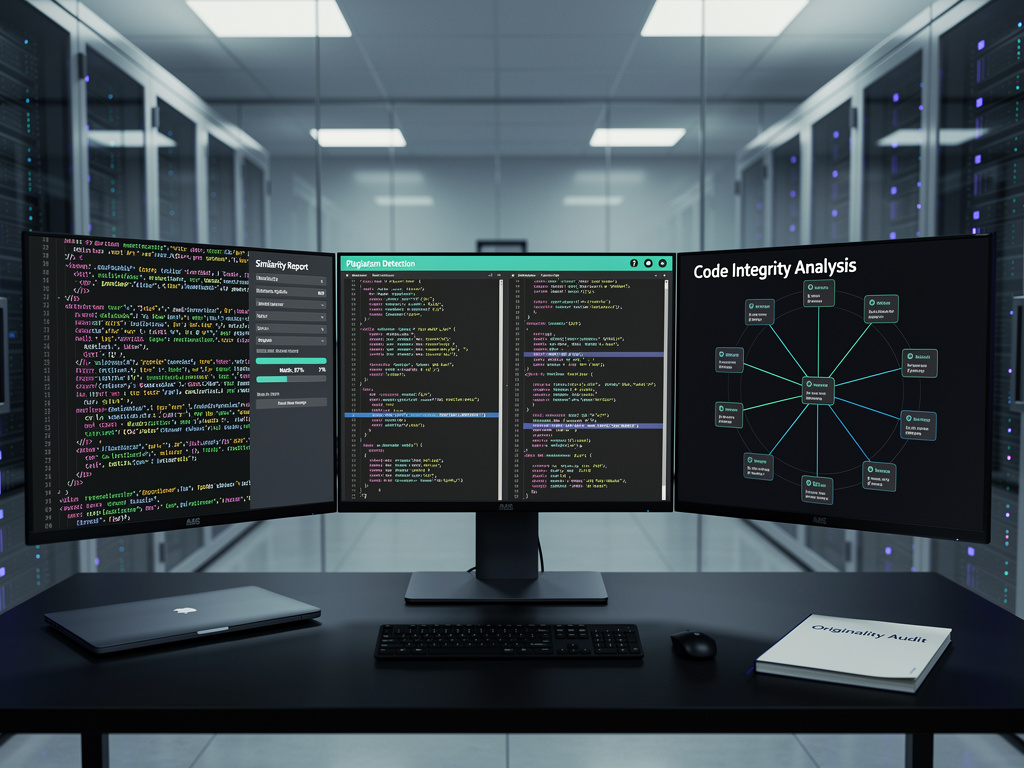
In the high-stakes world of software development and academia, determining whether code has been lifted from elsewhere remains a persistent challenge. There is no foolproof method to confirm copying without the original for direct comparison, as noted in discussions among developers. Yet, a suite of sophisticated tools has emerged to flag suspicious similarities, blending time-tested algorithms with cutting-edge AI to safeguard intellectual property and academic integrity.
At the forefront stands Moss, short for Measure of Software Similarity, developed at Stanford University since 1994. Moss automatically detects program similarities, primarily used in programming classes to identify potential plagiarism. “Moss is not a system for completely automatically detecting plagiarism,” its creators caution. “Plagiarism is a statement that someone copied code deliberately without attribution, and while Moss automatically detects program similarity, it has no way of knowing why codes are similar.” The tool generates similarity scores to highlight pairs warranting closer human inspection, saving educators hours of manual review.
Complementing Moss are open-source alternatives like JPlag and Dolos. Dolos, from Ghent University, offers quick plagiarism detection across numerous languages without installation, using state-of-the-art algorithms on uploaded files. Meanwhile, PMD’s Copy-Paste Detector (CPD) excels at spotting duplicated blocks within codebases, a staple for code audits as praised by developer Cory House on X.
Academic Tools Evolve with AI Threats
As AI tools like ChatGPT proliferate, new detectors target generated code alongside traditional copying. Codequiry positions itself as an enterprise MOSS alternative, scanning against over a trillion web sources, GitHub, and peers with its Zyla Hyper engine achieving 95%+ accuracy. It detects AI misuse, cross-language copies, and even heavily modified submissions. “Zeus uses machine learning to detect plagiarized code through semantic analysis,” the platform states, catching variable renames and restructurings that evade older tools.
Copyleaks provides side-by-side reports highlighting similar lines, emphasizing privacy by not saving scanned files. Copyleaks notes that plagiarists often insert loops or rename variables to dodge detection, but its algorithms persist in flagging such tactics. In education, Codio integrates Dolos for class-wide comparisons, pairing it with behavior insights to spot copy-paste from external sources.
These tools transform raw similarity data into actionable reports. For instance, jscpd, highlighted by House, scans over 150 languages and pinpoints exact duplicated lines, revealing cases where nearly half a JavaScript codebase consists of repeats. Such precision aids not just plagiarism hunts but also refactoring efforts in professional settings.
Enterprise Guardians Against Theft
In commercial environments, Black Duck emerges as an industry standard for scanning open-source risks and potential copies, as recommended on Software Recommendations Stack Exchange. It inventories components to mitigate licensing and security issues tied to reused code. PMD CPD, part of the PMD static analysis suite, focuses on intra-project duplicates, helping teams eliminate bloat.
Research underscores these tools’ limitations and strengths. A systematic review in ACM Transactions on Computing Education categorizes detectors like Sherlock, YAP, and Plaggie, expanding obfuscation classifications such as renaming and reordering. “Teachers deal with plagiarism on a regular basis,” the study observes, advocating hybrid approaches combining automated flags with manual verification.
Quantitative benchmarks, like those in the Computer Science Education Research Conference, pit nine tools—including CPD, JPlag, Moss, and baselines like Unix diff—against obfuscated datasets. Moss and JPlag consistently outperform on modified code, though none prove intent definitively. Developers on Reddit echo this: Moss employs winnowing, hashing sliding windows of normalized code to fingerprint submissions.
Obfuscation Arms Race Intensifies
Plagiarists employ tricks like synonym swaps, rearrangements, and behavioral cloning—similar outputs without direct lifts—as outlined in Applied Sciences journal. Detectors counter with tokenization (stripping whitespace, variables) and compression distances, as in the AC2 tool on GitHub. Copydetect, inspired by Moss’s winnowing, tunes sensitivity via noise thresholds post-normalization.
Privacy concerns loom large. Moss requires uploading to Stanford servers, problematic under regulations like GDPR, prompting local options like JPlag. “The biggest advantage JPlag has over MOSS is that the processing is done on your local machine,” notes Prof. James Andrew Smith. Dolos and Codequiry offer secure, browser-based or on-premise scans.
Recent X discussions reveal practical use: House’s audits uncovered thousands of duplicated lines via jscpd, while educators share lists including DupliChecker for quick checks. Netus.ai stresses manual attribution alongside tools: “Credit the original source whenever you use someone else’s code or idea.”
Future Frontiers in Detection
AI integration promises breakthroughs. Codequiry’s Zeus detects cross-language plagiarism, impossible for token-based predecessors. Paperpal and others benchmark against Scribbr, highlighting needs for hybrid human-AI checks amid false positives on paraphrases. Benchmarks call for standardized datasets and metrics to compare tools fairly.
Legal and ethical hurdles persist. Plagiarism hinges on intent, not just similarity; high matches to public repos like GitHub may be legitimate reuse. Institutions like UCI pair Moss with policies requiring student consent for prose tools like Turnitin. “If you get the source code of a program from a student, is there any good automatic way to check if the code is copied somewhere from the web?” queries Academia Stack Exchange, underscoring the demand.
Ultimately, these detectors serve as vigilant sentinels, narrowing suspects for expert judgment. As codebases swell and AI blurs authorship, their role in preserving originality grows indispensable, blending algorithm precision with human discernment to protect creators in an era of rampant reuse.


 WebProNews is an iEntry Publication