
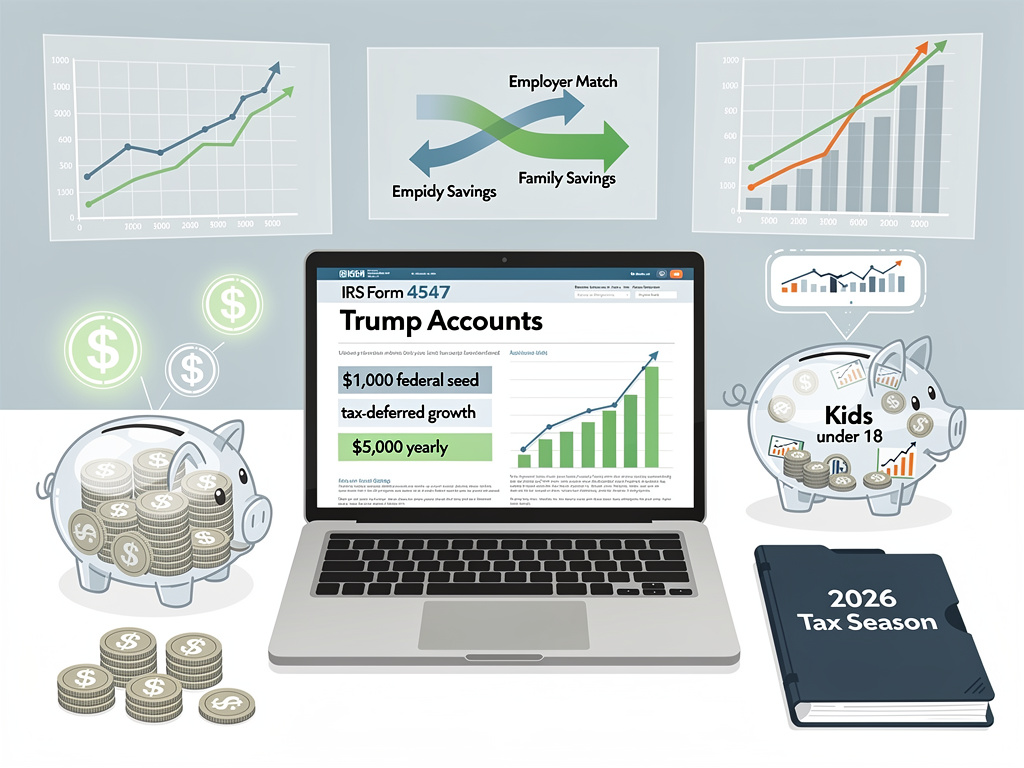
As the IRS swings open its doors for the 2026 filing season on January 26, parents and guardians face a pivotal choice embedded in their 2025 tax returns: elect to establish Trump Accounts for eligible children. These novel tax-advantaged savings vehicles, born from President Donald Trump’s “One Big Beautiful Bill Act” signed in July 2025, promise a federal $1,000 seed for newborns and tax-deferred growth aimed at jumpstarting generational wealth. “This is the first opportunity to claim, but it won’t be the last,” said Madeline Brown, senior policy associate at the Urban Institute, emphasizing the urgency for families filing now.
Trump Accounts, formally Section 530A accounts, function as custodial traditional IRAs for minors under 18 with valid Social Security numbers. Unlike standard IRAs, they bar distributions until age 18, after which they convert seamlessly into traditional IRAs with familiar rules on withdrawals, including penalties for early access unless exceptions like higher education or first-home purchases apply. The IRS stresses that filing Form 4547 with an e-filed return represents the “fastest, safest, and easiest way to make the elections,” per instructions released in December, as noted by CNBC.
Election Mechanics and Form 4547 Essentials
Parents initiate the process by submitting IRS Form 4547, which accommodates elections for up to two children per form—multiple forms handle larger families. The single-page document requires the child’s name, Social Security number, date of birth, and filer details, plus checkboxes for opening the account and claiming the $1,000 pilot contribution for births between January 1, 2025, and December 31, 2028. Eligible children must be under 18 by December 31, 2026, for this tax year’s elections. Post-submission, Treasury contacts filers starting May 2026 for identity verification to activate accounts, with no contributions permissible before July 4, 2026, according to Forbes.
Tax software providers like H&R Block integrate Form 4547 prompts during prep, confirming eligibility and guiding users. Standalone filings go by mail, but e-filing with returns accelerates processing amid IRS staffing strains from budget cuts. “There’s money on the table,” warned Josh Youngblood, owner of The Youngblood Group tax firm, highlighting risks for non-filers in CNBC coverage.
Eligibility Hurdles and Pilot Perks
For the $1,000 Treasury deposit, filers must affirm the child qualifies as their dependent under 2026 rules, with flexibility if status shifts later provided core requirements hold. Children outside the 2025-2028 birth window miss the seed but can still open accounts. State-specific boosts exist: Connecticut kids may tap Ray Dalio and Barbara Dalio donations, while others qualify for $250 from Michael Dell and Susan Dell based on age and income, as detailed in CNBC.
Authorized individuals prioritize as legal guardians, parents, adult siblings, or grandparents. Treasury verifies elections before depositing funds “as soon as practicable” post-July 4, 2026. The IRS portal at trumpaccounts.gov launches mid-2026 for standalone elections, per official guidance on IRS.gov.
Contribution Streams and Annual Caps
Once active, accounts accept up to $5,000 annually, inflation-adjusted post-2027, from five sources: the pilot $1,000, qualified general contributions from governments or 501(c)(3)s, employer matches up to $2,500 (non-taxable to employees), parental gifts, and rollovers. Employers like BNY, BlackRock, Robinhood, and Charles Schwab pledge matches up to $1,000, supercharging family efforts, reports CNBC.
Investments restrict to low-fee (<0.1%) unleveraged U.S. equity index mutual funds or ETFs, fostering disciplined long-term growth. Parental contributions carry no upfront deduction but build basis for tax purposes upon conversion at 18.
Growth Projections and Tax Treatment
White House Council of Economic Advisers models show a 2026-born child’s account hitting $303,800 by age 18 with max $5,000 yearly contributions at average returns, swelling to $1.09 million by age 28 or $600,000 at retirement assuming 10.5% S&P growth, per Treasury Secretary Scott Bessent cited in The Hill. Fidelity’s 7% return hypothetical yields substantial balances by age 18, as outlined on Fidelity.com.
Post-18, ordinary income taxes apply to distributions, with 10% early withdrawal penalties absent exceptions. Roth conversions at low child-income ages minimize lifetime taxes, a strategy Vanguard’s Joel Dickson endorses in Vanguard analysis.
Employer Programs and Compliance Nuances
Section 128 enables nontaxable employer contributions via direct deposits or Section 125 cafeteria plans, counting against the $5,000 cap. Firms must monitor limits and report to trustees like Fidelity or Schwab. ERISA status remains unclear, potentially hiking administrative loads, notes Troutman Pepper.
Gift tax reporting via Form 709 may snag parental contributions exceeding annual exclusions, prompting expert calls for fixes, though small sums typically evade duty.
Strategic Deployment Amid Tax Shifts
Trump Accounts slot into broader 2026 reforms: tip/overtime exemptions, $6,000 senior deductions, expanded child tax credits to $2,200, and SALT hikes to $40,000. VP Vance touted them at the March for Life: “We’ve got an expanded child tax credit and we’ve got the Trump accounts. We gotta take advantage of this stuff,” per Fox News video. Senator Markwayne Mullin echoed on X: “If you’re interested in a Trump Account for long-term savings for your children, and you qualify, be sure to select that on your tax form.”
Michael Dell pledged support for 25 million kids on X, urging sign-ups. A January 28 Trump Accounts Summit at Mellon Auditorium, featuring POTUS, Secretary Bessent, Nicki Minaj, and Ted Cruz, amplifies rollout, live on X per @TrumpAccounts.
Risks, Delays, and Action Steps
Non-filers risk forfeiting seeds: “For families who don’t file, there is a greater likelihood that they probably don’t open accounts,” Brown cautioned to CNBC. Paper delays loom with IRS cuts. Steps: Gather SSNs/birthdates; e-file with Form 4547 via TurboTax/H&R Block; monitor mail post-May; fund July 4 onward at custodians like Vanguard. IRS updates at IRS.gov/trumpaccounts and One Big Beautiful Bill provisions guide compliance.


 WebProNews is an iEntry Publication